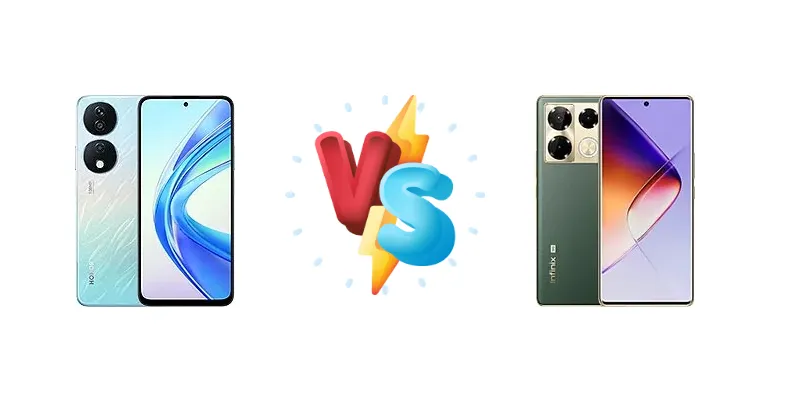
The mid-range smartphone market is fiercely competitive, and the Honor X7b and Infinix Note 40 Pro are two contenders vying for your attention. The X7b focuses on a reliable Qualcomm chipset and efficient power management, while the Note 40 Pro aims to impress with a more powerful MediaTek processor and significantly faster charging capabilities. This comparison will dissect their key differences to help you determine which device best suits your needs.
🏆 Quick Verdict
For the average user prioritizing consistent performance and a balanced experience, the Infinix Note 40 Pro emerges as the stronger choice. Its Dimensity 7020 chipset offers a noticeable performance uplift over the Snapdragon 680, and the inclusion of 45W wired and 20W MagCharge provides unparalleled charging versatility. However, the Honor X7b remains a viable option for those on a tighter budget.
| Network |
|---|
| 2G bands | GSM 850 / 900 / 1800 / 1900 | GSM 850 / 900 / 1800 / 1900 |
| 3G bands | HSDPA 850 / 900 / 1900 / 2100 | HSDPA 850 / 900 / 1700(AWS) / 1900 / 2100 |
| 4G bands | LTE | 1, 2, 3, 4, 5, 7, 8, 12, 17, 20, 28, 38, 40, 41, 42, 66 |
| 5G bands | - | 1, 3, 5, 7, 8, 12, 20, 28, 38, 40, 41, 66, 77, 78 SA/NSA |
| Speed | HSPA, LTE | HSPA, LTE, 5G |
| Technology | GSM / HSPA / LTE | GSM / HSPA / LTE / 5G |
| Launch |
|---|
| Announced | 2023, December 01 | 2024, March 18 |
| Status | Available. Released 2023, December 01 | Available. Released 2024, March 19 |
| Body |
|---|
| Dimensions | 166.7 x 76.5 x 8.2 mm (6.56 x 3.01 x 0.32 in) | 164.3 x 74.5 x 8.1 mm (6.47 x 2.93 x 0.32 in) |
| SIM | Nano-SIM + Nano-SIM | Nano-SIM + Nano-SIM |
| Weight | 199 g (7.02 oz) | 190 g or 196 g (6.70 oz) |
| Display |
|---|
| Protection | - | Corning Gorilla Glass |
| Resolution | 1080 x 2412 pixels, 20:9 ratio (~389 ppi density) | 1080 x 2436 pixels (~393 ppi density) |
| Size | 6.8 inches, 111.3 cm2 (~87.3% screen-to-body ratio) | 6.78 inches, 109.9 cm2 (~89.8% screen-to-body ratio) |
| Type | IPS LCD, 90Hz, 850 nits (peak) | AMOLED, 1B colors, 120Hz, 2160Hz PWM, 1300 nits (peak) |
| Platform |
|---|
| CPU | Octa-core (4x2.4 GHz Kryo 265 Gold & 4x1.9 GHz Kryo 265 Silver) | Octa-core (2x2.2 GHz Cortex-A78 & 6x2.0 GHz Cortex-A55) |
| Chipset | Qualcomm SM6225 Snapdragon 680 4G (6 nm) | Mediatek Dimensity 7020 (6 nm) |
| GPU | Adreno 610 | IMG BXM-8-256 |
| OS | Android 13, upgradable to Android 14, MagicOS 8 | Android 14, XOS 14 |
| Memory |
|---|
| Card slot | microSDXC | Unspecified |
| Internal | 128GB 6GB RAM, 128GB 8GB RAM, 256GB 6GB RAM, 256GB 8GB RAM, 256GB 12GB RAM | 256GB 8GB RAM |
| Main Camera |
|---|
| Features | LED flash, HDR, panorama | Dual-LED flash, HDR, panorama |
| Triple | 108 MP, f/1.8, 24mm (wide), 1/1.67", 0.64µm, PDAF
5 MP, f/2.2, (ultrawide)
Auxiliary lens | 108 MP, f/1.8, (wide), PDAF, OIS
2 MP, f/2.4
2 MP, f/2.4 |
| Video | 1080p@30fps | 1440p@30fps, 1080p@30/60fps |
| Selfie camera |
|---|
| Features | - | Dual-LED flash |
| Single | 8 MP, f/2.0, (wide) | 32 MP, f/2.2, (wide), 1/3.1" |
| Video | 1080p@30fps | 1080p@30fps |
| Sound |
|---|
| 35mm jack | Yes | No |
| Loudspeaker | Yes, with stereo speakers | Yes, with stereo speakers |
| Comms |
|---|
| Bluetooth | 5.0, A2DP, LE | Yes |
| Infrared port | - | Yes |
| NFC | Yes (CLK-LX1 only) | Yes (market/region dependent) |
| Positioning | GPS, GLONASS, GALILEO, BDS | GPS |
| Radio | No | FM radio |
| USB | USB Type-C 2.0, OTG | USB Type-C 2.0, OTG |
| WLAN | Wi-Fi 802.11 a/b/g/n/ac, dual-band, Wi-Fi Direct | Wi-Fi 802.11 a/b/g/n/ac, dual-band |
| Features |
|---|
| Sensors | Fingerprint (side-mounted), accelerometer | Fingerprint (under display, optical), accelerometer, gyro, proximity, compass |
| Battery |
|---|
| Charging | 35W wired | 45W wired, 50% in 26 min
20W wireless MagCharge
Reverse wired
Reverse wireless |
| Type | Market-dependent versions:· Li-Po 5330 mAh (Europe and LATAM)· Li-Po 6000 mAh (ROW) | 5000 mAh |
| Misc |
|---|
| Colors | Flowing Silver, Emerald Green, Midnight Black | Vintage Green, Titan Gold, Racing Edition |
| Models | CLK-LX1, CLK-LX2, CLK-LX3 | X6851 |
| Price | About 350 EUR | About 280 EUR |
Honor X7b
- Reliable Qualcomm Snapdragon 680 chipset
- Potentially better battery optimization
- Likely more affordable price point
- Slower charging speeds (35W)
- Less powerful processor for demanding tasks
- Lacks wireless charging capabilities
Infinix Note 40 Pro
- More powerful MediaTek Dimensity 7020 chipset
- 45W fast wired charging (50% in 26 min)
- 20W MagCharge wireless charging and reverse charging
- Potentially higher price
- Dimensity 7020 may run slightly warmer under sustained load
- Software experience may vary
Display Comparison
Neither device's display specifications are provided, so a direct comparison is limited. However, given the price points, we can expect both to utilize LCD panels. The Infinix Note 40 Pro, being the slightly more premium offering, may benefit from a higher peak brightness and potentially better color calibration. The absence of information regarding refresh rates is notable; a 90Hz or 120Hz panel on the Note 40 Pro would be a significant advantage for smoother scrolling and animations.
Camera Comparison
Without detailed camera specifications, a precise comparison is difficult. However, the market segment suggests both phones will feature multi-camera setups. The Infinix Note 40 Pro, positioned as a slightly higher-tier device, likely benefits from a larger primary sensor and potentially more advanced image processing algorithms. The presence of Optical Image Stabilization (OIS) on the Note 40 Pro would be a significant advantage, resulting in sharper images and smoother video recording, especially in low-light conditions. The inclusion of a 2MP macro camera on either device is likely a marketing feature with limited practical utility.
Performance
The core difference lies in the chipsets. The Infinix Note 40 Pro’s MediaTek Dimensity 7020, built on a 6nm process, features a dual-core Cortex-A78 setup clocked at 2.2 GHz, paired with six Cortex-A55 cores at 2.0 GHz. This architecture prioritizes peak performance, offering a substantial advantage in CPU-intensive tasks and gaming compared to the Honor X7b’s Qualcomm Snapdragon 680. The Snapdragon 680 utilizes a more power-efficient Kryo 265 core configuration (4x2.4 GHz Gold & 4x1.9 GHz Silver), but its overall processing power is lower. While both are 6nm chips, the Dimensity 7020’s core design translates to a more responsive user experience, particularly when handling demanding applications.
Battery Life
The battery capacity isn't specified for either device, but the charging capabilities are a key differentiator. The Infinix Note 40 Pro’s 45W wired charging, capable of delivering 50% charge in 26 minutes, is significantly faster than the Honor X7b’s 35W charging. Furthermore, the Note 40 Pro introduces 20W MagCharge wireless charging, reverse wired charging, and reverse wireless charging – features absent on the X7b. This provides unparalleled flexibility and convenience, allowing users to charge accessories or even other devices wirelessly. While a larger battery capacity on the X7b could partially offset the slower charging, the Note 40 Pro’s charging ecosystem is a clear win.
Buying Guide
Buy the Honor X7b if you need a dependable daily driver with a focus on battery life and a proven chipset, and are comfortable with slower charging speeds. It's ideal for users who prioritize stability over raw power. Buy the Infinix Note 40 Pro if you prefer a more responsive experience for multitasking and gaming, and value the convenience of fast wired and wireless charging, including the unique MagCharge ecosystem. This phone is geared towards users who demand more from their smartphone.
Frequently Asked Questions
❓ Does the Dimensity 7020 in the Infinix Note 40 Pro tend to overheat during prolonged gaming sessions?
While the Dimensity 7020 is a capable processor, it's built on a 6nm process and can generate heat under sustained load. However, Infinix likely incorporates thermal management solutions to mitigate overheating. Expect some throttling during extended gaming, but it shouldn't be severe enough to render the phone unusable. The Snapdragon 680 in the X7b will likely run cooler, but at the cost of performance.
❓ How practical is the MagCharge feature on the Infinix Note 40 Pro for everyday use?
MagCharge offers a convenient and versatile charging experience. Beyond wireless charging, the ability to reverse charge accessories like earbuds or smartwatches is a significant benefit. It also allows for easy attachment of magnetic accessories, expanding the phone's functionality. While not essential, MagCharge adds a layer of convenience that the Honor X7b lacks.
❓ Is the 35W charging on the Honor X7b slow compared to other phones in this price range?
Yes, 35W is relatively slow compared to the 45W (and beyond) offered by many competitors, including the Infinix Note 40 Pro. A full charge will take considerably longer, potentially exceeding two hours. This is a trade-off for the X7b's potentially lower price and focus on power efficiency.