
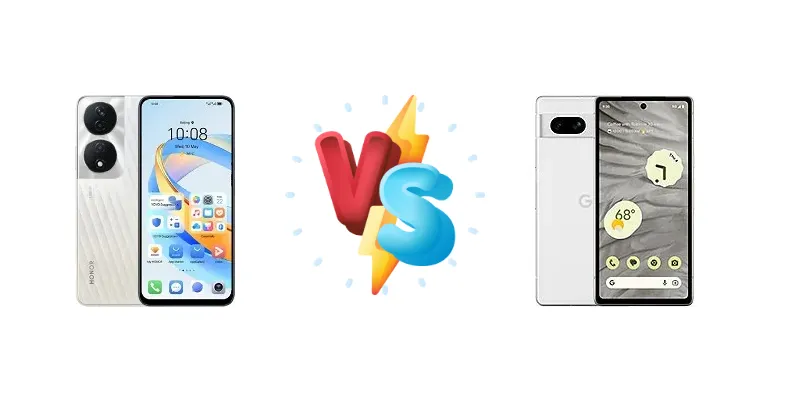
Honor X7b 5G vs Google Pixel 7a: A Detailed Comparison
| Phones Images | |||||
|---|---|---|---|---|---|
|
🏆 Quick Verdict
For the average user prioritizing camera quality and a smooth software experience, the Google Pixel 7a is the superior choice. Its Tensor G2 chipset and exceptional image processing capabilities justify the price premium. However, the Honor X7b 5G offers excellent value for those seeking 5G connectivity and fast charging on a tighter budget.
| PHONES | ||
|---|---|---|
| Phone Names | Honor X7b 5G | Google Pixel 7a |
| Network | ||
|---|---|---|
| 2G bands | GSM 850 / 900 / 1800 / 1900 | GSM 850 / 900 / 1800 / 1900 |
| 3G bands | HSDPA 850 / 900 / 1900 / 2100 | HSDPA 800 / 850 / 900 / 1700(AWS) / 1900 / 2100 |
| 4G bands | 1, 3, 5, 7, 8, 34, 38, 39, 40, 41 | 1, 2, 3, 4, 5, 7, 8, 12, 13, 14, 17, 20, 25, 26, 28, 29, 30, 38, 40, 41, 48, 66, 71 - GWKK3, G0DZQ |
| 5G bands | 1, 5, 8, 28, 41, 78 SA/NSA | 1, 2, 3, 5, 7, 8, 12, 14, 20, 25, 28, 30, 38, 41, 48, 66, 71, 77, 78 SA/NSA/Sub6 - GWKK3 |
| Speed | HSPA, LTE, 5G | HSPA, LTE, 5G |
| Technology | GSM / HSPA / LTE / 5G | GSM / HSPA / LTE / 5G |
| - | 1, 2, 3, 5, 7, 8, 12, 20, 25, 28, 38, 40, 41, 66, 75, 76, 77, 78, 79 SA/NSA/Sub6 - GHL1X, G82U8 | |
| Launch | ||
|---|---|---|
| Announced | 2024, April 04 | 2023, May 10 |
| Status | Available. Released 2024, May | Available. Released 2023, May 10 |
| Body | ||
|---|---|---|
| Build | - | Glass front (Gorilla Glass 3), aluminum frame, plastic back |
| Dimensions | 166.7 x 76.5 x 8.2 mm (6.56 x 3.01 x 0.32 in) | 152 x 72.9 x 9 mm (5.98 x 2.87 x 0.35 in) |
| SIM | Nano-SIM + Nano-SIM | Nano-SIM + eSIM |
| Weight | 199 g (7.02 oz) | 193.5 g (6.84 oz) |
| - | IP67 dust/water resistant (up to 1m for 30 min) | |
| Display | ||
|---|---|---|
| Protection | - | Corning Gorilla Glass 3 |
| Resolution | 1080 x 2412 pixels, 20:9 ratio (~389 ppi density) | 1080 x 2400 pixels, 20:9 ratio (~429 ppi density) |
| Size | 6.8 inches, 111.3 cm2 (~87.3% screen-to-body ratio) | 6.1 inches, 90.7 cm2 (~81.8% screen-to-body ratio) |
| Type | IPS LCD, 90Hz, 850 nits (peak) | OLED, HDR, 90Hz |
| - | Always-on display | |
| Platform | ||
|---|---|---|
| CPU | Octa-core (2x2.2 GHz Cortex-A76 & 6x2.0 GHz Cortex-A55) | Octa-core (2x2.85 GHz Cortex-X1 & 2x2.35 GHz Cortex-A78 & 4x1.80 GHz Cortex-A55) |
| Chipset | Mediatek Dimensity 6020 (7 nm) | Google Tensor G2 (5 nm) |
| GPU | Mali-G57 MC2 | Mali-G710 MP7 |
| OS | Android 13, Magic OS 7.2 | Android 13, upgradable to Android 15, up to 5 major Android upgrades |
| Memory | ||
|---|---|---|
| Card slot | No | No |
| Internal | 256GB 8GB RAM | 128GB 8GB RAM |
| - | UFS 3.1 | |
| Main Camera | ||
|---|---|---|
| Dual | - | 64 MP, f/1.9, 26mm (wide), 1/1.73", 0.8µm, dual pixel PDAF, OIS 13 MP, f/2.2, 120˚ (ultrawide), 1.12µm |
| Features | LED flash, HDR, panorama | Dual-LED flash, Pixel Shift, Auto-HDR, panorama |
| Triple | 108 MP, f/1.8, (wide), PDAF 2 MP (macro) Auxiliary lens | - |
| Video | 1080p@30fps | 4K@30/60fps, 1080p@30/60/120/240fps, OIS |
| Selfie camera | ||
|---|---|---|
| Features | - | HDR, panorama |
| Single | 8 MP, f/2.0, (wide) | 13 MP, f/2.2, 20mm (ultrawide), 1.12µm |
| Video | 1080p@30fps | 4K@30fps, 1080p@30fps |
| Sound | ||
|---|---|---|
| 3.5mm jack | - | No |
| 35mm jack | Yes | No |
| Loudspeaker | Yes, with stereo speakers | Yes, with stereo speakers |
| Comms | ||
|---|---|---|
| Bluetooth | 5.1, A2DP, LE, aptX HD | 5.3, A2DP, LE |
| NFC | No | Yes |
| Positioning | GPS, GLONASS, GALILEO, BDS | GPS, GLONASS, GALILEO, BDS, QZSS, NavIC |
| Radio | No | No |
| USB | USB Type-C 2.0, OTG | USB Type-C 3.2 |
| WLAN | Wi-Fi 802.11 a/b/g/n/ac, dual-band, Wi-Fi Direct | Wi-Fi 802.11 a/b/g/n/ac/6e, tri-band |
| Features | ||
|---|---|---|
| Sensors | Fingerprint (side-mounted), accelerometer, compass | Fingerprint (under display, optical), accelerometer, gyro, proximity, compass, barometer |
| Battery | ||
|---|---|---|
| Charging | 35W wired | 18W wired, PD3.0 7.5W wireless |
| Type | Li-Po 6000 mAh | Li-Po 4385 mAh |
| Misc | ||
|---|---|---|
| Colors | Crystal Silver, Emerald Green, Midnight Black | Charcoal, Snow, Sea, Coral |
| Models | - | GWKK3, GHL1X, G0DZQ, G82U8 |
| Price | About 150 EUR | € 179.90 / $ 150.00 / £ 170.00 / ₹ 25,980 |
Honor X7b 5G
- Faster 35W wired charging
- More affordable price point
- 5G connectivity
- Less powerful processor
- Likely inferior camera performance
- No wireless charging
Google Pixel 7a
- Superior camera quality and image processing
- Powerful Google Tensor G2 chipset
- Clean and updated Android experience
- Slower 18W wired charging
- Higher price
- Potentially shorter battery life compared to X7b 5G
Display Comparison
The Pixel 7a boasts a significantly brighter display, reaching a measured peak of 1070 nits, ensuring excellent visibility even in direct sunlight. While the Honor X7b 5G’s display specifications aren’t provided, it’s likely to be dimmer. The Pixel 7a’s OLED panel also benefits from Google’s color calibration, offering more accurate and vibrant colors. The absence of LTPO technology on either device means neither offers adaptive refresh rates for power saving, but the Pixel 7a’s superior brightness and color accuracy give it a clear advantage for media consumption and outdoor use.
Camera Comparison
The Pixel 7a’s camera system is a major differentiator. While specific sensor details aren’t provided, Google’s computational photography prowess, powered by the Tensor G2, elevates image quality significantly. The Pixel 7a excels in dynamic range, low-light performance, and overall image clarity. The Honor X7b 5G’s camera capabilities are likely more modest, relying on hardware rather than sophisticated software algorithms. The Pixel 7a’s video recording capabilities are also expected to be superior, benefiting from advanced stabilization and processing features. The absence of details regarding the X7b 5G’s camera sensors makes a direct comparison difficult, but the Pixel 7a’s reputation and chipset advantage position it as the clear winner.
Performance
The core difference lies in the chipsets. The Google Pixel 7a’s Tensor G2, fabricated on a 5nm process, features a prime Cortex-X1 core clocked at 2.85 GHz, offering substantially more processing power than the Honor X7b 5G’s Mediatek Dimensity 6020 (7nm). The Dimensity 6020’s Cortex-A76 cores, while capable, are older architecture and operate at a lower frequency (2.2 GHz). This translates to faster app loading, smoother multitasking, and better performance in demanding games on the Pixel 7a. The Tensor G2 also benefits from Google’s machine learning acceleration, enhancing features like voice recognition and image processing. While the X7b 5G is sufficient for everyday tasks, the Pixel 7a provides a more future-proof and responsive experience.
Battery Life
The Pixel 7a has an endurance rating of 76 hours, indicating strong battery life despite its 18W charging. The Honor X7b 5G counters with a faster 35W wired charging solution, allowing for quicker top-ups. While the X7b 5G’s battery capacity isn’t specified, the faster charging speed suggests it may compensate for a potentially smaller battery. The Pixel 7a also supports 7.5W wireless charging, a convenience the X7b 5G lacks. Ultimately, the Pixel 7a’s endurance rating suggests it can last a full day with moderate use, while the X7b 5G prioritizes rapid charging for those who frequently need to replenish their battery.
Buying Guide
Buy the Honor X7b 5G if you need a reliable 5G phone with a focus on battery life and fast 35W charging, and are willing to compromise on camera performance and raw processing power. Buy the Google Pixel 7a if you prioritize camera quality, a clean and consistently updated Android experience, and the performance benefits of Google’s Tensor G2 chip, even if it means slower charging and a potentially shorter battery lifespan.