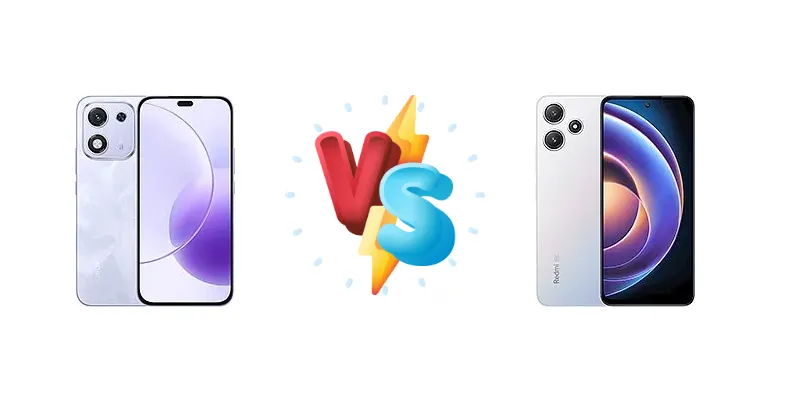
The Honor X70i and Xiaomi Redmi Note 12R represent compelling options in the increasingly competitive budget smartphone space. While both aim to deliver a solid experience without breaking the bank, they take different approaches to achieving this goal, primarily through their chipset choices and charging implementations. This comparison dissects those differences to reveal which device offers the best value for your money.
🏆 Quick Verdict
For the average user prioritizing sustained performance and future-proofing, the Honor X70i emerges as the stronger contender. Its Dimensity 7025 Ultra, built on a 6nm process, provides a noticeable performance edge over the Redmi Note 12R’s Snapdragon 4 Gen 2, despite the latter’s more efficient 4nm node. However, the Redmi Note 12R’s PD charging is a welcome addition.
| Network |
|---|
| 2G bands | GSM 850 / 900 / 1800 / 1900 | GSM 850 / 900 / 1800 / 1900 |
| 3G bands | HSDPA 850 / 900 / 1900 / 2100 | HSDPA 850 / 900 / 2100 |
| 4G bands | LTE | 1, 3, 5, 8, 34, 38, 39, 40, 41 |
| 5G bands | SA/NSA | 1, 5, 8, 28, 41, 78 SA/NSA |
| Speed | HSPA, LTE, 5G | HSPA, LTE, 5G |
| Technology | GSM / HSPA / LTE / 5G | GSM / CDMA / HSPA / EVDO / LTE / 5G |
| Launch |
|---|
| Announced | 2025, April 25 | 2023, June 28 |
| Status | Available. Released 2025, April 30 | Available. Released 2023, June 28 |
| Body |
|---|
| Build | - | Glass front, plastic frame, glass back |
| Dimensions | 161 x 74.6 x 7.3 mm (6.34 x 2.94 x 0.29 in) | 168.6 x 76.3 x 8.2 mm (6.64 x 3.00 x 0.32 in) |
| SIM | Nano-SIM + Nano-SIM | Nano-SIM + Nano-SIM |
| Weight | 178.5 g (6.31 oz) | 199 g (7.02 oz) |
| Display |
|---|
| Resolution | 1080 x 2412 pixels, 20:9 ratio (~394 ppi density) | 1080 x 2460 pixels (~396 ppi density) |
| Size | 6.7 inches, 108.0 cm2 (~89.9% screen-to-body ratio) | 6.79 inches, 109.5 cm2 (~85.1% screen-to-body ratio) |
| Type | AMOLED, 120Hz, 3500 nits (peak) | IPS LCD, 90Hz, 550 nits |
| Platform |
|---|
| CPU | Octa-core (2x2.5 GHz Cortex-A78 & 6x2.0 GHz Cortex-A55) | Octa-core (2x2.2 GHz Cortex-A78 & 6x1.95 GHz Cortex-A55) |
| Chipset | Mediatek Dimensity 7025 Ultra (6 nm) | Qualcomm SM4450 Snapdragon 4 Gen 2 (4 nm) |
| GPU | IMG BXM-8-256 | Adreno 613 |
| OS | Android 15, MagicOS 9 | Android 13, MIUI 14 |
| Memory |
|---|
| Card slot | No | microSDXC (uses shared SIM slot) |
| Internal | 256GB 8GB RAM, 256GB 12GB RAM, 512GB 12GB RAM | 128GB 4GB RAM, 128GB 6GB RAM, 128GB 8GB RAM, 256GB 8GB RAM |
| Main Camera |
|---|
| Dual | - | 50 MP, f/1.8, (wide), PDAF
2 MP (macro) |
| Features | LED flash, HDR, panorama | LED flash, HDR |
| Single | 108 MP, f/1.8, (wide), 1/1.67", PDAF | - |
| Video | 1080p@30fps | 1080p@30fps |
| Selfie camera |
|---|
| Features | - | HDR |
| Single | 8 MP, f/2.0, (wide) | 5 MP, f/2.2, (wide), 1/5.0", 1.12µm |
| Video | 1080p@30fps | 1080p@30fps |
| Sound |
|---|
| 35mm jack | No | Yes |
| Loudspeaker | Yes, with stereo speakers | Yes |
| Comms |
|---|
| Bluetooth | 5.3, A2DP, LE, aptX HD | 5.3, A2DP, LE |
| Infrared port | - | Yes |
| NFC | Yes | Yes (market/region dependent) |
| Positioning | GPS, GLONASS, GALILEO, BDS | GPS, GLONASS, GALILEO, BDS |
| Radio | No | No |
| USB | USB Type-C 2.0, OTG | USB Type-C |
| WLAN | Wi-Fi 802.11 a/b/g/n/ac, dual-band, Wi-Fi Direct | Wi-Fi 802.11 a/b/g/n/ac, dual-band |
| Features |
|---|
| Sensors | Fingerprint (under display, optical), accelerometer, compass, proximity (ultrasound) | Fingerprint (side-mounted), accelerometer, compass |
| Battery |
|---|
| Charging | 35W wired | 18W wired, PD |
| Type | Si/C Li-Ion 6000 mAh | Li-Po 5000 mAh |
| Misc |
|---|
| Colors | Black, White, Purple, Mint Green | Black, Blue, Silver |
| Models | ABR-AN00 | 23076RA4BC |
| Price | About 170 EUR | About 150 EUR |
Honor X70i
- More powerful Dimensity 7025 Ultra chipset
- Faster 35W wired charging
- Potentially better image processing
- Less power-efficient chipset (6nm vs 4nm)
- Charging lacks Power Delivery compatibility
Xiaomi Redmi Note 12R
- More power-efficient Snapdragon 4 Gen 2 chipset (4nm)
- Power Delivery (PD) charging compatibility
- Potentially longer battery life under light use
- Slower 18W wired charging
- Less powerful chipset for demanding tasks
Display Comparison
Neither device boasts a standout display. While specific panel details (like peak brightness or color gamut coverage) are absent, the focus here is on the underlying processing power needed to drive a smooth visual experience. Both likely utilize LCD panels given their price point. The absence of high refresh rate information suggests both are likely capped at 60Hz, meaning the chipset’s GPU will be less stressed compared to driving a 90Hz or 120Hz panel.
Camera Comparison
Without detailed camera sensor information, a direct comparison is difficult. However, given the price bracket, both phones likely feature a primary sensor around the 50MP mark. The image signal processor (ISP) within the Dimensity 7025 Ultra may offer slightly more advanced processing capabilities, potentially leading to better dynamic range and noise reduction in challenging lighting conditions. The Redmi Note 12R’s Snapdragon 4 Gen 2 ISP is competent, but likely less sophisticated. The presence of a 2MP macro camera on both devices is largely a marketing gimmick and should be disregarded by serious photographers.
Performance
The core of the difference lies in the chipsets. The Honor X70i’s Mediatek Dimensity 7025 Ultra (6nm) features a 2x2.5 GHz Cortex-A78 and 6x2.0 GHz Cortex-A55 configuration. This contrasts with the Xiaomi Redmi Note 12R’s Qualcomm SM4450 Snapdragon 4 Gen 2 (4nm) with its 2x2.2 GHz Cortex-A78 and 6x1.95 GHz Cortex-A55 setup. While the Snapdragon 4 Gen 2 benefits from a more efficient 4nm process, the Dimensity 7025 Ultra’s higher clock speeds on the performance cores provide a tangible advantage in CPU-intensive tasks. This translates to faster app loading times and smoother multitasking. The 6nm process of the Dimensity 7025 Ultra, while not as cutting-edge as 4nm, still offers a good balance of performance and efficiency. The slightly lower clock speeds on the Snapdragon 4 Gen 2’s Cortex-A78 cores suggest a more conservative power profile, potentially prioritizing battery life over raw speed.
Battery Life
Battery capacity is not specified, but both devices likely house batteries in the 5000mAh range, typical for this segment. The Honor X70i’s 35W wired charging is significantly faster than the Redmi Note 12R’s 18W wired charging with Power Delivery (PD). This means the X70i can replenish its battery much quicker, reducing downtime. While PD offers wider charger compatibility, the slower charging speed is a trade-off. A full charge on the X70i will likely take under 90 minutes, while the Redmi Note 12R could take over two hours.
Buying Guide
Buy the Honor X70i if you need a phone capable of handling demanding apps and moderate gaming with more headroom. Its more powerful chipset translates to a smoother experience over the long term. Buy the Xiaomi Redmi Note 12R if you prioritize power efficiency and compatibility with Power Delivery chargers, and your usage is primarily focused on basic tasks like calling, texting, and social media. The Redmi Note 12R is a solid choice for those seeking a reliable daily driver with a focus on battery life.
Frequently Asked Questions
❓ Will the Snapdragon 4 Gen 2 in the Redmi Note 12R struggle with graphically intensive games like PUBG Mobile?
While the Snapdragon 4 Gen 2 is capable of running PUBG Mobile, you’ll likely need to lower the graphics settings to achieve a consistently smooth frame rate. The Dimensity 7025 Ultra in the Honor X70i offers more headroom for gaming, allowing for higher settings and potentially more stable performance.
❓ Does the Honor X70i’s faster charging significantly impact battery health over the long term?
While faster charging can theoretically contribute to slightly faster battery degradation, modern smartphones employ sophisticated charging management systems to mitigate this effect. The difference in long-term battery health between the two devices is unlikely to be substantial for typical usage patterns.
❓ Is the Power Delivery (PD) charging on the Redmi Note 12R a significant advantage if I already have a PD charger?
Yes, if you already own a USB-PD charger, the Redmi Note 12R’s compatibility allows you to use your existing accessories. However, keep in mind that the phone is limited to 18W charging, even with a more powerful PD charger.