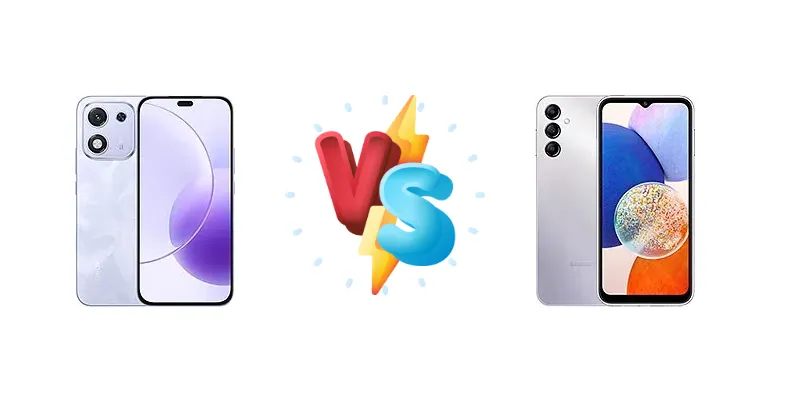
The Honor X70i and Samsung Galaxy A14 5G represent compelling options in the increasingly competitive sub-$250 5G smartphone market. While both aim to deliver 5G connectivity at an accessible price, they take different approaches to achieving this, particularly in chipset selection and charging technology. This comparison dissects their key specifications to determine which device offers the best value for your money.
🏆 Quick Verdict
For users prioritizing raw performance and faster charging, the Honor X70i emerges as the winner. Its Mediatek Dimensity 7025 Ultra, built on a 6nm process, offers a slight edge over the Samsung Galaxy A14 5G’s Exynos 1330 (or Dimensity 700 depending on region), coupled with significantly faster 35W charging. However, the A14 5G’s established brand reputation and consistent software experience remain strong considerations.
| Network |
|---|
| 2G bands | GSM 850 / 900 / 1800 / 1900 | GSM 850 / 900 / 1800 / 1900 |
| 3G bands | HSDPA 850 / 900 / 1900 / 2100 | HSDPA 850 / 900 / 1700(AWS) / 1900 / 2100 |
| 4G bands | LTE | 1, 2, 3, 4, 5, 7, 8, 12, 17, 20, 26, 28, 38, 40, 41, 66 - International |
| 5G bands | SA/NSA | 2, 5, 66, 77 Sub6/mmWave - USA |
| Speed | HSPA, LTE, 5G | HSPA, LTE, 5G |
| Technology | GSM / HSPA / LTE / 5G | GSM / HSPA / LTE / 5G |
| | - | 1, 3, 5, 7, 8, 20, 28, 40, 41, 78 SA/NSA/Sub6 - India |
| Launch |
|---|
| Announced | 2025, April 25 | 2023, January 04 |
| Status | Available. Released 2025, April 30 | Available. Released 2023, January 12 |
| Body |
|---|
| Build | - | Glass front, plastic back, plastic frame |
| Dimensions | 161 x 74.6 x 7.3 mm (6.34 x 2.94 x 0.29 in) | 167.7 x 78 x 9.1 mm (6.60 x 3.07 x 0.36 in) |
| SIM | Nano-SIM + Nano-SIM | · Nano-SIM· Nano-SIM + Nano-SIM |
| Weight | 178.5 g (6.31 oz) | 202 g (7.13 oz) |
| Display |
|---|
| Resolution | 1080 x 2412 pixels, 20:9 ratio (~394 ppi density) | 1080 x 2408 pixels, 20:9 ratio (~400 ppi density) |
| Size | 6.7 inches, 108.0 cm2 (~89.9% screen-to-body ratio) | 6.6 inches, 104.9 cm2 (~80.2% screen-to-body ratio) |
| Type | AMOLED, 120Hz, 3500 nits (peak) | PLS LCD, 90Hz |
| Platform |
|---|
| CPU | Octa-core (2x2.5 GHz Cortex-A78 & 6x2.0 GHz Cortex-A55) | Octa-core (2x2.4 GHz Cortex-A78 & 6x2.0 GHz Cortex-A55) - SM-A146BOcta-core (2x2.2 GHz Cortex-A76 & 6x2.0 GHz Cortex-A55) - SM-A146P |
| Chipset | Mediatek Dimensity 7025 Ultra (6 nm) | Exynos 1330 (5 nm) - SM-A146BMediatek Dimensity 700 (7 nm) - SM-A146P |
| GPU | IMG BXM-8-256 | Mali-G68 MP2 - SM-A146BMali-G57 MC2 - SM-A146P |
| OS | Android 15, MagicOS 9 | Android 13, upgradable to Android 15, One UI Core 7 |
| Memory |
|---|
| Card slot | No | microSDXC (uses shared SIM slot) - USA onlymicroSDXC (dedicated slot) - International |
| Internal | 256GB 8GB RAM, 256GB 12GB RAM, 512GB 12GB RAM | 64GB 4GB RAM, 128GB 4GB RAM, 128GB 6GB RAM, 128GB 8GB RAM |
| Main Camera |
|---|
| Features | LED flash, HDR, panorama | LED flash, panorama, HDR |
| Single | 108 MP, f/1.8, (wide), 1/1.67", PDAF | 13 MP, f/2.0, (wide) |
| Triple | - | 50 MP, f/1.8, 26mm (wide), 1/2.76", 0.64µm, PDAF
2 MP (macro)
Auxiliary lens |
| Video | 1080p@30fps | 1080p@30fps |
| Selfie camera |
|---|
| Single | 8 MP, f/2.0, (wide) | 13 MP, f/2.0, 26mm (wide), 1.12µm |
| Video | 1080p@30fps | 1080p@30fps |
| Sound |
|---|
| 3.5mm jack | - | Yes |
| 35mm jack | No | Yes |
| Loudspeaker | Yes, with stereo speakers | Yes |
| Comms |
|---|
| Bluetooth | 5.3, A2DP, LE, aptX HD | 5.2, A2DP, LE |
| NFC | Yes | Yes |
| Positioning | GPS, GLONASS, GALILEO, BDS | GPS, GLONASS, GALILEO |
| Radio | No | FM radio (Exynos 1330 chipset only), recording |
| USB | USB Type-C 2.0, OTG | USB Type-C 2.0 |
| WLAN | Wi-Fi 802.11 a/b/g/n/ac, dual-band, Wi-Fi Direct | Wi-Fi 802.11 a/b/g/n/ac, dual-band, Wi-Fi Direct |
| Features |
|---|
| Sensors | Fingerprint (under display, optical), accelerometer, compass, proximity (ultrasound) | Fingerprint (side-mounted), accelerometer, gyro, proximity, compass, barometer (USA only) |
| Battery |
|---|
| Charging | 35W wired | 15W wired |
| Type | Si/C Li-Ion 6000 mAh | Li-Po 5000 mAh |
| Misc |
|---|
| Colors | Black, White, Purple, Mint Green | Black, Light Green, Dark Red, Silver |
| Models | ABR-AN00 | SM-A146B, SM-A146B/DS, SM-A146P, SM-A146P/DS, SM-A146U, SM-A146U1, SM-A146U1/DS, SM-A146W, SM-A146P/N, SM-A146P/DSN, SM-S146VL, SM-A146M |
| Price | About 170 EUR | $ 77.63 / C$ 151.00 / £ 97.00 / € 159.79 / ₹ 14,990 |
| SAR | - | 1.00 W/kg (head) 1.00 W/kg (body) |
| SAR EU | - | 0.56 W/kg (head) 1.28 W/kg (body) |
| Tests |
|---|
| Battery life | - |
Endurance rating 130h
|
| Camera | - |
Photo / Video |
| Display | - |
Contrast ratio: 1334:1 (nominal) |
| Loudspeaker | - |
-26.8 LUFS (Good)
|
| Performance | - |
AnTuTu: 307886 (v9)
GeekBench: 1727 (v5.1)
GFXBench: 12fps (ES 3.1 onscreen) |
Honor X70i
- Faster 35W charging for quick power-ups
- Potentially better performance with Dimensity 7025 Ultra
- More efficient 6nm chipset fabrication
- Less established brand recognition
- Software updates may be less frequent
Samsung Galaxy A14 5G
- Strong brand reputation and software support from Samsung
- Excellent 130-hour battery endurance rating
- Bright 519 nit display for outdoor visibility
- Slower 15W charging
- Potentially lower performance depending on chipset variant (Exynos 1330 or Dimensity 700)
Display Comparison
Both the Honor X70i and Samsung Galaxy A14 5G feature displays with a 1334:1 contrast ratio, suggesting similar visual quality in terms of black levels and color depth. However, the Galaxy A14 5G’s measured peak brightness of 519 nits provides a noticeable advantage in outdoor visibility. While neither manufacturer specifies panel technology, the lack of high refresh rate support on either device indicates a focus on power efficiency rather than fluid scrolling. Bezels are likely comparable, typical for this price segment.
Camera Comparison
Both phones offer 'Photo / Video' capabilities, but detailed camera specifications are limited. Without information on sensor size, aperture, or image stabilization, a direct comparison is difficult. It’s safe to assume both rely on multi-camera setups with a primary sensor and supporting lenses, likely including a depth or macro sensor. Given the price point, image quality will likely be adequate in good lighting conditions but struggle in low-light scenarios. The inclusion of Optical Image Stabilization (OIS) on either device is unlikely.
Performance
The performance landscape is where the two phones diverge significantly. The Honor X70i’s Mediatek Dimensity 7025 Ultra, fabricated on a 6nm process, boasts a CPU configuration of 2x2.5 GHz Cortex-A78 cores and 6x2.0 GHz Cortex-A55 cores. This contrasts with the Samsung Galaxy A14 5G, which utilizes either the Exynos 1330 (SM-A146B) with 2x2.4 GHz Cortex-A78 cores and 6x2.0 GHz Cortex-A55 cores, or the Mediatek Dimensity 700 (SM-A146P) with 2x2.2 GHz Cortex-A76 cores and 6x2.0 GHz Cortex-A55 cores. The 6nm process and slightly higher clock speeds of the Dimensity 7025 Ultra suggest a performance advantage for the Honor X70i, particularly in sustained workloads. The Exynos 1330, while competitive, may exhibit more thermal throttling under prolonged stress. The Dimensity 700 variant of the A14 5G will likely offer the lowest performance of the three.
Battery Life
The Samsung Galaxy A14 5G claims an endurance rating of 130 hours, indicating solid battery life. However, the Honor X70i compensates for a potentially smaller battery capacity with significantly faster 35W wired charging. The Galaxy A14 5G is limited to 15W charging, resulting in a considerably longer 0-100% charge time. This difference in charging speed is a major advantage for the Honor X70i, allowing for quick top-ups throughout the day.
Buying Guide
Buy the Honor X70i if you need a phone that can handle demanding apps and games with a bit more headroom, and if you value quick top-ups thanks to its 35W charging. Buy the Samsung Galaxy A14 5G if you prefer a phone from a well-established brand with a predictable software experience, and if consistent battery life (130h endurance) is more important than peak performance or charging speed.
Frequently Asked Questions
❓ Does the Exynos 1330 in the Galaxy A14 5G tend to overheat during extended gaming sessions?
While the Exynos 1330 is a capable chip, it's built on a 5nm process, which can lead to thermal throttling during prolonged, demanding tasks like gaming. The Honor X70i's Dimensity 7025 Ultra, with its 6nm process, is likely to manage heat more effectively, resulting in more sustained performance.
❓ Is the 2MP macro camera on either phone actually useful for taking detailed close-up photos?
Generally, 2MP macro cameras on budget phones offer limited detail and image quality. The small sensor size and lack of autofocus result in soft, often blurry images. They are primarily included for marketing purposes and are unlikely to deliver truly impressive macro photography.
❓ Can the Honor X70i reliably run PUBG Mobile at 60fps with high graphics settings?
The Dimensity 7025 Ultra should be capable of running PUBG Mobile at 60fps with medium to high graphics settings. However, sustained performance will depend on thermal management. Expect some frame drops during extended gaming sessions, but overall, it should provide a playable experience.
❓ Which phone is better for watching videos on the go?
The Samsung Galaxy A14 5G has a slight edge due to its higher peak brightness of 519 nits. This makes the screen more visible in bright sunlight, improving the viewing experience when watching videos outdoors.