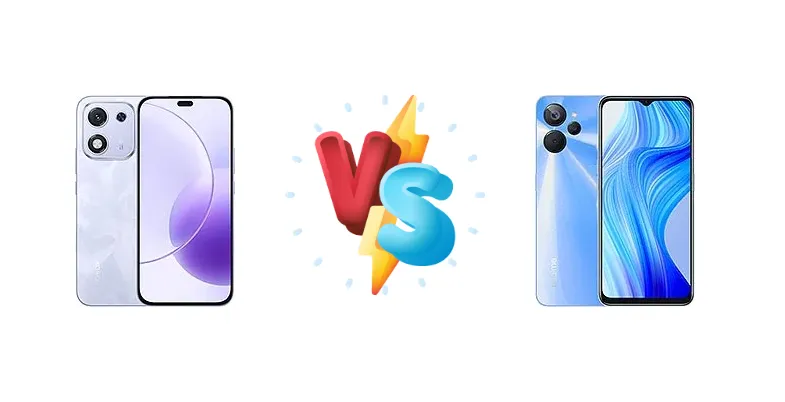
The Honor X70i and Realme 10T represent compelling options in the increasingly competitive mid-range smartphone market. Both leverage Mediatek's Dimensity series to deliver a balance of performance and efficiency, but key differences in chipset architecture and charging capabilities create distinct user experiences. This comparison dives deep into these nuances to determine which device offers the best value.
🏆 Quick Verdict
For the average user prioritizing sustained performance and faster charging, the Honor X70i is the better choice. Its Dimensity 7025 Ultra, while not drastically faster on paper, offers a more modern CPU architecture and a significantly quicker 35W charging solution compared to the Realme 10T's 18W.
| Network |
|---|
| 2G bands | GSM 850 / 900 / 1800 / 1900 | GSM 850 / 900 / 1800 / 1900 |
| 3G bands | HSDPA 850 / 900 / 1900 / 2100 | HSDPA 800 / 850 / 900 / 1700(AWS) / 1900 / 2100 |
| 4G bands | LTE | 1, 2, 3, 4, 5, 7, 8, 12, 13, 17, 18, 19, 20, 26, 28, 38, 39, 40, 41, 66 |
| 5G bands | SA/NSA | 1, 3, 5, 7, 8, 20, 28, 38, 40, 41, 66, 77, 78 SA/NSA |
| Speed | HSPA, LTE, 5G | HSPA, LTE, 5G |
| Technology | GSM / HSPA / LTE / 5G | GSM / HSPA / LTE / 5G |
| Launch |
|---|
| Announced | 2025, April 25 | 2023, March 21 |
| Status | Available. Released 2025, April 30 | Available. Released 2023, March 23 |
| Body |
|---|
| Dimensions | 161 x 74.6 x 7.3 mm (6.34 x 2.94 x 0.29 in) | 164.4 x 75.1 x 8.1 mm (6.47 x 2.96 x 0.32 in) |
| SIM | Nano-SIM + Nano-SIM | Nano-SIM + Nano-SIM |
| Weight | 178.5 g (6.31 oz) | 187 g (6.60 oz) |
| Display |
|---|
| Resolution | 1080 x 2412 pixels, 20:9 ratio (~394 ppi density) | 1080 x 2408 pixels, 20:9 ratio (~400 ppi density) |
| Size | 6.7 inches, 108.0 cm2 (~89.9% screen-to-body ratio) | 6.6 inches, 104.9 cm2 (~85.0% screen-to-body ratio) |
| Type | AMOLED, 120Hz, 3500 nits (peak) | IPS LCD, 90Hz, 400 nits (typ) |
| Platform |
|---|
| CPU | Octa-core (2x2.5 GHz Cortex-A78 & 6x2.0 GHz Cortex-A55) | Octa-core (2x2.4 GHz Cortex-A76 & 6x2.0 GHz Cortex-A55) |
| Chipset | Mediatek Dimensity 7025 Ultra (6 nm) | Mediatek Dimensity 810 (6 nm) |
| GPU | IMG BXM-8-256 | Mali-G57 MC2 |
| OS | Android 15, MagicOS 9 | Android 12, Realme UI 3.0 |
| Memory |
|---|
| Card slot | No | microSDXC (dedicated slot) |
| Internal | 256GB 8GB RAM, 256GB 12GB RAM, 512GB 12GB RAM | 128GB 4GB RAM, 128GB 8GB RAM, 256GB 8GB RAM |
| | - | UFS 2.2 |
| Main Camera |
|---|
| Features | LED flash, HDR, panorama | LED flash, HDR, panorama |
| Single | 108 MP, f/1.8, (wide), 1/1.67", PDAF | - |
| Triple | - | 50 MP, f/1.8, (wide), 1/2.76", 0.64µm, PDAF
Unspecified MP, f/2.8, 46mm (telephoto)
2 MP (macro) |
| Video | 1080p@30fps | 1080p@30fps |
| Selfie camera |
|---|
| Features | - | HDR, panorama |
| Single | 8 MP, f/2.0, (wide) | 8 MP, f/2.0, 27mm (wide) |
| Video | 1080p@30fps | 1080p@30fps |
| Sound |
|---|
| 3.5mm jack | - | Yes |
| 35mm jack | No | Yes |
| Loudspeaker | Yes, with stereo speakers | Yes |
| Comms |
|---|
| Bluetooth | 5.3, A2DP, LE, aptX HD | 5.2, A2DP, LE |
| NFC | Yes | No |
| Positioning | GPS, GLONASS, GALILEO, BDS | GPS, GLONASS, BDS |
| Radio | No | No |
| USB | USB Type-C 2.0, OTG | USB Type-C 2.0, OTG |
| WLAN | Wi-Fi 802.11 a/b/g/n/ac, dual-band, Wi-Fi Direct | Wi-Fi 802.11 a/b/g/n/ac, dual-band |
| Features |
|---|
| Sensors | Fingerprint (under display, optical), accelerometer, compass, proximity (ultrasound) | Fingerprint (side-mounted), accelerometer, proximity, compass |
| Battery |
|---|
| Charging | 35W wired | 18W wired |
| Type | Si/C Li-Ion 6000 mAh | 5000 mAh |
| Misc |
|---|
| Colors | Black, White, Purple, Mint Green | Electric Black, Dash Blue |
| Models | ABR-AN00 | - |
| Price | About 170 EUR | About 200 EUR |
Honor X70i
- Faster 35W charging for quicker top-ups
- More modern CPU architecture (Cortex-A78)
- Potentially better ISP performance from the Dimensity 7025 Ultra
- Limited information available on display specifications
- Camera performance details are unknown
Realme 10T
- Potentially lower price point
- Established Realme software experience
- Likely similar battery capacity to the X70i
- Slower 18W charging
- Older CPU architecture (Cortex-A76)
- May offer less sustained performance under load
Display Comparison
Neither Honor nor Realme provide display specifications beyond the basic panel type. Assuming both utilize IPS LCDs common in this price bracket, the display experience will likely be similar in terms of color accuracy and viewing angles. The absence of high refresh rates or advanced features like LTPO suggests a focus on cost optimization. Bezels are expected to be moderate, typical of the segment.
Camera Comparison
Without detailed camera specs, a direct comparison is difficult. However, both phones likely feature a primary camera sensor paired with depth and macro lenses. The Realme 10T, given Realme’s marketing, may emphasize camera features more heavily, but sensor size and image processing algorithms are crucial. The X70i’s chipset may offer slightly better image signal processing (ISP) capabilities, potentially leading to improved low-light performance. The inclusion of a 2MP macro lens on both devices is largely a marketing tactic and offers limited practical benefit.
Performance
The core difference lies in the chipsets. The Honor X70i features the Mediatek Dimensity 7025 Ultra (6nm), utilizing a more modern CPU configuration with 2x2.5 GHz Cortex-A78 cores and 6x2.0 GHz Cortex-A55 cores. The Realme 10T employs the Dimensity 810 (6nm) with 2x2.4 GHz Cortex-A76 cores and 6x2.0 GHz Cortex-A55 cores. While clock speeds are close, the Cortex-A78 architecture in the X70i generally offers a performance advantage in single-core tasks and improved efficiency. This translates to snappier app launches and smoother multitasking. Both phones likely share similar RAM configurations, but the X70i’s more efficient chipset may result in better sustained performance under load.
Battery Life
The Realme 10T’s 18W charging is a significant disadvantage compared to the Honor X70i’s 35W charging. While battery capacity isn’t specified, the faster charging on the X70i will dramatically reduce the time spent plugged into the wall. A full charge on the X70i is expected to take around 60-75 minutes, while the Realme 10T will likely require over 2 hours. This difference is substantial for users who prioritize convenience and quick power boosts.
Buying Guide
Buy the Honor X70i if you need a phone that can handle multitasking and moderate gaming with a focus on quick top-ups thanks to its 35W charging. It’s ideal for users who frequently use their phone throughout the day and don’t want to be tethered to a charger for long. Buy the Realme 10T if you prioritize a slightly older, but still capable, chipset and are less concerned with charging speed, potentially benefiting from a lower price point if available.
Frequently Asked Questions
❓ Will the Dimensity 7025 Ultra in the Honor X70i handle demanding games like PUBG Mobile smoothly?
The Dimensity 7025 Ultra is capable of running PUBG Mobile at medium to high settings with stable frame rates. While it’s not a flagship chipset, the Cortex-A78 cores provide sufficient processing power for a good gaming experience. However, extended gaming sessions may lead to some thermal throttling, which is common in this price range.
❓ How long will it take to fully charge the Realme 10T from 0% with the included 18W charger?
Expect a full charge from 0% to 100% on the Realme 10T to take approximately 2 hours and 15 minutes to 2 hours and 30 minutes with the 18W charger. This is considerably slower than the Honor X70i’s 35W charging, making it less convenient for users who need a quick power boost.
❓ Does the Honor X70i support any form of fast charging protocols beyond its 35W wired charging?
Currently, there is no information available regarding support for wireless charging or other fast charging protocols like Power Delivery (PD) on the Honor X70i. It is likely limited to the 35W wired charging standard.
❓ Is the Realme 10T a good choice for users who frequently take photos in low-light conditions?
Without detailed camera specifications, it's difficult to say definitively. However, the Realme 10T's image processing capabilities will be crucial. Realme often focuses on software enhancements, but the Dimensity 810's ISP may not be as advanced as the one in the X70i, potentially resulting in slightly less detailed low-light photos.