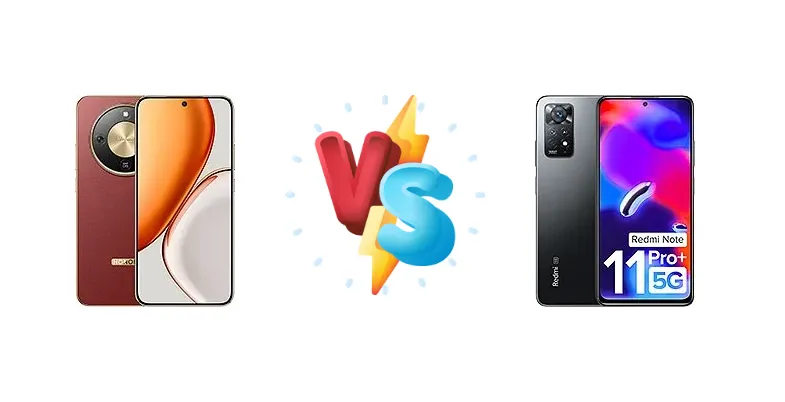
The Honor X70 and Xiaomi Redmi Note 11 Pro+ 5G (India) represent compelling options in the increasingly competitive mid-range smartphone market. While both aim to deliver a balanced experience, they diverge significantly in their core components, particularly their chipsets and charging capabilities. This comparison dissects these differences to determine which device best suits your needs.
🏆 Quick Verdict
For the average user prioritizing future-proofing and faster charging, the Honor X70 emerges as the stronger contender. Its Snapdragon 6 Gen 4, built on a more efficient 4nm process, offers a performance edge and the inclusion of 80W wireless charging (on the 512GB model) is a significant differentiator.
| Network |
|---|
| 2G bands | GSM 850 / 900 / 1800 / 1900 | GSM 850 / 900 / 1800 / 1900 - SIM 1 & SIM 2 |
| 3G bands | HSDPA 850 / 900 / 1700(AWS) / 1900 / 2100 | HSDPA 850 / 900 / 1900 / 2100 |
| 4G bands | LTE | 1, 3, 5, 8, 40, 41 |
| 5G bands | SA/NSA | 1, 3, 5, 8, 28, 40, 78 SA/NSA |
| Speed | HSPA, LTE, 5G | HSPA, LTE-A (CA), 5G |
| Technology | GSM / CDMA / HSPA / CDMA2000 / LTE / 5G | GSM / HSPA / LTE / 5G |
| Launch |
|---|
| Announced | 2025, July 15 | 2022, March 09 |
| Status | Available. Released 2025, July 18 | Available. Released 2022, March 15 |
| Body |
|---|
| Build | - | Glass front (Gorilla Glass 5), glass back |
| Dimensions | 161.9 x 76.1 x 7.8 or 8.0 mm | 164.2 x 76.1 x 8.1 mm (6.46 x 3.00 x 0.32 in) |
| SIM | Nano-SIM + Nano-SIM | Hybrid Dual SIM (Nano-SIM, dual stand-by) |
| Weight | 193 g or 199 g (6.81 oz) | 202 g (7.13 oz) |
| | - | IP53, dust and splash resistant |
| Display |
|---|
| Protection | Aluminosilicate glass | Corning Gorilla Glass 5 |
| Resolution | 1200 x 2640 pixels (~427 ppi density) | 1080 x 2400 pixels, 20:9 ratio (~395 ppi density) |
| Size | 6.79 inches, 112.1 cm2 (~90.9% screen-to-body ratio) | 6.67 inches, 107.4 cm2 (~86.0% screen-to-body ratio) |
| Type | AMOLED, 1B colors, 120Hz, 3840Hz PWM, HDR, 800 nits (typ), 1800 nits (HBM), 6000 nits (peak) | Super AMOLED, 120Hz, 700 nits, 1200 nits (peak) |
| Platform |
|---|
| CPU | Octa-core (1x2.3 GHz Cortex-A720s & 3x2.2 GHz Cortex-A720s & 4x1.8 GHz Cortex-A520s) | Octa-core (2x2.2 GHz Kryo 660 Gold & 6x1.7 GHz Kryo 660 Silver) |
| Chipset | Qualcomm Snapdragon 6 Gen 4 (4 nm) | Qualcomm SM6375 Snapdragon 695 5G (6 nm) |
| GPU | Adreno 810 | Adreno 619 |
| OS | Android 15, Magic OS 9 | Android 11, MIUI 13 |
| Memory |
|---|
| Card slot | No | microSDXC (uses shared SIM slot) |
| Internal | 128GB 8GB RAM, 256GB 8GB RAM, 256GB 12GB RAM, 512GB 12GB RAM | 64GB 6GB RAM, 128GB 6GB RAM, 128GB 8GB RAM, 256GB 8GB RAM |
| | - | UFS 2.2 |
| Main Camera |
|---|
| Features | LED flash, panorama, HDR | LED flash, HDR, panorama |
| Single | 50 MP, f/1.9, (wide), PDAF, OIS | - |
| Triple | - | 108 MP, f/1.9, 26mm (wide), 1/1.52", 0.7µm, PDAF
8 MP, f/2.2, 118˚ (ultrawide)
2 MP, f/2.4, (macro) |
| Video | 4K@30fps, 1080p@30fps, gyro-EIS | 1080p@30fps |
| Selfie camera |
|---|
| Single | 8 MP, f/2.0, (wide) | 16 MP, f/2.5, (wide), 1/3.06" 1.0µm |
| Video | 1080p@30fps | 1080p@30fps |
| Sound |
|---|
| 3.5mm jack | - | Yes |
| 35mm jack | No | - |
| Loudspeaker | Yes, with stereo speakers | Yes, with stereo speakers |
| | - | 24-bit/192kHz audio |
| Comms |
|---|
| Bluetooth | 5.2, A2DP, LE, aptX HD, aptX Adaptive, ASHA | 5.1, A2DP, LE |
| Infrared port | Yes | Yes |
| NFC | Yes | No |
| Positioning | GPS (L1+L5), BDS (B1I+B1c+B2a), GALILEO (E1+E5a), QZSS (L1+L5), NavIC (L5), GLONASS | GPS, GLONASS, BDS, GALILEO |
| Radio | No | Unspecified |
| USB | USB Type-C 2.0, OTG | USB Type-C 2.0, OTG |
| WLAN | Wi-Fi 802.11 a/b/g/n/ac/6, dual-band, Wi-Fi Direct | Wi-Fi 802.11 a/b/g/n/ac, dual-band, Wi-Fi Direct |
| Features |
|---|
| Sensors | Fingerprint (under display, optical), accelerometer, compass, gyro, proximity (ultrasound) | Fingerprint (side-mounted), accelerometer, gyro, proximity, compass |
| Battery |
|---|
| Charging | 80W wired
80W wireless (512GB model only)
Reverse wireless (512GB model only)
5W reverse wired | 67W wired, PD3.0, QC3, 50% in 15 min, 100% in 42 min (advertised) |
| Type | Si/C Li-Ion 8300 mAh | Li-Po 5000 mAh, non-removable |
| Misc |
|---|
| Colors | Black, Green, White, Red | Mirage Blue, Phantom White, Stealth Black |
| Models | MTN-AN00 | 2201116SI |
| Price | About 170 EUR | About 250 EUR |
Honor X70
- More efficient Snapdragon 6 Gen 4 chipset
- 80W wired and wireless charging (512GB model)
- Potential for longer battery life due to 4nm process
- Brand recognition may be lower than Xiaomi in some markets
- Camera specifications are currently unknown
Xiaomi Redmi Note 11 Pro+ 5G (India)
- Established brand reputation in India
- Fast 67W wired charging
- Likely well-optimized software experience
- Less efficient Snapdragon 695 chipset
- No wireless charging support
- 6nm process may lead to more thermal throttling
Display Comparison
Neither device's display specifications are provided, so a direct comparison is limited. However, given the price points, we can expect both to feature AMOLED panels with at least a 90Hz refresh rate. The Redmi Note 11 Pro+ 5G likely benefits from Xiaomi's established display calibration expertise, potentially offering slightly more accurate colors out of the box. The Honor X70, being newer, *may* incorporate advancements in PWM dimming for reduced eye strain, but this requires further testing.
Camera Comparison
Without detailed camera specifications, a direct comparison is challenging. However, the Redmi Note 11 Pro+ 5G is known for its 108MP main sensor, which, while not always indicative of superior image quality, provides more flexibility for cropping and digital zoom. The Honor X70’s sensor resolution is unknown, but its image processing algorithms will be crucial. The presence or absence of Optical Image Stabilization (OIS) on either device would be a significant factor, impacting low-light performance and video stabilization. We can assume both will include standard ultra-wide and macro lenses, but their quality is likely to be secondary to the main sensor.
Performance
The core difference lies in the chipsets. The Honor X70’s Snapdragon 6 Gen 4 (4nm) represents a significant leap over the Redmi Note 11 Pro+ 5G’s Snapdragon 695 (6nm). The 4nm process inherently provides better power efficiency, translating to less heat generation and potentially sustained performance during demanding tasks. While the Snapdragon 695 utilizes Kryo 660 cores, the Snapdragon 6 Gen 4’s Cortex-A720s architecture is newer and generally more efficient. The Honor X70's CPU configuration (1x2.3 GHz Cortex-A720s & 3x2.2 GHz Cortex-A720s & 4x1.8 GHz Cortex-A520s) suggests a focus on both peak and sustained performance, while the Redmi Note 11 Pro+ 5G’s (2x2.2 GHz Kryo 660 Gold & 6x1.7 GHz Kryo 660 Silver) leans towards a more traditional big.LITTLE configuration. This means the X70 is likely to handle multitasking and graphically intensive games more smoothly.
Battery Life
The Redmi Note 11 Pro+ 5G boasts 67W wired charging, advertised to reach 100% in 42 minutes. The Honor X70 steps up the game with 80W wired charging, potentially shaving off some charging time. Crucially, the 512GB model of the X70 also includes 80W *wireless* charging and 5W reverse wireless charging – features absent on the Redmi Note 11 Pro+ 5G. While battery capacity isn't specified for either device, the Snapdragon 6 Gen 4’s superior efficiency in the X70 could offset a potentially smaller battery size, resulting in comparable or even better real-world battery life.
Buying Guide
Buy the Honor X70 if you need a phone with a more modern chipset for sustained performance and appreciate the convenience of fast wired *and* wireless charging. Buy the Xiaomi Redmi Note 11 Pro+ 5G (India) if you prioritize a slightly more established brand reputation within the Indian market and are content with a proven, though less cutting-edge, chipset and a focus on fast wired charging.
Frequently Asked Questions
❓ Will the Snapdragon 6 Gen 4 in the Honor X70 handle demanding games like Genshin Impact at high settings?
While the Snapdragon 6 Gen 4 isn't a flagship chipset, its newer architecture and 4nm process should allow for playable frame rates in Genshin Impact at medium to high settings. Expect some frame drops during intense scenes, but it will likely offer a smoother experience than the Snapdragon 695 in the Redmi Note 11 Pro+ 5G.
❓ How much faster is 80W charging compared to 67W, and will it significantly impact my daily usage?
80W charging will noticeably reduce charging times compared to 67W. While the Redmi Note 11 Pro+ 5G claims 0-100% in 42 minutes, the Honor X70 should achieve a similar result in around 35-40 minutes. The convenience of a quicker top-up is particularly beneficial for users who frequently find themselves with low battery levels.
❓ Does the Honor X70 support 5G connectivity, and what bands are compatible?
The Honor X70 utilizes the Snapdragon 6 Gen 4, which inherently supports 5G connectivity. However, specific 5G band compatibility will vary depending on the region. It's crucial to check the specifications for your specific market to ensure compatibility with your carrier's 5G network.