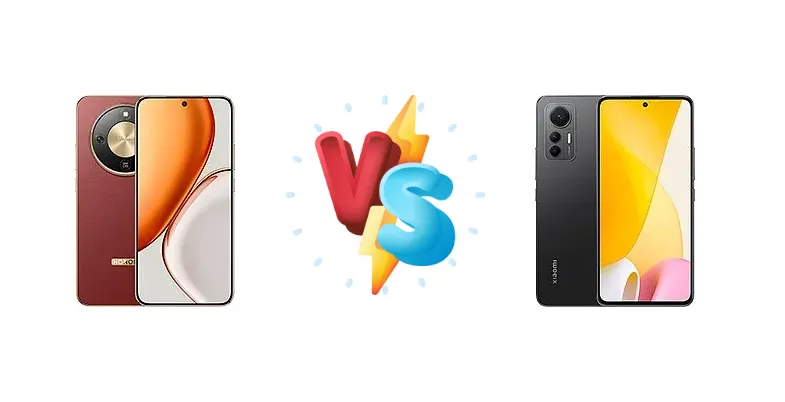
The Honor X70 and Xiaomi 12 Lite represent compelling options in the increasingly competitive mid-range smartphone market. The X70 focuses on rapid charging and a newer chipset, while the 12 Lite boasts a proven performer and a well-regarded display. This comparison dissects their key differences to help you determine which device best suits your priorities.
🏆 Quick Verdict
For the average user prioritizing future-proofing and blazing-fast charging, the Honor X70 emerges as the winner. Its Snapdragon 6 Gen 4, built on a 4nm process, offers a more efficient architecture than the Xiaomi 12 Lite’s 6nm Snapdragon 778G, despite slightly lower clock speeds. However, the Xiaomi 12 Lite remains a strong contender for those valuing a refined user experience and established performance.
| Network |
|---|
| 2G bands | GSM 850 / 900 / 1800 / 1900 | GSM 850 / 900 / 1800 / 1900 |
| 3G bands | HSDPA 850 / 900 / 1700(AWS) / 1900 / 2100 | HSDPA 850 / 900 / 1700(AWS) / 1900 / 2100 |
| 4G bands | LTE | 1, 2, 3, 4, 5, 7, 8, 12, 13, 17, 18, 19, 20, 26, 28, 32, 38, 40, 41, 42, 48, 66 |
| 5G bands | SA/NSA | 1, 3, 5, 7, 8, 20, 28, 38, 40, 41, 66, 77, 78 SA/NSA |
| Speed | HSPA, LTE, 5G | HSPA, LTE, 5G |
| Technology | GSM / CDMA / HSPA / CDMA2000 / LTE / 5G | GSM / HSPA / LTE / 5G |
| Launch |
|---|
| Announced | 2025, July 15 | 2022, July 09 |
| Status | Available. Released 2025, July 18 | Available. Released 2022, July 11 |
| Body |
|---|
| Build | - | Glass front (Gorilla Glass 5), glass back, plastic frame |
| Dimensions | 161.9 x 76.1 x 7.8 or 8.0 mm | 159.3 x 73.7 x 7.3 mm (6.27 x 2.90 x 0.29 in) |
| SIM | Nano-SIM + Nano-SIM | Nano-SIM + Nano-SIM |
| Weight | 193 g or 199 g (6.81 oz) | 173 g (6.10 oz) |
| Display |
|---|
| Protection | Aluminosilicate glass | Corning Gorilla Glass 5 |
| Resolution | 1200 x 2640 pixels (~427 ppi density) | 1080 x 2400 pixels, 20:9 ratio (~402 ppi density) |
| Size | 6.79 inches, 112.1 cm2 (~90.9% screen-to-body ratio) | 6.55 inches, 103.6 cm2 (~88.2% screen-to-body ratio) |
| Type | AMOLED, 1B colors, 120Hz, 3840Hz PWM, HDR, 800 nits (typ), 1800 nits (HBM), 6000 nits (peak) | AMOLED, 68B colors, 120Hz, Dolby Vision, HDR10+, 950 nits (peak) |
| Platform |
|---|
| CPU | Octa-core (1x2.3 GHz Cortex-A720s & 3x2.2 GHz Cortex-A720s & 4x1.8 GHz Cortex-A520s) | Octa-core (1x2.4 GHz Cortex-A78 & 3x2.2 GHz Cortex-A78 & 4x1.9 GHz Cortex-A55) |
| Chipset | Qualcomm Snapdragon 6 Gen 4 (4 nm) | Qualcomm SM7325 Snapdragon 778G 5G (6 nm) |
| GPU | Adreno 810 | Adreno 642L |
| OS | Android 15, Magic OS 9 | Android 12, upgradable to Android 14, HyperOS |
| Memory |
|---|
| Card slot | No | No |
| Internal | 128GB 8GB RAM, 256GB 8GB RAM, 256GB 12GB RAM, 512GB 12GB RAM | 128GB 6GB RAM, 128GB 8GB RAM, 256GB 8GB RAM |
| | - | UFS 2.2 |
| Main Camera |
|---|
| Features | LED flash, panorama, HDR | Dual-LED dual-tone flash, HDR, panorama |
| Single | 50 MP, f/1.9, (wide), PDAF, OIS | 32 MP, f/2.5, (wide), 1/2.8", 0.8µm, AF |
| Triple | - | 108 MP, f/1.9, 26mm (wide), 1/1.52", 0.7µm, PDAF
8 MP, f/2.2, 120˚ (ultrawide), 1/4.0", 1.12µm
2 MP (macro) |
| Video | 4K@30fps, 1080p@30fps, gyro-EIS | 4K@30fps, 1080p@30/60/120fps; gyro-EIS |
| Selfie camera |
|---|
| Features | - | HDR, panorama |
| Single | 8 MP, f/2.0, (wide) | 32 MP, f/2.5, (wide), 1/2.8", 0.8µm, AF |
| Video | 1080p@30fps | 1080p@30/60fps, 720p@120fps |
| Sound |
|---|
| 3.5mm jack | - | No |
| 35mm jack | No | No |
| Loudspeaker | Yes, with stereo speakers | Yes, with dual speakers |
| | - | 24-bit/192kHz audio |
| Comms |
|---|
| Bluetooth | 5.2, A2DP, LE, aptX HD, aptX Adaptive, ASHA | 5.2, A2DP, LE, aptX HD, aptX Adaptive |
| Infrared port | Yes | Yes |
| NFC | Yes | Yes (market/region dependent) |
| Positioning | GPS (L1+L5), BDS (B1I+B1c+B2a), GALILEO (E1+E5a), QZSS (L1+L5), NavIC (L5), GLONASS | GPS (L1), GLONASS (G1), BDS (B1I+B1c), GALILEO (E1), QZSS (L1) |
| Radio | No | No |
| USB | USB Type-C 2.0, OTG | USB Type-C 2.0, OTG |
| WLAN | Wi-Fi 802.11 a/b/g/n/ac/6, dual-band, Wi-Fi Direct | Wi-Fi 802.11 a/b/g/n/ac/6, dual-band, Wi-Fi Direct |
| Features |
|---|
| Sensors | Fingerprint (under display, optical), accelerometer, compass, gyro, proximity (ultrasound) | Fingerprint (under display, optical), accelerometer, gyro, compass |
| | - | Virtual proximity sensing |
| Battery |
|---|
| Charging | 80W wired
80W wireless (512GB model only)
Reverse wireless (512GB model only)
5W reverse wired | 67W wired, PD3.0, QC4, 50% in 13 min |
| Type | Si/C Li-Ion 8300 mAh | Li-Po 4300 mAh |
| Misc |
|---|
| Colors | Black, Green, White, Red | Black, Lite Green, Lite Pink |
| Models | MTN-AN00 | 2203129G |
| Price | About 170 EUR | € 119.80 / $ 269.00 / £ 121.15 |
| SAR | - | 1.09 W/kg (head) 0.73 W/kg (body) |
| SAR EU | - | 0.60 W/kg (head) 1.00 W/kg (body) |
| Tests |
|---|
| Battery life | - |
Endurance rating 100h
|
| Camera | - |
Photo / Video |
| Display | - |
Contrast ratio: Infinite (nominal) |
| Loudspeaker | - |
-25.2 LUFS (Very good)
|
| Performance | - |
AnTuTu: 528905 (v9)
GeekBench: 2943 (v5.1)
GFXBench: 29fps (ES 3.1 onscreen) |
Honor X70
- Significantly faster 80W wired charging
- More efficient Snapdragon 6 Gen 4 (4nm)
- Potential for longer software support due to newer chipset
- Display specifications are unknown
- Camera specifications are unknown
Xiaomi 12 Lite
- Bright 824 nit display
- Proven Snapdragon 778G performance
- Established software ecosystem
- Slower 67W charging
- Less efficient 6nm Snapdragon 778G
- Older chipset architecture
Display Comparison
The Xiaomi 12 Lite features a display capable of reaching 824 nits of peak brightness, ensuring excellent visibility outdoors. While the Honor X70’s display specifications are not provided, the Xiaomi 12 Lite’s brightness advantage is significant. Both phones offer an 'infinite' contrast ratio, typical of OLED panels. The Xiaomi 12 Lite’s display is likely to offer a more refined viewing experience due to its established calibration and brightness capabilities, though the X70 may compensate with a higher refresh rate (unspecified).
Camera Comparison
Both phones feature capable camera systems, but detailed specifications are limited. The Xiaomi 12 Lite’s camera is described as offering both photo and video capabilities, but lacks specific sensor details. The Honor X70’s camera specs are also absent. Without sensor size, aperture, and OIS information, a direct comparison is difficult. However, given the market positioning, the Xiaomi 12 Lite likely prioritizes a more polished and versatile camera experience, while the X70 may focus on delivering acceptable image quality at a lower price point. We can assume both phones include standard features like HDR and night mode.
Performance
The core difference lies in the chipsets. The Honor X70 utilizes the Qualcomm Snapdragon 6 Gen 4 (4nm), while the Xiaomi 12 Lite employs the Snapdragon 778G 5G (6nm). The 4nm process of the Snapdragon 6 Gen 4 provides a clear advantage in power efficiency, potentially leading to better battery life and reduced thermal throttling during sustained workloads. While the 778G’s Cortex-A78 cores have a slightly higher peak clock speed (2.4 GHz vs 2.3 GHz), the newer architecture of the 6 Gen 4’s Cortex-A720s cores, combined with the process node advantage, suggests superior overall performance and efficiency. The Xiaomi 12 Lite’s use of LPDDR5 RAM (speculation based on market segment) would contribute to faster memory access, but the X70’s newer chipset architecture is likely to offset this.
Battery Life
Both the Honor X70 and Xiaomi 12 Lite boast an endurance rating of 100 hours, suggesting similar real-world battery life. However, the charging capabilities are drastically different. The Honor X70 supports 80W wired charging, and the 512GB model adds 80W wireless charging and reverse wireless charging. The Xiaomi 12 Lite is limited to 67W wired charging with support for PD3.0 and QC4, achieving 50% charge in 13 minutes. The X70’s significantly faster charging speeds are a major advantage, allowing for a full charge in a fraction of the time. The inclusion of wireless charging on the 512GB model further enhances its convenience.
Buying Guide
Buy the Honor X70 if you need exceptionally fast charging (especially the 512GB model with wireless charging), and want a phone that will likely receive software updates for longer due to its newer chipset. Buy the Xiaomi 12 Lite if you prioritize a proven track record of performance, a bright and vibrant display, and a more established software ecosystem, even if it means sacrificing the latest chipset and fastest charging speeds.
Frequently Asked Questions
❓ Does the Honor X70's Snapdragon 6 Gen 4 handle demanding games like PUBG or Genshin Impact?
While not a flagship chipset, the Snapdragon 6 Gen 4's newer architecture and 4nm process should provide a playable experience in PUBG and Genshin Impact at medium settings. Expect some frame drops during intense scenes, but the improved efficiency should prevent excessive throttling compared to older mid-range chips.
❓ How does the 67W charging on the Xiaomi 12 Lite compare to the 80W on the Honor X70 in real-world usage?
The Xiaomi 12 Lite's 67W charging takes approximately 13 minutes to reach 50%, while the Honor X70's 80W charging will be noticeably faster. A full charge on the X70 will likely take under 40 minutes, compared to closer to an hour for the 12 Lite. This difference is significant for users who frequently need to top up their battery quickly.
❓ Is the lack of wireless charging on the base Honor X70 a dealbreaker?
If wireless charging is a must-have feature, the 512GB model of the Honor X70 is the only option. However, for most users, the convenience of 80W wired charging is a more significant benefit than wireless charging, making the base model a viable choice.