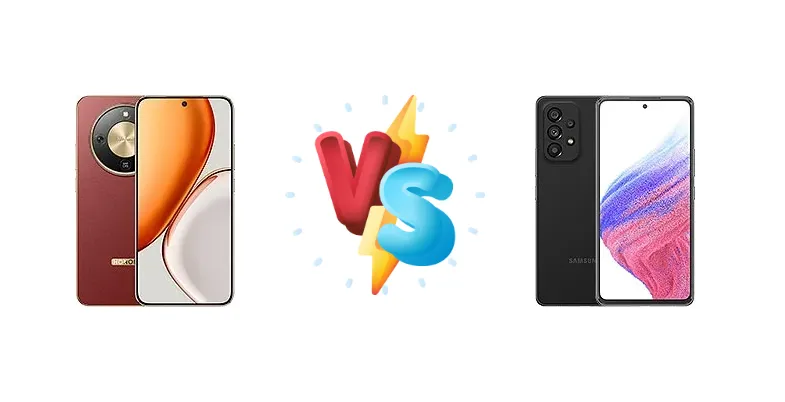
The mid-range smartphone market is fiercely competitive, and the Honor X70 and Samsung Galaxy A53 5G represent compelling options. The X70 aggressively targets charging speed and a newer chipset, while the A53 5G leverages Samsung’s established brand and software ecosystem. This comparison dissects their key differences to determine which device delivers the best value.
🏆 Quick Verdict
For the average user prioritizing fast charging and potentially better long-term performance, the Honor X70 emerges as the winner. Its 80W charging dwarfs the A53’s 25W, and the Snapdragon 6 Gen 4’s 4nm process offers improved efficiency. However, Samsung’s software and established camera processing remain strong contenders.
| Network |
|---|
| 2G bands | GSM 850 / 900 / 1800 / 1900 | GSM 850 / 900 / 1800 / 1900 |
| 3G bands | HSDPA 850 / 900 / 1700(AWS) / 1900 / 2100 | HSDPA 850 / 900 / 1700(AWS) / 1900 / 2100 |
| 4G bands | LTE | 1, 2, 3, 4, 5, 7, 12, 14, 20, 29, 30, 38, 39, 40, 41, 46, 48, 66 - SM-A536U |
| 5G bands | SA/NSA | 2, 5, 41, 66, 77, 78 SA/NSA/Sub6/mmWave - SM-A536U |
| Speed | HSPA, LTE, 5G | HSPA, LTE, 5G |
| Technology | GSM / CDMA / HSPA / CDMA2000 / LTE / 5G | GSM / HSPA / LTE / 5G |
| | - | 2, 5, 48, 66, 77, 78, 260, 261 SA/NSA/Sub6/mmWave - SM-A536V |
| Launch |
|---|
| Announced | 2025, July 15 | 2022, March 17 |
| Status | Available. Released 2025, July 18 | Available. Released 2022, March 24 |
| Body |
|---|
| Build | - | Glass front (Gorilla Glass 5), plastic frame, plastic back |
| Dimensions | 161.9 x 76.1 x 7.8 or 8.0 mm | 159.6 x 74.8 x 8.1 mm (6.28 x 2.94 x 0.32 in) |
| SIM | Nano-SIM + Nano-SIM | · Nano-SIM· Nano-SIM + Nano-SIM |
| Weight | 193 g or 199 g (6.81 oz) | 189 g (6.67 oz) |
| | - | IP67 dust/water resistant (up to 1m for 30 min) |
| Display |
|---|
| Protection | Aluminosilicate glass | Corning Gorilla Glass 5 |
| Resolution | 1200 x 2640 pixels (~427 ppi density) | 1080 x 2400 pixels, 20:9 ratio (~405 ppi density) |
| Size | 6.79 inches, 112.1 cm2 (~90.9% screen-to-body ratio) | 6.5 inches, 102.0 cm2 (~85.4% screen-to-body ratio) |
| Type | AMOLED, 1B colors, 120Hz, 3840Hz PWM, HDR, 800 nits (typ), 1800 nits (HBM), 6000 nits (peak) | Super AMOLED, 120Hz, 800 nits (HBM) |
| Platform |
|---|
| CPU | Octa-core (1x2.3 GHz Cortex-A720s & 3x2.2 GHz Cortex-A720s & 4x1.8 GHz Cortex-A520s) | Octa-core (2x2.4 GHz Cortex-A78 & 6x2.0 GHz Cortex-A55) |
| Chipset | Qualcomm Snapdragon 6 Gen 4 (4 nm) | Exynos 1280 (5 nm) |
| GPU | Adreno 810 | Mali-G68 |
| OS | Android 15, Magic OS 9 | Android 12, up to 4 major Android upgrades, One UI 8 |
| Memory |
|---|
| Card slot | No | microSDXC (uses shared SIM slot) |
| Internal | 128GB 8GB RAM, 256GB 8GB RAM, 256GB 12GB RAM, 512GB 12GB RAM | 128GB 4GB RAM, 128GB 6GB RAM, 128GB 8GB RAM, 256GB 6GB RAM, 256GB 8GB RAM |
| Main Camera |
|---|
| Features | LED flash, panorama, HDR | LED flash, panorama, HDR |
| Quad | - | 64 MP, f/1.8, 26mm (wide), 1/1.7X", 0.8µm, PDAF, OIS
12 MP, f/2.2, 123˚ (ultrawide), 1.12µm
5 MP (macro)
Auxiliary lens |
| Single | 50 MP, f/1.9, (wide), PDAF, OIS | 32 MP, f/2.2, 26mm (wide), 1/2.8", 0.8µm |
| Video | 4K@30fps, 1080p@30fps, gyro-EIS | 4K@30fps, 1080p@30/60fps; gyro-EIS |
| Selfie camera |
|---|
| Features | - | HDR |
| Single | 8 MP, f/2.0, (wide) | 32 MP, f/2.2, 26mm (wide), 1/2.8", 0.8µm |
| Video | 1080p@30fps | 4K@30fps, 1080p@30fps |
| Sound |
|---|
| 3.5mm jack | - | No |
| 35mm jack | No | No |
| Loudspeaker | Yes, with stereo speakers | Yes, with stereo speakers |
| Comms |
|---|
| Bluetooth | 5.2, A2DP, LE, aptX HD, aptX Adaptive, ASHA | 5.1, A2DP, LE |
| Infrared port | Yes | - |
| NFC | Yes | Yes (market/region dependent) |
| Positioning | GPS (L1+L5), BDS (B1I+B1c+B2a), GALILEO (E1+E5a), QZSS (L1+L5), NavIC (L5), GLONASS | GPS, GLONASS, GALILEO, BDS |
| Radio | No | No |
| USB | USB Type-C 2.0, OTG | USB Type-C 2.0, OTG |
| WLAN | Wi-Fi 802.11 a/b/g/n/ac/6, dual-band, Wi-Fi Direct | Wi-Fi 802.11 a/b/g/n/ac, dual-band, Wi-Fi Direct |
| Features |
|---|
| Sensors | Fingerprint (under display, optical), accelerometer, compass, gyro, proximity (ultrasound) | Fingerprint (under display, optical), accelerometer, gyro, compass, barometer (market/region dependent) |
| | - | Virtual proximity sensing |
| Battery |
|---|
| Charging | 80W wired
80W wireless (512GB model only)
Reverse wireless (512GB model only)
5W reverse wired | 25W wired |
| Type | Si/C Li-Ion 8300 mAh | Li-Po 5000 mAh |
| Misc |
|---|
| Colors | Black, Green, White, Red | Black, White, Blue, Peach |
| Models | MTN-AN00 | SM-A536B, SM-A536B/DS, SM-A536U, SM-A536U1, SM-A5360, SM-A536E, SM-A536E/DS, SM-A536V, SM-A536W, SM-A536N, SM-S536DL |
| Price | About 170 EUR | $ 151.42 / £ 185.00 / € 169.14 |
| SAR | - | 0.75 W/kg (head) 1.58 W/kg (body) |
| SAR EU | - | 0.89 W/kg (head) 1.60 W/kg (body) |
| Tests |
|---|
| Battery life | - |
Endurance rating 113h
|
| Camera | - |
Photo / Video |
| Display | - |
Contrast ratio: Infinite (nominal) |
| Loudspeaker | - |
-26.5 LUFS (Good)
|
| Performance | - |
AnTuTu: 329802 (v8), 379313 (v9)
GeekBench: 1891 (v5.1)
GFXBench: 19fps (ES 3.1 onscreen) |
Honor X70
- Significantly faster 80W wired charging
- Newer Snapdragon 6 Gen 4 chipset with 4nm efficiency
- Potential for better sustained performance due to thermal efficiency
- 80W wireless charging (512GB model)
- Camera specs are unknown, potentially less refined than Samsung
- Honor’s Magic UI may not appeal to all users
Samsung Galaxy A53 5G
- Brighter display for better outdoor visibility
- Samsung’s established software ecosystem and updates
- Refined camera processing and consistent image quality
- Strong brand recognition and resale value
- Significantly slower 25W charging
- Older Exynos 1280 chipset may throttle under heavy load
- Less efficient 5nm process compared to X70’s 4nm
Display Comparison
The Samsung Galaxy A53 5G boasts a brighter display, peaking at 830 nits, which translates to better visibility outdoors. While the Honor X70’s display specs are not provided, it’s likely lower in peak brightness. Both devices feature an 'infinite' contrast ratio (nominal), typical of AMOLED panels. The A53’s display is likely to offer a more vibrant and easily viewable experience in direct sunlight, a significant advantage for outdoor users. However, without PWM frequency data for the X70, it's impossible to assess potential flicker-related eye strain.
Camera Comparison
Both phones offer photo and video capabilities, but detailed sensor information is lacking for the Honor X70. The Galaxy A53 5G likely benefits from Samsung’s well-tuned image processing algorithms. Without knowing the main sensor size or aperture of the X70, it’s difficult to assess its low-light performance. The A53’s camera system is likely more refined, offering consistent results across various shooting conditions. The presence of a 2MP macro camera on the A53 is largely a marketing feature with limited practical benefit.
Performance
The core difference lies in the chipsets. The Honor X70 utilizes the Qualcomm Snapdragon 6 Gen 4 (4nm), while the Samsung Galaxy A53 5G is powered by the Exynos 1280 (5nm). While the Exynos 1280 features Cortex-A78 cores clocked at 2.4 GHz, the Snapdragon 6 Gen 4’s Cortex-A720s cores, coupled with the more efficient 4nm process, suggest better sustained performance and thermal management. The A53’s older architecture may exhibit more throttling during extended gaming sessions. The Snapdragon 6 Gen 4’s architecture is also newer, potentially offering better software optimization and future-proofing.
Battery Life
Both devices achieve an endurance rating of 113 hours, indicating similar overall battery life. However, the Honor X70’s 80W wired charging is a game-changer, allowing for a full charge in under 40 minutes. The Samsung Galaxy A53 5G’s 25W charging is significantly slower, requiring over an hour for a complete charge. Furthermore, the X70 (512GB model) adds 80W wireless charging and reverse wireless charging, features absent on the A53. This charging speed advantage makes the X70 ideal for users who frequently need to top up their battery quickly.
Buying Guide
Buy the Honor X70 if you need blazing-fast charging, prioritize a newer chipset for sustained performance, and are comfortable with Honor’s Magic UI. Buy the Samsung Galaxy A53 5G if you prefer a more polished software experience, value Samsung’s brand reputation, and prioritize a consistently reliable camera experience, even if it means slower charging and potentially more thermal throttling under heavy load.
Frequently Asked Questions
❓ Does the Exynos 1280 in the Galaxy A53 5G tend to overheat during prolonged gaming sessions?
The Exynos 1280, while capable, is known to exhibit thermal throttling under sustained load, particularly in graphically demanding games. This can lead to frame rate drops and a less smooth gaming experience compared to devices with more efficient chipsets and better cooling solutions.
❓ How long does it actually take to fully charge the Honor X70 with the 80W charger?
The Honor X70 can charge from 0% to 100% in approximately 35-40 minutes with the 80W charger. This is a significant advantage over the Galaxy A53 5G’s 25W charging, which takes well over an hour.
❓ Is the 512GB model of the Honor X70 worth the extra cost, considering the wireless charging?
If you value wireless charging convenience and frequently use wireless charging pads, the 512GB model is worth the premium. The addition of 80W wireless charging and reverse wireless charging adds significant functionality.
❓ How does Honor’s Magic UI compare to Samsung’s One UI in terms of software updates and features?
Samsung’s One UI generally receives more frequent and longer-term software updates compared to Honor’s Magic UI. One UI also offers a more polished and feature-rich experience, though Magic UI has improved significantly in recent iterations.