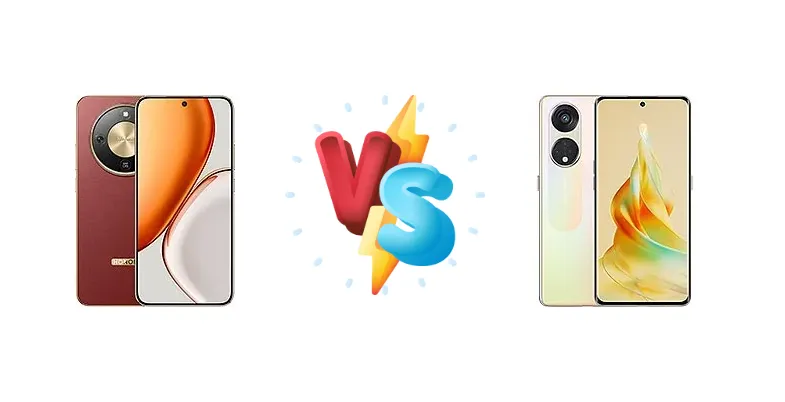
The Honor X70 and Oppo Reno8 T 5G represent compelling options in the increasingly competitive mid-range 5G smartphone market. While both aim to deliver a balanced experience, they diverge significantly in their core components, particularly their chipsets and charging capabilities. This comparison will dissect these differences to determine which device best suits your needs.
🏆 Quick Verdict
For the average user prioritizing fast charging and potentially better long-term performance, the Honor X70 emerges as the stronger choice. Its Snapdragon 6 Gen 4, built on a more efficient 4nm process, coupled with 80W wired (and potentially wireless) charging, offers a tangible advantage over the Oppo Reno8 T 5G's Snapdragon 695 and 67W charging.
| Network |
|---|
| 2G bands | GSM 850 / 900 / 1800 / 1900 | GSM 850 / 900 / 1800 / 1900 |
| 3G bands | HSDPA 850 / 900 / 1700(AWS) / 1900 / 2100 | HSDPA 800 / 850 / 900 / 1700(AWS) / 1900 / 2100 |
| 4G bands | LTE | 1, 2, 3, 4, 5, 7, 8, 12, 17, 18, 19, 20, 26, 28, 38, 39, 40, 41, 66 |
| 5G bands | SA/NSA | 1, 3, 5, 7, 8, 20, 28, 38, 40, 41, 66, 77, 78 SA/NSA |
| Speed | HSPA, LTE, 5G | HSPA, LTE, 5G |
| Technology | GSM / CDMA / HSPA / CDMA2000 / LTE / 5G | GSM / HSPA / LTE / 5G |
| Launch |
|---|
| Announced | 2025, July 15 | 2023, February 01 |
| Status | Available. Released 2025, July 18 | Available. Released 2023, February 10 |
| Body |
|---|
| Dimensions | 161.9 x 76.1 x 7.8 or 8.0 mm | 162.3 x 74.3 x 7.7 mm (6.39 x 2.93 x 0.30 in) |
| SIM | Nano-SIM + Nano-SIM | Nano-SIM + Nano-SIM |
| Weight | 193 g or 199 g (6.81 oz) | 171 g (6.03 oz) |
| Display |
|---|
| Protection | Aluminosilicate glass | Asahi Glass AGC DT-Star2 |
| Resolution | 1200 x 2640 pixels (~427 ppi density) | 1080 x 2412 pixels, 20:9 ratio (~394 ppi density) |
| Size | 6.79 inches, 112.1 cm2 (~90.9% screen-to-body ratio) | 6.7 inches, 108.0 cm2 (~89.6% screen-to-body ratio) |
| Type | AMOLED, 1B colors, 120Hz, 3840Hz PWM, HDR, 800 nits (typ), 1800 nits (HBM), 6000 nits (peak) | AMOLED, 1B colors, 120Hz, 500 nits (typ), 800 nits (HBM), 950 nits (peak) |
| Platform |
|---|
| CPU | Octa-core (1x2.3 GHz Cortex-A720s & 3x2.2 GHz Cortex-A720s & 4x1.8 GHz Cortex-A520s) | Octa-core (2x2.2 GHz Kryo 660 Gold & 6x1.7 GHz Kryo 660 Silver) |
| Chipset | Qualcomm Snapdragon 6 Gen 4 (4 nm) | Qualcomm SM6375 Snapdragon 695 5G (6 nm) |
| GPU | Adreno 810 | Adreno 619 |
| OS | Android 15, Magic OS 9 | Android 13, upgradable to Android 14, ColorOS 14 |
| Memory |
|---|
| Card slot | No | microSDXC (uses shared SIM slot) |
| Internal | 128GB 8GB RAM, 256GB 8GB RAM, 256GB 12GB RAM, 512GB 12GB RAM | 128GB 8GB RAM, 256GB 8GB RAM |
| | - | UFS 2.2 |
| Main Camera |
|---|
| Dual | - | 108 MP, f/1.7, 24mm (wide), 1/1.67", 0.64µm, AF
2 MP, f/3.3, 34mm (microscope)
2 MP, f/2.4, (depth) |
| Features | LED flash, panorama, HDR | LED flash, HDR, panorama |
| Single | 50 MP, f/1.9, (wide), PDAF, OIS | 32 MP, f/2.4, 22mm (wide) |
| Triple | - | 108 MP, f/1.7, 24mm (wide), 1/1.67", 0.64µm, AF
2 MP, f/3.3, 34mm (microscope)
Auxiliary lens |
| Video | 4K@30fps, 1080p@30fps, gyro-EIS | 1080p@30fps |
| Selfie camera |
|---|
| Features | - | HDR, panorama |
| Single | 8 MP, f/2.0, (wide) | 32 MP, f/2.4, 22mm (wide) |
| Video | 1080p@30fps | 1080p@30fps |
| Sound |
|---|
| 3.5mm jack | - | No |
| 35mm jack | No | No |
| Loudspeaker | Yes, with stereo speakers | Yes, with stereo speakers |
| Comms |
|---|
| Bluetooth | 5.2, A2DP, LE, aptX HD, aptX Adaptive, ASHA | 5.1, A2DP, LE, aptX HD |
| Infrared port | Yes | - |
| NFC | Yes | Yes |
| Positioning | GPS (L1+L5), BDS (B1I+B1c+B2a), GALILEO (E1+E5a), QZSS (L1+L5), NavIC (L5), GLONASS | GPS, GALILEO, GLONASS, BDS, QZSS |
| Radio | No | No |
| USB | USB Type-C 2.0, OTG | USB Type-C 2.0, OTG |
| WLAN | Wi-Fi 802.11 a/b/g/n/ac/6, dual-band, Wi-Fi Direct | Wi-Fi 802.11 a/b/g/n/ac, dual-band |
| Features |
|---|
| Sensors | Fingerprint (under display, optical), accelerometer, compass, gyro, proximity (ultrasound) | Fingerprint (under display, optical), accelerometer, gyro, proximity, compass |
| Battery |
|---|
| Charging | 80W wired
80W wireless (512GB model only)
Reverse wireless (512GB model only)
5W reverse wired | 67W wired, PD, 100% in 44 min
Reverse wired |
| Type | Si/C Li-Ion 8300 mAh | Li-Po 4800 mAh |
| Misc |
|---|
| Colors | Black, Green, White, Red | Black Starlight (Midnight Black), Dawn Gold (Sunrise Gold) |
| Models | MTN-AN00 | CPH2505 |
| Price | About 170 EUR | About 340 EUR |
Honor X70
- Significantly faster 80W wired charging
- Potentially better performance with Snapdragon 6 Gen 4
- More efficient 4nm process for improved thermal management
- Wireless charging limited to 512GB model
- Brand recognition may be lower than Oppo
Oppo Reno8 T 5G
- Established Oppo Reno series reputation
- Competent Snapdragon 695 5G chipset
- Reliable 67W fast charging
- Less efficient 6nm process
- Slower charging compared to Honor X70
Display Comparison
Neither Honor nor Oppo provided display specs. Given the price bracket, both likely feature 6.6-6.7 inch LCD panels with FHD+ resolution. The Reno series historically prioritizes display quality, so it *may* have slightly better color accuracy. However, without specific data, it's difficult to definitively say. The absence of LTPO technology on either device suggests standard 60Hz or 90Hz refresh rates.
Camera Comparison
Without detailed sensor information, a direct comparison is challenging. Both phones likely feature a primary camera around 50MP. The Oppo Reno8 T 5G benefits from Oppo’s established image processing algorithms, which are generally well-regarded for producing vibrant and social media-ready images. However, the X70’s newer ISP (Image Signal Processor) within the Snapdragon 6 Gen 4 could offer improved noise reduction and dynamic range. We can safely assume both will include standard auxiliary lenses (ultrawide, depth) of limited utility.
Performance
The core difference lies in the chipsets. The Honor X70’s Snapdragon 6 Gen 4 (4nm) represents a significant leap over the Oppo Reno8 T 5G’s Snapdragon 695 (6nm). The 4nm process inherently offers better power efficiency, translating to less heat generation and potentially sustained performance during demanding tasks. While the Snapdragon 695’s Kryo 660 Gold cores offer a 2.2 GHz clock speed, the X70’s Cortex-A720s cores, also clocked at 2.3 GHz, are architecturally more advanced. This means the X70 will likely exhibit superior single-core and multi-core performance, benefiting gaming and app responsiveness. The X70's RAM configuration is unknown, but LPDDR5X would be a significant advantage.
Battery Life
The Honor X70’s 80W wired charging is a standout feature, promising significantly faster top-ups compared to the Oppo Reno8 T 5G’s 67W charging (advertised 0-100% in 44 minutes). The X70 also boasts 80W *wireless* charging on the 512GB model, a feature absent on the Reno8 T 5G. While battery capacity isn’t specified, the Snapdragon 6 Gen 4’s efficiency could offset a potentially smaller battery size in the X70, resulting in comparable real-world battery life. The X70 also offers 5W reverse wired and wireless charging, adding to its versatility.
Buying Guide
Buy the Honor X70 if you need blazing-fast charging speeds, potentially better thermal management during extended use, and are looking for a phone that might hold its value slightly longer due to the newer chipset. Buy the Oppo Reno8 T 5G if you prioritize a well-established brand reputation within the Reno series and are comfortable with a slightly older, but still capable, chipset and a slightly slower charging experience.
Frequently Asked Questions
❓ Will the Snapdragon 6 Gen 4 in the Honor X70 handle demanding games like PUBG Mobile smoothly?
The Snapdragon 6 Gen 4's architectural improvements over the 695 suggest it will deliver a smoother gaming experience in PUBG Mobile, particularly at medium settings. The 4nm process should also help mitigate thermal throttling during extended gaming sessions, maintaining consistent frame rates.
❓ Does the Honor X70's 80W charging degrade the battery health faster than the Oppo Reno8 T 5G's 67W charging?
While faster charging *can* contribute to slightly faster battery degradation over the long term, modern smartphones employ sophisticated charging management systems to minimize this effect. The difference between 80W and 67W is unlikely to be significant enough to cause noticeable battery health issues within the typical 2-3 year lifespan of a smartphone.
❓ Is the reverse wireless charging on the Honor X70 512GB model useful for charging accessories like earbuds?
Yes, the 5W reverse wireless charging is convenient for topping up accessories like wireless earbuds or smartwatches, although it's a relatively slow charging speed. It's best suited for emergency situations or overnight trickle charging rather than quickly replenishing a depleted accessory.