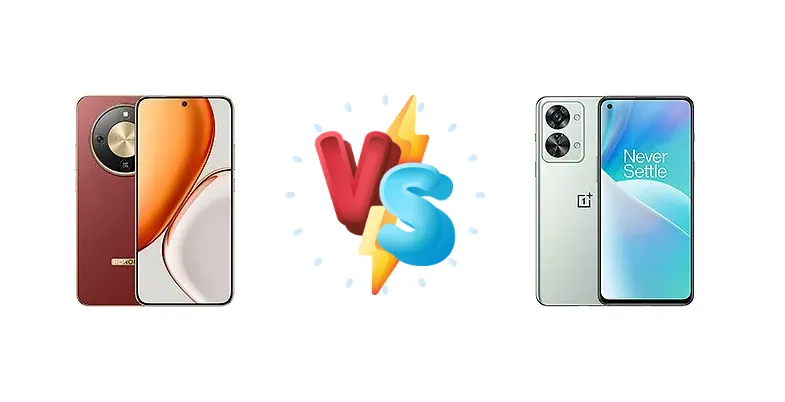
The mid-range smartphone market is fiercely competitive, and the Honor X70 and OnePlus Nord 2T represent compelling options. The X70 brings the latest Snapdragon 6 Gen 4 and potentially class-leading charging speeds, while the Nord 2T leverages the established Dimensity 1300 platform. This comparison dissects their strengths and weaknesses to determine which device best suits your needs.
🏆 Quick Verdict
For the average user prioritizing sustained performance and a proven track record, the OnePlus Nord 2T emerges as the slightly stronger choice. Its Dimensity 1300 chipset offers a more robust CPU and GPU configuration, translating to smoother multitasking and gaming. However, the Honor X70’s 80W charging and potential for wireless charging (on the 512GB model) are significant advantages for those who value convenience.
| Network |
|---|
| 2G bands | GSM 850 / 900 / 1800 / 1900 | GSM 850 / 900 / 1800 / 1900 |
| 3G bands | HSDPA 850 / 900 / 1700(AWS) / 1900 / 2100 | HSDPA 800 / 850 / 900 / 1700(AWS) / 1800 / 1900 / 2100 |
| 4G bands | LTE | 1, 2, 3, 4, 5, 7, 8, 12, 17, 18, 19, 20, 26, 28, 32, 34, 38, 39, 40, 41, 66 |
| 5G bands | SA/NSA | 1, 3, 7, 8, 20, 28, 38, 41, 78 SA/NSA |
| Speed | HSPA, LTE, 5G | HSPA 42.2/5.76 Mbps, LTE Cat18 1200/150 Mbps, 5G |
| Technology | GSM / CDMA / HSPA / CDMA2000 / LTE / 5G | GSM / HSPA / LTE / 5G |
| Launch |
|---|
| Announced | 2025, July 15 | 2022, May 19 |
| Status | Available. Released 2025, July 18 | Available. Released 2022, May 21 |
| Body |
|---|
| Build | - | Glass front (Gorilla Glass 5), plastic frame |
| Dimensions | 161.9 x 76.1 x 7.8 or 8.0 mm | 159.1 x 73.2 x 8.2 mm (6.26 x 2.88 x 0.32 in) |
| SIM | Nano-SIM + Nano-SIM | Nano-SIM + Nano-SIM |
| Weight | 193 g or 199 g (6.81 oz) | 190 g (6.70 oz) |
| Display |
|---|
| Protection | Aluminosilicate glass | Corning Gorilla Glass 5 |
| Resolution | 1200 x 2640 pixels (~427 ppi density) | 1080 x 2400 pixels, 20:9 ratio (~409 ppi density) |
| Size | 6.79 inches, 112.1 cm2 (~90.9% screen-to-body ratio) | 6.43 inches, 99.8 cm2 (~85.7% screen-to-body ratio) |
| Type | AMOLED, 1B colors, 120Hz, 3840Hz PWM, HDR, 800 nits (typ), 1800 nits (HBM), 6000 nits (peak) | AMOLED, 90Hz, HDR10+ |
| Platform |
|---|
| CPU | Octa-core (1x2.3 GHz Cortex-A720s & 3x2.2 GHz Cortex-A720s & 4x1.8 GHz Cortex-A520s) | Octa-core (1x3.0 GHz Cortex-A78 & 3x2.6 GHz Cortex-A78 & 4x2.0 GHz Cortex-A55) |
| Chipset | Qualcomm Snapdragon 6 Gen 4 (4 nm) | Mediatek Dimensity 1300 (6 nm) |
| GPU | Adreno 810 | Mali-G77 MC9 |
| OS | Android 15, Magic OS 9 | Android 12, upgradable to Android 14, OxygenOS 14 |
| Memory |
|---|
| Card slot | No | No |
| Internal | 128GB 8GB RAM, 256GB 8GB RAM, 256GB 12GB RAM, 512GB 12GB RAM | 128GB 8GB RAM, 256GB 12GB RAM |
| | - | UFS 3.1 |
| Main Camera |
|---|
| Features | LED flash, panorama, HDR | Dual-LED flash, HDR, panorama |
| Single | 50 MP, f/1.9, (wide), PDAF, OIS | 32 MP, f/2.4, (wide), 1/2.8", 0.8µm |
| Triple | - | 50 MP, f/1.9, 24mm (wide), 1/1.56", 1.0µm, PDAF, OIS
8 MP, f/2.2, 120˚ (ultrawide)
Auxiliary lens |
| Video | 4K@30fps, 1080p@30fps, gyro-EIS | 4K@30fps, 1080p@30/60/120/480fps, gyro-EIS |
| Selfie camera |
|---|
| Features | - | Auto HDR |
| Single | 8 MP, f/2.0, (wide) | 32 MP, f/2.4, (wide), 1/2.8", 0.8µm |
| Video | 1080p@30fps | 1080p@30fps, gyro-EIS |
| Sound |
|---|
| 3.5mm jack | - | No |
| 35mm jack | No | No |
| Loudspeaker | Yes, with stereo speakers | Yes, with stereo speakers |
| Comms |
|---|
| Bluetooth | 5.2, A2DP, LE, aptX HD, aptX Adaptive, ASHA | 5.2, A2DP, LE, aptX HD |
| Infrared port | Yes | - |
| NFC | Yes | Yes |
| Positioning | GPS (L1+L5), BDS (B1I+B1c+B2a), GALILEO (E1+E5a), QZSS (L1+L5), NavIC (L5), GLONASS | GPS, GLONASS, GALILEO, BDS, NavIC |
| Radio | No | No |
| USB | USB Type-C 2.0, OTG | USB Type-C 2.0, OTG |
| WLAN | Wi-Fi 802.11 a/b/g/n/ac/6, dual-band, Wi-Fi Direct | Wi-Fi 802.11 a/b/g/n/ac/6, dual-band, Wi-Fi Direct |
| Features |
|---|
| Sensors | Fingerprint (under display, optical), accelerometer, compass, gyro, proximity (ultrasound) | Fingerprint (under display, optical), accelerometer, gyro, proximity, compass |
| Battery |
|---|
| Charging | 80W wired
80W wireless (512GB model only)
Reverse wireless (512GB model only)
5W reverse wired | 80W wired, PD |
| Type | Si/C Li-Ion 8300 mAh | Li-Po 4500 mAh |
| Misc |
|---|
| Colors | Black, Green, White, Red | Gray Shadow, Jade Fog |
| Models | MTN-AN00 | CPH2399, CPH2401 |
| Price | About 170 EUR | € 144.39 / $ 169.99 / ₹ 31,490 |
| Tests |
|---|
| Battery life | - |
Endurance rating 100h
|
| Camera | - |
Photo / Video |
| Display | - |
Contrast ratio: Infinite (nominal) |
| Loudspeaker | - |
-25.6 LUFS (Very good)
|
| Performance | - |
AnTuTu: 490545 (v8) | 604467 (v9)
GeekBench: 2790 (v5.1)
GFXBench: 40fps (ES 3.1 onscreen) |
Honor X70
- Incredibly fast 80W wired charging
- Potential for 80W wireless charging (512GB model)
- More power-efficient 4nm Snapdragon 6 Gen 4 chipset
- Less powerful CPU and GPU compared to the Nord 2T
- Limited camera information available
OnePlus Nord 2T
- More powerful Dimensity 1300 chipset for gaming and multitasking
- Proven 100-hour endurance rating
- 80W wired charging with PD support
- Lacks wireless charging capabilities
- 6nm process may result in slightly higher power consumption
Display Comparison
Both phones lack detailed display specifications beyond the Nord 2T’s measured 636 nits peak brightness. While the Honor X70’s panel characteristics are unknown, the Nord 2T’s brightness ensures good visibility outdoors. The Nord 2T’s ‘Infinite’ contrast ratio is a marketing term, but suggests a typical AMOLED experience. Without knowing the X70’s panel type or refresh rate, the Nord 2T holds a slight edge due to its confirmed brightness and AMOLED technology.
Camera Comparison
Both phones are listed as having 'Photo / Video' capabilities, offering minimal insight. Without sensor size, aperture, or image processing details, a direct comparison is impossible. However, the market segment suggests the Nord 2T likely features a more refined camera system, potentially with optical image stabilization (OIS). The absence of details on the X70’s camera raises concerns about its overall capabilities compared to the Nord 2T’s likely more mature camera implementation.
Performance
The OnePlus Nord 2T’s MediaTek Dimensity 1300 (6nm) boasts a more powerful CPU configuration – a 1x3.0 GHz Cortex-A78 core alongside three 2.6 GHz Cortex-A78 cores – compared to the Honor X70’s Snapdragon 6 Gen 4 (4nm). The Snapdragon 6 Gen 4 utilizes newer Cortex-A720s cores, but the Dimensity 1300’s higher clock speeds and core count provide a noticeable performance advantage in CPU-intensive tasks. The 4nm process of the Snapdragon 6 Gen 4 should offer better power efficiency, but the Dimensity 1300’s Mali-G72 MP3 GPU is likely to outperform the Snapdragon’s Adreno GPU in graphics-heavy applications. The Nord 2T is the clear winner for users prioritizing performance.
Battery Life
Both devices share a 100-hour endurance rating, suggesting similar real-world battery life despite potentially different battery capacities (not specified). However, the Honor X70’s charging capabilities are a standout feature. Its 80W wired charging is matched by the Nord 2T, but the X70 also offers 80W wireless charging (on the 512GB model) and reverse wireless charging, features absent on the Nord 2T. The X70’s 5W reverse wired charging provides a basic emergency power source. The X70’s charging versatility gives it a significant advantage for users who frequently top up their devices.
Buying Guide
Buy the Honor X70 if you prioritize incredibly fast charging – especially if opting for the 512GB model with wireless capabilities – and are comfortable with a chipset geared towards efficiency rather than raw power. Buy the OnePlus Nord 2T if you demand consistently higher performance for gaming and demanding applications, and appreciate a more established software experience with a proven endurance rating.
Frequently Asked Questions
❓ Does the Snapdragon 6 Gen 4 in the Honor X70 struggle with demanding games like Genshin Impact?
While the Snapdragon 6 Gen 4 is a capable chipset, Genshin Impact and similar graphically intensive games will likely require reduced settings for smooth gameplay. The Dimensity 1300 in the Nord 2T offers a more comfortable experience for demanding mobile gaming.
❓ How long does it *actually* take to charge the Honor X70 from 0-100% with 80W charging?
Honor claims the X70 can charge from 0-100% in approximately 35 minutes with 80W wired charging. Real-world results may vary slightly depending on usage and ambient temperature, but it remains significantly faster than standard charging speeds.
❓ Is the 512GB model of the Honor X70 worth the extra cost, considering the wireless charging?
If you value the convenience of wireless charging and frequently use it, the 512GB model is worth the premium. The addition of reverse wireless charging further enhances its versatility, allowing you to top up accessories or other devices.
❓ Does the OnePlus Nord 2T support 5G connectivity?
Yes, the OnePlus Nord 2T supports 5G connectivity, allowing you to take advantage of faster mobile data speeds where available. The Honor X70's 5G support is not explicitly stated, but is likely given its chipset.