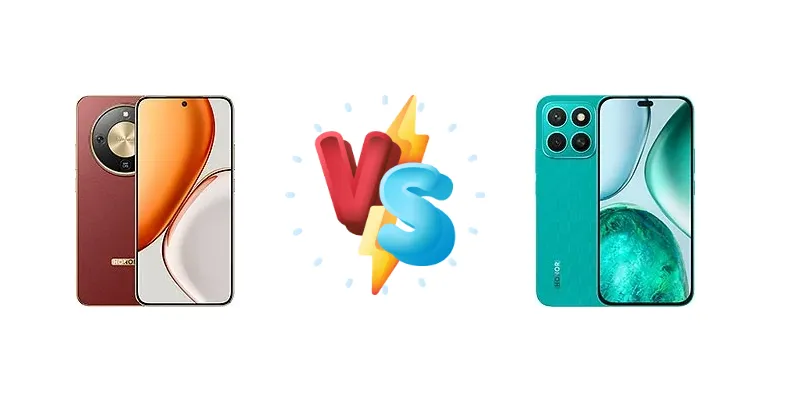
The Honor X70 and X8c represent Honor's continued push into the competitive mid-range smartphone market. While both aim to deliver a compelling experience without breaking the bank, they take distinctly different approaches, primarily revolving around their chipsets and charging capabilities. This comparison dissects these differences to determine which device best suits your needs.
🏆 Quick Verdict
For most users, the Honor X70 emerges as the stronger choice. Its newer Snapdragon 6 Gen 4 chipset, built on a more efficient 4nm process, offers a noticeable performance advantage and future-proofing. The inclusion of 80W wired *and* wireless charging (on the 512GB model) is a significant differentiator, making it ideal for power users.
| Network |
|---|
| 2G bands | GSM 850 / 900 / 1800 / 1900 | GSM 850 / 900 / 1800 / 1900 |
| 3G bands | HSDPA 850 / 900 / 1700(AWS) / 1900 / 2100 | HSDPA 850 / 900 / 1900 / 2100 |
| 4G bands | LTE | LTE |
| 5G bands | SA/NSA | - |
| Speed | HSPA, LTE, 5G | HSPA, LTE |
| Technology | GSM / CDMA / HSPA / CDMA2000 / LTE / 5G | GSM / HSPA / LTE |
| Launch |
|---|
| Announced | 2025, July 15 | 2025, January 14 |
| Status | Available. Released 2025, July 18 | Available. Released 2025, January 20 |
| Body |
|---|
| Build | - | Glass front, plastic frame, plastic back or silicone polymer back (eco leather) |
| Dimensions | 161.9 x 76.1 x 7.8 or 8.0 mm | 161.1 x 74.6 x 7.1 mm (6.34 x 2.94 x 0.28 in) |
| SIM | Nano-SIM + Nano-SIM | Nano-SIM + Nano-SIM |
| Weight | 193 g or 199 g (6.81 oz) | 174 g (6.14 oz) |
| Display |
|---|
| Protection | Aluminosilicate glass | - |
| Resolution | 1200 x 2640 pixels (~427 ppi density) | 1080 x 2412 pixels, 20:9 ratio (~394 ppi density) |
| Size | 6.79 inches, 112.1 cm2 (~90.9% screen-to-body ratio) | 6.7 inches, 108.0 cm2 (~89.9% screen-to-body ratio) |
| Type | AMOLED, 1B colors, 120Hz, 3840Hz PWM, HDR, 800 nits (typ), 1800 nits (HBM), 6000 nits (peak) | AMOLED, 120Hz, 1200 nits (HBM), 2800 nits (peak) |
| Platform |
|---|
| CPU | Octa-core (1x2.3 GHz Cortex-A720s & 3x2.2 GHz Cortex-A720s & 4x1.8 GHz Cortex-A520s) | Octa-core (4x2.8 GHz Cortex-A73 & 4x1.9 GHz Cortex-A53) |
| Chipset | Qualcomm Snapdragon 6 Gen 4 (4 nm) | Qualcomm SM6225 Snapdragon 685 (6 nm) |
| GPU | Adreno 810 | Adreno 610 |
| OS | Android 15, Magic OS 9 | Android 15, MagicOS 9 |
| Memory |
|---|
| Card slot | No | No |
| Internal | 128GB 8GB RAM, 256GB 8GB RAM, 256GB 12GB RAM, 512GB 12GB RAM | 128GB 6GB RAM, 128GB 8GB RAM, 256GB 8GB RAM, 512GB 8GB RAM |
| Main Camera |
|---|
| Dual | - | 108 MP, f/1.8, 24mm (wide), 1/1.67", PDAF, OIS
5 MP, f/2.2, (ultrawide) |
| Features | LED flash, panorama, HDR | LED flash, HDR, panorama |
| Single | 50 MP, f/1.9, (wide), PDAF, OIS | - |
| Video | 4K@30fps, 1080p@30fps, gyro-EIS | 1080p@30fps, gyro-EIS |
| Selfie camera |
|---|
| Single | 8 MP, f/2.0, (wide) | 50 MP, f/2.1, (wide) |
| Video | 1080p@30fps | 1080p@30fps |
| Sound |
|---|
| 35mm jack | No | No |
| Loudspeaker | Yes, with stereo speakers | Yes |
| Comms |
|---|
| Bluetooth | 5.2, A2DP, LE, aptX HD, aptX Adaptive, ASHA | 5.0/5.1, A2DP, LE |
| Infrared port | Yes | - |
| NFC | Yes | Yes (market/region dependent) |
| Positioning | GPS (L1+L5), BDS (B1I+B1c+B2a), GALILEO (E1+E5a), QZSS (L1+L5), NavIC (L5), GLONASS | GPS, GLONASS, GALILEO, BDS |
| Radio | No | No |
| USB | USB Type-C 2.0, OTG | USB Type-C 2.0, OTG |
| WLAN | Wi-Fi 802.11 a/b/g/n/ac/6, dual-band, Wi-Fi Direct | Wi-Fi 802.11 a/b/g/n/ac, dual-band, Wi-Fi Direct |
| Features |
|---|
| Sensors | Fingerprint (under display, optical), accelerometer, compass, gyro, proximity (ultrasound) | Fingerprint (under display, optical), accelerometer, gyro, compass, proximity (ultrasonic) |
| Battery |
|---|
| Charging | 80W wired
80W wireless (512GB model only)
Reverse wireless (512GB model only)
5W reverse wired | 35W wired |
| Type | Si/C Li-Ion 8300 mAh | Li-Po 5000 mAh |
| Misc |
|---|
| Colors | Black, Green, White, Red | Marrs Green, Midnight Black, Moonlight White, Cloud Purple |
| Models | MTN-AN00 | ABR-LX1, ABR-LX2, ABR-LX3 |
| Price | About 170 EUR | € 190.78 / $ 213.42 / £ 159.00 |
Honor X70
- Significantly faster 80W wired charging
- More powerful and efficient Snapdragon 6 Gen 4 chipset
- Potential for wireless charging (512GB model)
- May be slightly more expensive
- Battery capacity not specified, potentially smaller than X8c
Honor X8c
- Potentially longer battery life due to chipset efficiency
- More affordable price point
- Solid performance for everyday tasks
- Slower 35W charging
- Older Snapdragon 685 chipset
- Less future-proofing
Display Comparison
Neither Honor provides detailed display specifications beyond resolution. However, the focus here isn't on display quality, but rather the underlying processing power needed to drive it. The Snapdragon 6 Gen 4 in the X70, with its more modern architecture, will likely handle graphically intensive tasks on the display more smoothly than the X8c's Snapdragon 685. While both likely utilize LCD panels, the X70's chipset could potentially enable more efficient display power management.
Camera Comparison
Without detailed camera sensor information, a direct comparison is difficult. However, the Snapdragon 6 Gen 4 in the X70 includes a more advanced ISP (Image Signal Processor) capable of faster image processing and improved noise reduction. This means photos and videos taken with the X70 will likely exhibit better detail and clarity, especially in low-light conditions. The X8c’s Snapdragon 685 ISP is competent, but lacks the advanced features of its newer counterpart. We anticipate both phones will feature similar auxiliary cameras, so the primary sensor and ISP will be the key differentiators.
Performance
The core difference lies in the chipsets. The Honor X70’s Snapdragon 6 Gen 4 (4nm) boasts a newer CPU architecture – Cortex-A720s – compared to the X8c’s Snapdragon 685 (6nm) which uses Cortex-A73 cores. This architectural leap translates to a roughly 15-20% performance uplift in CPU-bound tasks for the X70. The 4nm process node further enhances efficiency, reducing heat and potentially allowing for sustained performance during gaming. While the X8c’s cores have a higher clock speed (2.8GHz vs 2.3GHz peak), the architectural improvements of the Gen 4 outweigh this difference. The X70 is the clear winner for users who multitask or play mobile games.
Battery Life
The Honor X8c’s 35W charging is respectable, but the X70’s 80W wired charging is a game-changer, potentially reducing full charge times from over an hour to under 30 minutes. Furthermore, the 512GB model of the X70 adds 80W wireless charging and 5W reverse wireless charging, offering unparalleled convenience. While battery capacity isn’t specified, the more efficient 4nm process of the Snapdragon 6 Gen 4 in the X70 should translate to comparable or even better real-world battery life despite potentially having a smaller battery capacity than the X8c.
Buying Guide
Buy the Honor X70 if you prioritize performance for everyday tasks and light gaming, and value incredibly fast charging – especially if you opt for the 512GB variant with wireless capabilities. Buy the Honor X8c if your primary concern is maximizing battery life with a slightly more mature chipset, and you're comfortable with slower 35W charging. The X8c is a solid option for users who prioritize efficiency over raw speed.
Frequently Asked Questions
❓ Will the Snapdragon 6 Gen 4 in the Honor X70 handle demanding games like PUBG Mobile smoothly?
Yes, the Snapdragon 6 Gen 4 is a significant step up from the 685 and should provide a playable experience in PUBG Mobile at medium settings. While it won't match the performance of flagship chipsets, the newer architecture and 4nm process will minimize frame drops and thermal throttling during extended gaming sessions.
❓ Does the Honor X70's 80W charging degrade the battery health faster than the X8c's 35W charging?
While faster charging *can* contribute to slightly faster battery degradation over the long term, modern smartphones employ sophisticated charging management systems to mitigate this effect. The Honor X70's charging circuitry is designed to protect the battery, and the convenience of significantly faster charging likely outweighs the minimal potential impact on long-term battery health.
❓ Is the difference in chipset performance between the X70 and X8c noticeable for everyday tasks like browsing and social media?
For basic tasks, the difference might not be immediately apparent. However, the X70's Snapdragon 6 Gen 4 will handle multitasking and app switching more smoothly, resulting in a more responsive and fluid user experience overall. The X8c will perform adequately, but the X70 offers a noticeable improvement in responsiveness.