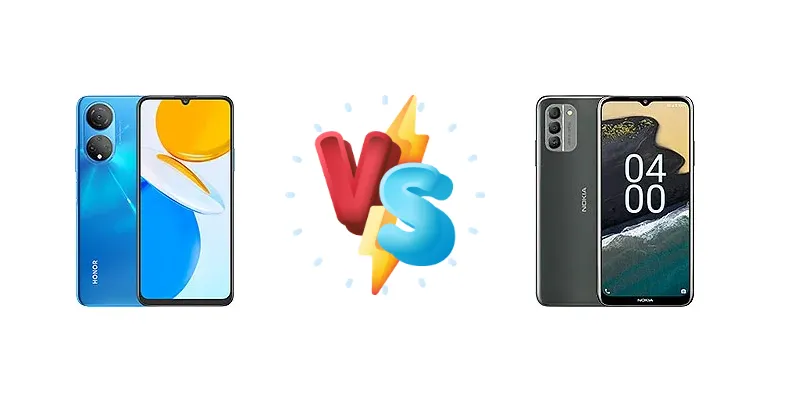
The Honor X7 and Nokia G400 represent compelling options in the sub-$200 smartphone market. While both aim to deliver essential features at an accessible price, they take different approaches to achieving this. The Honor X7 prioritizes efficiency with the Snapdragon 680, while the Nokia G400 opts for 5G connectivity via the Snapdragon 480+ – but at what cost to overall performance and battery life?
🏆 Quick Verdict
For the average user prioritizing consistent performance and efficient power management, the Honor X7 emerges as the better choice. Its Snapdragon 680, built on a smaller 6nm process, offers a smoother experience for everyday tasks and light gaming, despite lacking 5G. The Nokia G400’s 5G is appealing, but the Snapdragon 480+ struggles to deliver comparable sustained performance.
| Network |
|---|
| 2G bands | GSM 850 / 900 / 1800 / 1900 | GSM 850 / 900 / 1800 / 1900 |
| 3G bands | HSDPA 850 / 900 / 2100 | HSDPA 850 / 1700(AWS) / 1900 |
| 4G bands | LTE | 2, 4, 5, 12, 13, 25, 26, 41, 66, 71 |
| 5G bands | - | 2, 5, 25, 41, 66, 71, 77 SA/NSA |
| Speed | HSPA, LTE | HSPA, LTE, 5G |
| Technology | GSM / HSPA / LTE | GSM / HSPA / LTE / 5G |
| Launch |
|---|
| Announced | 2022, March 30 | 2022, January 05 |
| Status | Available. Released 2022, April 14 | Available. Released 2022, August 24 |
| Body |
|---|
| Build | Glass front, plastic back, plastic frame | Glass front (Gorilla Glass 3), aluminum frame |
| Dimensions | 167.6 x 77.2 x 8.6 mm (6.60 x 3.04 x 0.34 in) | 166.4 x 76.7 x 8.8 mm (6.55 x 3.02 x 0.35 in) |
| SIM | · Nano-SIM· Nano-SIM + Nano-SIM | Nano-SIM |
| Weight | 198 g (6.98 oz) | 198 g (6.98 oz) |
| Display |
|---|
| Protection | - | Corning Gorilla Glass 3 |
| Resolution | 720 x 1600 pixels, 20:9 ratio (~260 ppi density) | 1080 x 2408 pixels, 20:9 ratio (~401 ppi density) |
| Size | 6.74 inches, 109.7 cm2 (~84.8% screen-to-body ratio) | 6.58 inches, 104.3 cm2 (~81.7% screen-to-body ratio) |
| Type | IPS LCD, 90Hz | IPS LCD, 120Hz |
| Platform |
|---|
| CPU | Octa-core (4x2.4 GHz Kryo 265 Gold & 4x1.9 GHz Kryo 265 Silver) | Octa-core (2x2.2 GHz Kryo 460 & 6x1.9 GHz Kryo 460) |
| Chipset | Qualcomm SM6225 Snapdragon 680 4G (6 nm) | Qualcomm SM4350-AC Snapdragon 480+ 5G (8 nm) |
| GPU | Adreno 610 | Adreno 619 |
| OS | Android 11, Magic UI 4.2 | Android 12 |
| Memory |
|---|
| Card slot | microSDXC (uses shared SIM slot) | microSDXC (dedicated slot) |
| Internal | 128GB 4GB RAM, 128GB 6GB RAM | 64GB 4GB RAM |
| | eMMC 5.1 | - |
| Main Camera |
|---|
| Dual | 48 MP, f/1.8, (wide), PDAF
5 MP, f/2.2, (ultrawide)
2 MP (macro)
Auxiliary lens | - |
| Features | LED flash, HDR, panorama | LED flash, HDR, panorama |
| Single | 8 MP, f/2.0, (wide) | 16 MP, (wide) |
| Triple | - | 48 MP, f/1.8, (wide), PDAF
5 MP, f/2.2, 115˚ (ultrawide)
Auxiliary lens |
| Video | 1080p@30fps | 1080p@30/60fps |
| Selfie camera |
|---|
| Single | 8 MP, f/2.0, (wide) | 16 MP, (wide) |
| Video | 1080p@30fps | 1080p@30fps |
| Sound |
|---|
| 3.5mm jack | Yes | Yes |
| 35mm jack | Yes | Yes |
| Loudspeaker | Yes | Yes |
| Comms |
|---|
| Bluetooth | 5.1, A2DP, LE | 5.1, A2DP, LE, aptX HD, aptX Adaptive |
| NFC | Yes (market/region dependent) | Yes |
| Positioning | GPS, BDS | GPS, GALILEO |
| Radio | No | FM radio |
| USB | USB Type-C 2.0, OTG | USB Type-C 2.0, OTG |
| WLAN | Wi-Fi 802.11 a/b/g/n/ac, dual-band, Wi-Fi Direct | Wi-Fi 802.11 b/g/n/ac |
| Features |
|---|
| Sensors | Fingerprint (side-mounted), accelerometer, compass | Fingerprint (side-mounted), accelerometer, gyro, proximity, compass, barometer |
| | Virtual proximity sensing | - |
| Battery |
|---|
| Charging | 22.5W wired | 20W wired, PD3.0 |
| Type | Li-Po 5000 mAh | Li-Po 5000 mAh |
| Misc |
|---|
| Colors | Ocean Blue, Titanium Silver | Meteor Grey |
| Models | CMA-LX2, CMA-LX1, CMA-LX3 | TA-1530, TA-1448, TA-1476, N1530DL |
| Price | About 90 EUR | About 70 EUR |
| SAR | - | 1.05 W/kg (head) 1.09 W/kg (body) |
Honor X7
- More efficient Snapdragon 680 processor
- Potentially longer battery life
- Faster 22.5W charging
- Lacks 5G connectivity
- Likely less impressive camera performance in low light
Nokia G400
- 5G connectivity for faster data speeds
- PD3.0 charging support
- Larger display size
- Less efficient Snapdragon 480+ processor
- Shorter battery life
- Potential for thermal throttling
Display Comparison
Neither device boasts a standout display. Both likely utilize LCD panels, a common cost-saving measure in this segment. The focus here is on functionality rather than fidelity. While specific display specs are unavailable, the Nokia G400’s larger 6.6-inch display (versus the X7’s 6.75-inch) may offer a slightly more immersive viewing experience, but this is offset by the lower pixel density expected with the 480+ chipset’s processing demands. Bezels are likely comparable, prioritizing affordability over premium aesthetics.
Camera Comparison
Without detailed camera specs, a direct comparison is difficult. However, both phones likely employ similar budget camera setups. The focus will be on software processing rather than high-end hardware. The Snapdragon 680’s image signal processor (ISP) in the X7 may offer slightly better image quality in good lighting conditions due to its more efficient processing capabilities. The Nokia G400’s 5G modem may introduce additional noise during image capture due to electromagnetic interference, though this is speculative. Expect both to struggle in low-light scenarios.
Performance
The core difference lies in the chipsets. The Honor X7’s Snapdragon 680 (6nm) is architecturally more efficient than the Nokia G400’s Snapdragon 480+ (8nm). The 6nm process allows for higher transistor density and lower power consumption, translating to better thermal management and sustained performance. While the 480+ boasts 5G connectivity, its CPU configuration (2x2.2 GHz Kryo 460 & 6x1.9 GHz Kryo 460) is less optimized for multi-core tasks compared to the X7’s (4x2.4 GHz Kryo 265 Gold & 4x1.9 GHz Kryo 265 Silver). This means the X7 will likely handle multitasking and more demanding apps more smoothly. The 480+’s 5G modem also contributes to increased power draw.
Battery Life
The Honor X7’s Snapdragon 680’s efficiency gives it a clear advantage in battery life. While specific battery capacities are not provided, the 6nm process allows for more efficient power usage. The Nokia G400’s 5G modem and less efficient chipset will drain the battery faster, especially when connected to a 5G network. The X7’s 22.5W charging is also slightly faster than the G400’s 20W, with PD3.0 support on the G400 offering potentially faster charging with a compatible charger, but the overall time to full charge will likely be similar.
Buying Guide
Buy the Honor X7 if you need a reliable daily driver with good battery life and a responsive user experience for common tasks like browsing, social media, and streaming. It’s ideal for users who don’t heavily rely on 5G connectivity. Buy the Nokia G400 if 5G is a non-negotiable requirement and you’re willing to accept some performance compromises and potentially shorter battery life. It suits users who frequently travel or live in areas with strong 5G coverage and need occasional faster data speeds.
Frequently Asked Questions
❓ Will the Nokia G400’s 5G actually make a noticeable difference in my daily use?
The benefit of 5G on the Nokia G400 depends heavily on your location and carrier coverage. If you live in an area with limited 5G access, you’ll rarely experience the faster speeds. Even with 5G, the Snapdragon 480+’s processing limitations may bottleneck the experience, preventing you from fully utilizing the increased bandwidth.
❓ Is the Snapdragon 480+ known to overheat during extended gaming sessions?
The Snapdragon 480+ is prone to thermal throttling under sustained load. While it can handle casual gaming, demanding titles will likely experience frame drops and reduced performance as the chip heats up. The Honor X7’s Snapdragon 680, with its more efficient 6nm process, will maintain more consistent performance during gaming.
❓ Does either phone support fast storage standards like UFS 2.2 or higher?
Given the price point, it's unlikely either phone utilizes UFS 2.2 or higher. Expect both to use eMMC storage, which is slower but more cost-effective. This will impact app loading times and overall system responsiveness.
❓ How will software updates be handled on each device?
Honor’s software update track record is improving, but typically lags behind Nokia. Nokia, backed by HMD Global, generally offers more consistent and timely Android updates, including security patches. This is a significant advantage for long-term security and feature support.