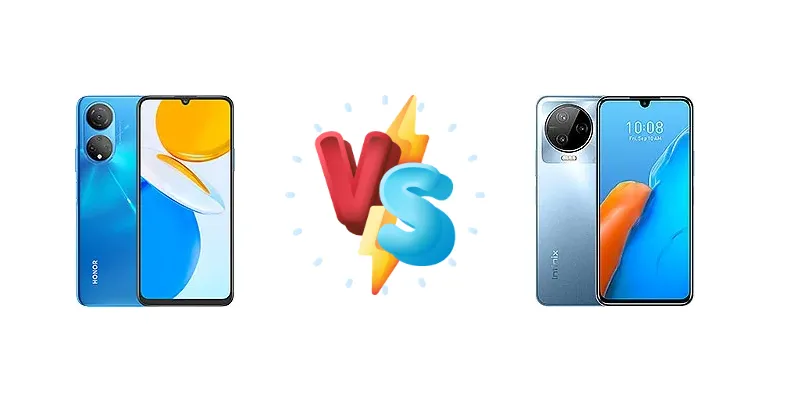
The Honor X7 and Infinix Note 12 (2023) represent compelling options in the crowded budget smartphone market. Both aim to deliver a solid experience without breaking the bank, but they take different approaches to achieving this. The X7 leverages Qualcomm's Snapdragon 680, while the Note 12 (2023) opts for MediaTek's Helio G99. This comparison dives deep into the specifics to determine which device offers the best value.
🏆 Quick Verdict
For the average user prioritizing fast charging and slightly better overall performance, the Infinix Note 12 (2023) is the stronger choice. Its 33W charging significantly reduces downtime, and the Helio G99 offers a modest performance advantage over the Snapdragon 680. However, the Honor X7 remains a viable option for those seeking a reliable and efficient device.
| Network |
|---|
| 2G bands | GSM 850 / 900 / 1800 / 1900 | GSM 850 / 900 / 1800 / 1900 |
| 3G bands | HSDPA 850 / 900 / 2100 | HSDPA 850 / 900 / 1700(AWS) / 1900 / 2100 |
| 4G bands | LTE | 1, 2, 3, 4, 5, 7, 8, 20, 28, 38, 40, 41 |
| Speed | HSPA, LTE | HSPA, LTE |
| Technology | GSM / HSPA / LTE | GSM / HSPA / LTE |
| | - | 1, 3, 5, 8, 38, 40, 41 |
| Launch |
|---|
| Announced | 2022, March 30 | 2022, October 06 |
| Status | Available. Released 2022, April 14 | Available. Released 2022, October 06 |
| Body |
|---|
| Build | Glass front, plastic back, plastic frame | Glass front, plastic frame, plastic back |
| Dimensions | 167.6 x 77.2 x 8.6 mm (6.60 x 3.04 x 0.34 in) | 164.4 x 76.5 x 7.8 mm (6.47 x 3.01 x 0.31 in) |
| SIM | · Nano-SIM· Nano-SIM + Nano-SIM | Nano-SIM + Nano-SIM |
| Weight | 198 g (6.98 oz) | 195 g (6.88 oz) |
| Display |
|---|
| Resolution | 720 x 1600 pixels, 20:9 ratio (~260 ppi density) | 1080 x 2400 pixels, 20:9 ratio (~393 ppi density) |
| Size | 6.74 inches, 109.7 cm2 (~84.8% screen-to-body ratio) | 6.7 inches, 108.4 cm2 (~86.2% screen-to-body ratio) |
| Type | IPS LCD, 90Hz | AMOLED |
| Platform |
|---|
| CPU | Octa-core (4x2.4 GHz Kryo 265 Gold & 4x1.9 GHz Kryo 265 Silver) | Octa-core (2x2.2 GHz Cortex-A76 & 6x2.0 GHz Cortex-A55) |
| Chipset | Qualcomm SM6225 Snapdragon 680 4G (6 nm) | Mediatek Helio G99 (6 nm) |
| GPU | Adreno 610 | Mali-G57 MC2 |
| OS | Android 11, Magic UI 4.2 | Android 12, XOS 10.6 |
| Memory |
|---|
| Card slot | microSDXC (uses shared SIM slot) | microSDXC (dedicated slot) |
| Internal | 128GB 4GB RAM, 128GB 6GB RAM | 128GB 8GB RAM, 256GB 8GB RAM |
| | eMMC 5.1 | - |
| Main Camera |
|---|
| Dual | 48 MP, f/1.8, (wide), PDAF
5 MP, f/2.2, (ultrawide)
2 MP (macro)
Auxiliary lens | - |
| Features | LED flash, HDR, panorama | Quad-LED flash, HDR, panorama |
| Single | 8 MP, f/2.0, (wide) | 16 MP, (wide) |
| Triple | - | 50 MP, f/1.6, (wide), PDAF
Auxiliary lenses |
| Video | 1080p@30fps | 1440p@30fps |
| Selfie camera |
|---|
| Single | 8 MP, f/2.0, (wide) | 16 MP, (wide) |
| Video | 1080p@30fps | 1440p@30fps |
| Sound |
|---|
| 3.5mm jack | Yes | Yes |
| 35mm jack | Yes | Yes |
| Loudspeaker | Yes | Yes, with dual speakers |
| Comms |
|---|
| Bluetooth | 5.1, A2DP, LE | Yes |
| NFC | Yes (market/region dependent) | Yes |
| Positioning | GPS, BDS | GPS |
| Radio | No | FM radio |
| USB | USB Type-C 2.0, OTG | USB Type-C 2.0, OTG |
| WLAN | Wi-Fi 802.11 a/b/g/n/ac, dual-band, Wi-Fi Direct | Wi-Fi 802.11 a/b/g/n/ac, dual-band |
| Features |
|---|
| Sensors | Fingerprint (side-mounted), accelerometer, compass | Fingerprint (side-mounted), accelerometer, gyro, proximity, compass |
| | Virtual proximity sensing | 24-bit/192kHz audio |
| Battery |
|---|
| Charging | 22.5W wired | 33W wired |
| Type | Li-Po 5000 mAh | 5000 mAh |
| Misc |
|---|
| Colors | Ocean Blue, Titanium Silver | Volcanic Grey, Tuscany Blue, Alpine White |
| Models | CMA-LX2, CMA-LX1, CMA-LX3 | X676C |
| Price | About 90 EUR | About 220 EUR |
Honor X7
- Qualcomm Snapdragon 680 offers reliable performance.
- 6nm process for improved power efficiency.
- Generally stable software experience (typical of Honor).
- Slower 22.5W charging.
- Helio G99 offers a performance edge in multitasking.
Infinix Note 12 (2023)
- Faster 33W wired charging.
- MediaTek Helio G99 provides better sustained performance.
- Cortex-A76 cores offer improved single-core performance.
- Software optimization can be more aggressive.
- Potential for more bloatware.
Display Comparison
Neither device boasts a standout display. Both likely utilize LCD panels, common in this price bracket. While specific details like peak brightness and color accuracy are unavailable, the focus here is on processing power. Display quality will likely be similar, with both offering adequate viewing experiences for everyday tasks. Bezels are expected to be moderate, typical of budget devices.
Camera Comparison
Without detailed camera specs, a direct comparison is difficult. Both phones likely feature a multi-camera setup with a primary sensor and supporting lenses. However, the quality of image processing and sensor size will be crucial. We can assume both will include a 2MP macro lens, which offers limited practical benefit due to its low resolution. The Helio G99’s ISP (Image Signal Processor) may offer slightly more advanced features, but the overall camera experience will heavily depend on software optimization.
Performance
The core difference lies in the chipsets. The Infinix Note 12 (2023) features the MediaTek Helio G99 (6nm), utilizing a dual-core Cortex-A76 setup paired with six Cortex-A55 cores clocked at 2.2 GHz and 2.0 GHz respectively. This architecture prioritizes sustained performance. The Honor X7, on the other hand, employs the Qualcomm Snapdragon 680 (6nm) with a more traditional octa-core configuration (4x2.4 GHz Kryo 265 Gold & 4x1.9 GHz Kryo 265 Silver). While the Snapdragon 680 offers a higher clock speed on its performance cores, the Helio G99’s Cortex-A76 cores are more efficient and deliver better single-core performance, translating to snappier app launches and smoother multitasking. The 6nm process node on both chips contributes to improved power efficiency, but the Helio G99’s architecture gives it a slight edge in sustained workloads.
Battery Life
The Infinix Note 12 (2023) takes a clear lead in charging speed with its 33W wired charging capability. This will significantly reduce charging times compared to the Honor X7’s 22.5W charging. While battery capacity isn’t specified, the faster charging of the Note 12 (2023) mitigates any potential disadvantage from a slightly smaller battery. Users who frequently find themselves needing to top up their phone will greatly benefit from the Note 12’s faster charging.
Buying Guide
Buy the Honor X7 if you prioritize a proven, efficient chipset and a generally stable software experience. It's ideal for users who primarily use their phone for communication, social media, and light web browsing. Buy the Infinix Note 12 (2023) if you value faster charging speeds and a bit more processing power for gaming or multitasking. This phone is better suited for users who demand more from their device and don't mind potentially more aggressive software optimization.
Frequently Asked Questions
❓ Does the MediaTek Helio G99 in the Infinix Note 12 (2023) get noticeably hot during extended gaming sessions?
The Helio G99 is designed with efficiency in mind, and the 6nm process helps manage thermals. While some heat is inevitable during prolonged gaming, the G99 generally performs well without significant throttling. However, sustained peak performance may lead to moderate warming, which is typical for phones in this price range.
❓ Is the 2MP macro camera on either phone worth using for detailed close-up shots?
Unfortunately, the 2MP macro cameras on both the Honor X7 and Infinix Note 12 (2023) are largely marketing features. The low resolution results in images lacking detail and sharpness. While they can be used for very close-up shots, the quality is unlikely to be impressive, and you're better off using the main camera and cropping.
❓ Can the Infinix Note 12 (2023) handle popular games like PUBG Mobile at high frame rates?
The Helio G99 can run PUBG Mobile, but achieving consistently high frame rates (60fps or higher) will likely require lowering the graphics settings. The phone may be able to sustain 40-50fps on medium settings, providing a playable experience. Expect some frame drops during intense action sequences.
❓ How does the software experience differ between Honor's Magic UI and Infinix's XOS?
Honor's Magic UI is generally considered to be cleaner and more refined, with a focus on stability. Infinix's XOS, while feature-rich, often includes more pre-installed apps (bloatware) and can be more aggressive with its power management and notifications. This can lead to a less streamlined user experience.