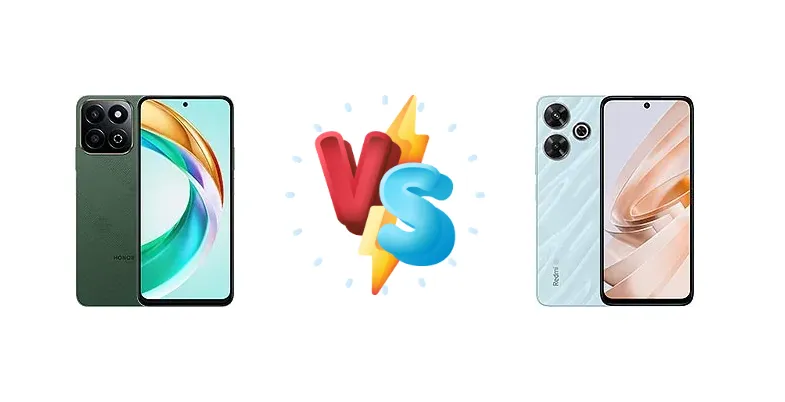
The Honor X6b and Xiaomi Redmi Note 13R represent the latest wave of aggressively priced smartphones aiming to deliver a compelling experience without breaking the bank. Both devices leverage Qualcomm's Snapdragon 4 series, but subtle differences in chipset and charging capabilities could make one a significantly better choice depending on your priorities. This comparison dissects those differences to help you decide.
🏆 Quick Verdict
For the average user prioritizing slightly better performance and reverse wireless charging, the Xiaomi Redmi Note 13R edges out the Honor X6b. The Snapdragon 4+ Gen 2 offers a modest CPU clock speed bump, and the overall package remains incredibly competitive in the sub-$200 price bracket.
| Network |
|---|
| 2G bands | GSM 850 / 900 / 1800 / 1900 | GSM 850 / 900 / 1800 / 1900 |
| 3G bands | HSDPA 850 / 900 / 1700(AWS) / 1900 / 2100 | HSDPA 850 / 900 / 2100 |
| 4G bands | LTE | 1, 3, 5, 8, 34, 38, 39, 40, 41 |
| 5G bands | SA/NSA | 1, 5, 8, 28, 41, 78 SA/NSA |
| Speed | HSPA, LTE, 5G | HSPA, LTE, 5G |
| Technology | GSM / HSPA / LTE / 5G | GSM / CDMA / HSPA / EVDO / LTE / 5G |
| Launch |
|---|
| Announced | 2025, June | 2024, May 17 |
| Status | Available. Released 2025, June | Available. Released 2024, May 17 |
| Body |
|---|
| Build | - | Glass front, plastic frame, glass back |
| Dimensions | 166.9 x 76.8 x 8.1 mm (6.57 x 3.02 x 0.32 in) | 168.6 x 76.3 x 8.2 mm (6.64 x 3.00 x 0.32 in) |
| SIM | Nano-SIM + Nano-SIM | Nano-SIM + Nano-SIM |
| Weight | 191 g or 193 g (6.74 oz) | 205 g (7.23 oz) |
| Display |
|---|
| Protection | Aluminosilicate glass | - |
| Resolution | 720 x 1610 pixels, 20:9 ratio (~261 ppi density) | 1080 x 2460 pixels (~396 ppi density) |
| Size | 6.77 inches, 110.2 cm2 (~86.0% screen-to-body ratio) | 6.79 inches, 109.5 cm2 (~85.1% screen-to-body ratio) |
| Type | TFT LCD, 120Hz, 850 nits (peak) | IPS LCD, 120Hz, 550 nits |
| Platform |
|---|
| CPU | Octa-core (2x2.2 GHz Cortex-A78 & 6x1.95 GHz Cortex-A55) | Octa-core (2x2.3 GHz Cortex-A78 & 6x1.95 GHz Cortex-A55) |
| Chipset | Qualcomm SM4450 Snapdragon 4 Gen 2 (4 nm) | Qualcomm SM4450 Snapdragon 4+ Gen 2 (4 nm) |
| GPU | Adreno 613 | Adreno 613 |
| OS | Android 14, MagicOS 8 | Android 14, HyperOS |
| Memory |
|---|
| Card slot | No | No |
| Internal | 256GB 4GB RAM | 128GB 6GB RAM, 128GB 8GB RAM, 256GB 8GB RAM, 256GB 12GB RAM, 512GB 12GB RAM |
| Main Camera |
|---|
| Dual | 50 MP, f/1.8, (wide), PDAF
Auxiliary lens | 50 MP, f/1.8, (wide), 1/2.76", 0.64µm, PDAF
2 MP (macro) |
| Features | LED flash, HDR | LED flash, HDR |
| Video | 1080p@30fps | 1080p@30fps |
| Selfie camera |
|---|
| Single | 5 MP, f/2.2, (wide) | 8 MP, (wide), 1/4.0", 1.12µm |
| Video | 1080p@30fps | 1080p@30fps |
| Sound |
|---|
| 35mm jack | Yes | Yes |
| Loudspeaker | Yes, with stereo speakers | Yes |
| Comms |
|---|
| Bluetooth | 5.0, A2DP, LE | 5.3, A2DP, LE |
| Infrared port | - | Yes |
| NFC | Yes (market/region dependent) | Yes |
| Positioning | GPS, GLONASS, GALILEO, BDS | GPS, GLONASS, GALILEO, BDS |
| Radio | No | No |
| USB | USB Type-C 2.0, OTG | USB Type-C |
| WLAN | Wi-Fi 802.11 a/b/g/n/ac, dual-band, Wi-Fi Direct | Wi-Fi 802.11 a/b/g/n/ac, dual-band |
| Features |
|---|
| Sensors | Fingerprint (side-mounted), accelerometer, proximity, compass | Fingerprint (side-mounted), accelerometer, compass |
| Battery |
|---|
| Charging | 35W wired
Reverse wired | 33W wired |
| Type | Li-Po 5200 mAh | 5030 mAh |
| Misc |
|---|
| Colors | Midnight Black, Forest Green | Black, Blue, Silver |
| Models | - | 2406ERN9CC |
| Price | - | About 180 EUR |
Honor X6b
- Faster 35W charging
- Reverse wired charging capability
- Potentially more refined software experience (Honor MagicOS)
- Slightly slower processor (Snapdragon 4 Gen 2)
- May have less aggressive pricing
Xiaomi Redmi Note 13R
- Faster processor (Snapdragon 4+ Gen 2)
- Competitive pricing
- MIUI offers extensive customization options
- Slower 33W charging
- No reverse charging
Display Comparison
Both the Honor X6b and Redmi Note 13R are expected to feature LCD panels, typical for this price segment. While specific details like peak brightness and color gamut coverage are currently unavailable, the focus here is on the processing power driving the display. The absence of high refresh rates is standard, prioritizing battery life. Bezels are likely to be similar, with the overall display experience geared towards practicality rather than visual extravagance.
Camera Comparison
Without detailed camera specifications, a direct comparison is challenging. However, both phones will likely feature a primary camera paired with depth and macro sensors. The quality will heavily rely on the main sensor’s resolution and aperture. Given the price point, expect competent daylight photography but limited low-light performance. The Redmi Note 13R may benefit from slightly improved image signal processing (ISP) capabilities inherent in the Snapdragon 4+ Gen 2, potentially leading to better dynamic range and noise reduction. The inclusion of a 2MP macro camera on both devices is largely a marketing tactic and offers limited practical value.
Performance
The core difference lies in the chipsets: the Honor X6b utilizes the Qualcomm SM4450 Snapdragon 4 Gen 2, while the Redmi Note 13R boasts the SM4450 Snapdragon 4+ Gen 2. The ‘+’ variant signifies a slight performance uplift, specifically a 0.1 GHz increase in the Cortex-A78 prime core clock speed (2.3 GHz vs 2.2 GHz). While seemingly minor, this can translate to a marginally snappier experience in demanding applications. Both chips are built on a power-efficient 4nm process, ensuring good thermal management. The identical RAM configuration (likely LPDDR4X) means memory bandwidth won’t be a differentiating factor. The Snapdragon 4+ Gen 2 will likely offer a small edge in sustained performance due to slightly improved thermal headroom.
Battery Life
The Honor X6b features 35W wired charging, while the Redmi Note 13R is limited to 33W. This 2W difference translates to a potentially faster 0-100% charge time for the Honor X6b, though the actual difference will likely be minimal in real-world usage. Both phones are expected to have battery capacities around 5000mAh, providing all-day battery life for moderate users. The Honor X6b also includes reverse wired charging, a feature absent on the Redmi Note 13R, allowing it to act as a power bank for other devices.
Buying Guide
Buy the Honor X6b if you value a slightly more established brand reputation and prioritize a potentially more refined software experience. Buy the Xiaomi Redmi Note 13R if you want the marginally faster processor, the convenience of reverse wired charging, and are comfortable with Xiaomi’s MIUI software ecosystem. Both are excellent choices for first-time smartphone buyers or those seeking a reliable secondary device.
Frequently Asked Questions
❓ Will the Snapdragon 4+ Gen 2 in the Redmi Note 13R handle demanding games like PUBG Mobile?
While the Snapdragon 4+ Gen 2 isn't a gaming powerhouse, it should be capable of running PUBG Mobile at medium settings with reasonable frame rates. Expect some frame drops during intense action, but the experience should be playable. Optimizing in-game settings is crucial for a smoother experience.
❓ How significant is the difference in charging speed between 33W and 35W?
The difference between 33W and 35W charging is relatively small. You can expect the Honor X6b to charge approximately 5-10% faster, translating to around 10-15 minutes saved for a full charge. This difference is more noticeable for topping up the battery quickly rather than a full 0-100% charge.
❓ Is the reverse wired charging on the Honor X6b useful in everyday scenarios?
Reverse wired charging is a convenient feature for emergencies. It allows you to use the Honor X6b to charge accessories like wireless earbuds or even another smartphone, albeit at a slower rate. It's not a primary charging method, but it can be a lifesaver when you're on the go and a power outlet isn't available.