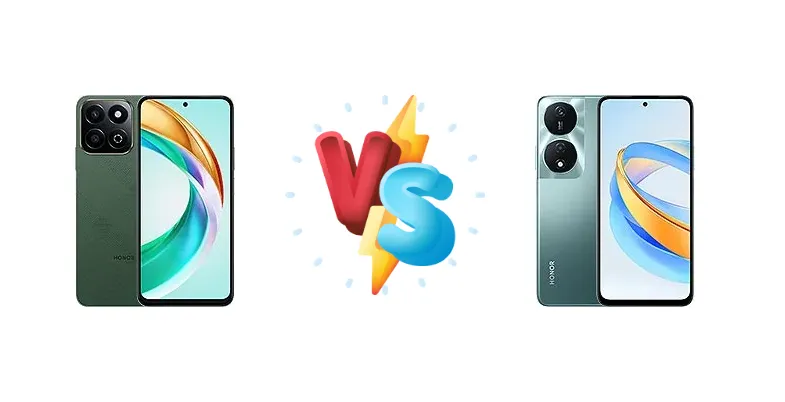
Honor's X series consistently delivers impressive value, but the X6b and X7b 5G represent distinct approaches. The X6b leverages Qualcomm's efficient Snapdragon 4 Gen 2, while the X7b 5G opts for MediaTek's Dimensity 6020, adding 5G connectivity. This comparison dissects these key differences to determine which phone best suits your needs.
🏆 Quick Verdict
For most users, the Honor X7b 5G (50 MP) emerges as the stronger choice. The inclusion of 5G connectivity, coupled with a CPU architecture that, while older, offers comparable performance, provides a more future-proof and versatile experience. However, the X6b's more modern 4nm process offers potential efficiency gains.
| Network |
|---|
| 2G bands | GSM 850 / 900 / 1800 / 1900 | GSM 850 / 900 / 1800 / 1900 |
| 3G bands | HSDPA 850 / 900 / 1700(AWS) / 1900 / 2100 | HSDPA 850 / 900 / 1900 / 2100 |
| 4G bands | LTE | LTE |
| 5G bands | SA/NSA | SA/NSA |
| Speed | HSPA, LTE, 5G | HSPA, LTE, 5G |
| Technology | GSM / HSPA / LTE / 5G | GSM / HSPA / LTE / 5G |
| Launch |
|---|
| Announced | 2025, June | 2024, June |
| Status | Available. Released 2025, June | Available. Released 2024, June |
| Body |
|---|
| Dimensions | 166.9 x 76.8 x 8.1 mm (6.57 x 3.02 x 0.32 in) | 166.7 x 76.5 x 8.2 mm (6.56 x 3.01 x 0.32 in) |
| SIM | Nano-SIM + Nano-SIM | Nano-SIM + Nano-SIM |
| Weight | 191 g or 193 g (6.74 oz) | 199 g (7.02 oz) |
| Display |
|---|
| Protection | Aluminosilicate glass | - |
| Resolution | 720 x 1610 pixels, 20:9 ratio (~261 ppi density) | 1080 x 2412 pixels, 20:9 ratio (~389 ppi density) |
| Size | 6.77 inches, 110.2 cm2 (~86.0% screen-to-body ratio) | 6.8 inches, 111.3 cm2 (~87.3% screen-to-body ratio) |
| Type | TFT LCD, 120Hz, 850 nits (peak) | IPS LCD, 90Hz, 850 nits (peak) |
| Platform |
|---|
| CPU | Octa-core (2x2.2 GHz Cortex-A78 & 6x1.95 GHz Cortex-A55) | Octa-core (2x2.2 GHz Cortex-A76 & 6x2.0 GHz Cortex-A55) |
| Chipset | Qualcomm SM4450 Snapdragon 4 Gen 2 (4 nm) | Mediatek Dimensity 6020 (7 nm) |
| GPU | Adreno 613 | Mali-G57 MC2 |
| OS | Android 14, MagicOS 8 | Android 13, Magic OS 7.2 |
| Memory |
|---|
| Card slot | No | No |
| Internal | 256GB 4GB RAM | 256GB 8GB RAM |
| Main Camera |
|---|
| Dual | 50 MP, f/1.8, (wide), PDAF
Auxiliary lens | 50 MP, f/1.8, (wide), PDAF
Auxiliary lens |
| Features | LED flash, HDR | LED flash, HDR, panorama |
| Video | 1080p@30fps | 1080p@30fps |
| Selfie camera |
|---|
| Single | 5 MP, f/2.2, (wide) | 8 MP, f/2.0, (wide) |
| Video | 1080p@30fps | 1080p@30fps |
| Sound |
|---|
| 35mm jack | Yes | Yes |
| Loudspeaker | Yes, with stereo speakers | Yes, with stereo speakers |
| Comms |
|---|
| Bluetooth | 5.0, A2DP, LE | 5.1, A2DP, LE, aptX HD |
| NFC | Yes (market/region dependent) | Yes (market/region dependent) |
| Positioning | GPS, GLONASS, GALILEO, BDS | GPS, GLONASS, GALILEO, BDS |
| Radio | No | No |
| USB | USB Type-C 2.0, OTG | USB Type-C 2.0, OTG |
| WLAN | Wi-Fi 802.11 a/b/g/n/ac, dual-band, Wi-Fi Direct | Wi-Fi 802.11 a/b/g/n/ac, dual-band, Wi-Fi Direct |
| Features |
|---|
| Sensors | Fingerprint (side-mounted), accelerometer, proximity, compass | Fingerprint (side-mounted), accelerometer, compass |
| Battery |
|---|
| Charging | 35W wired
Reverse wired | 35W wired |
| Type | Li-Po 5200 mAh | Li-Po 6000 mAh |
| Misc |
|---|
| Colors | Midnight Black, Forest Green | Crystal Silver, Emerald Green, Midnight Black |
| Price | - | About 200 EUR |
Honor X6b
- More efficient 4nm Snapdragon 4 Gen 2 chipset
- Potential for better sustained performance
- 35W fast charging
- Lacks 5G connectivity
- Camera specifications are unknown
- Older CPU architecture compared to X7b 5G
Honor X7b 5G (50 MP)
- 5G connectivity for faster data speeds
- 35W fast charging
- 50MP main camera sensor
- Less efficient 7nm Dimensity 6020 chipset
- Potentially more thermal throttling under load
- Older CPU architecture
Display Comparison
Neither Honor specifies display details beyond size. However, the core difference lies within. While both likely utilize LCD panels given the price point, the absence of detailed specs makes a direct comparison difficult. We anticipate both will offer adequate viewing angles and color reproduction for everyday use, but neither is likely to challenge flagship-level displays. Expect 60Hz refresh rates on both.
Camera Comparison
The Honor X7b 5G (50 MP) highlights a 50MP main sensor, suggesting a potential advantage in detail capture compared to the X6b, whose camera specs are not provided. However, megapixel count isn't everything; sensor size and image processing algorithms are crucial. Without knowing the sensor size on either device, it’s difficult to definitively declare a winner. Both phones likely include standard auxiliary lenses (depth, macro) which are typically of limited utility. Image processing will likely lean towards vibrant, social media-friendly results on both.
Performance
The chipset battle is central here. The Honor X6b’s Qualcomm Snapdragon 4 Gen 2 (4nm) features a newer architecture, utilizing Cortex-A78 cores for peak performance, paired with efficient A55 cores. The X7b 5G’s MediaTek Dimensity 6020 (7nm) employs older Cortex-A76 cores alongside A55s. While the A76 cores have a similar clock speed (2.2 GHz), the 7nm process is less efficient than the X6b’s 4nm node. This suggests the X6b *could* maintain performance for longer under sustained load, but the Dimensity 6020’s 5G modem is a significant advantage for users in 5G areas. Both phones likely feature similar RAM configurations, minimizing RAM-related performance bottlenecks.
Battery Life
Both devices feature 35W wired charging, promising reasonably quick top-ups. The actual battery capacity isn't specified, but given the target market, we can estimate capacities around 5000mAh for both. The Snapdragon 4 Gen 2’s 4nm process *should* translate to slightly better battery life during typical usage, offsetting any potential capacity differences. The 35W charging will likely deliver a full charge in approximately 1.5-2 hours for both devices.
Buying Guide
Buy the Honor X6b if you prioritize long-term efficiency and are content with Wi-Fi-only connectivity. Its Snapdragon 4 Gen 2 chipset, built on a 4nm process, promises better thermal management during sustained tasks. Buy the Honor X7b 5G (50 MP) if you need 5G access for faster data speeds and are willing to trade a slight potential efficiency advantage for broader network compatibility.
Frequently Asked Questions
❓ Will the Dimensity 6020 in the X7b 5G overheat during extended gaming sessions?
While the 7nm process isn't as efficient as the X6b's 4nm node, the Dimensity 6020 is a capable chipset for casual gaming. Expect some thermal throttling during prolonged, graphically intensive games, but it shouldn't render the phone unusable. The X6b may handle sustained loads slightly better.
❓ Is the 5G connectivity on the X7b 5G worth the extra cost if I don't have 5G coverage in my area?
If 5G isn't currently available, the immediate benefit is minimal. However, purchasing the X7b 5G future-proofs your device for when 5G infrastructure expands. It also typically offers slightly better 4G LTE performance compared to phones without 5G modems.
❓ How does the Snapdragon 4 Gen 2's efficiency translate to real-world battery life on the X6b?
The 4nm process allows the Snapdragon 4 Gen 2 to deliver more performance per watt. This means you can expect slightly longer battery life during typical usage – browsing, social media, and light gaming – compared to the X7b 5G. However, the difference will likely be noticeable only with moderate to heavy use.