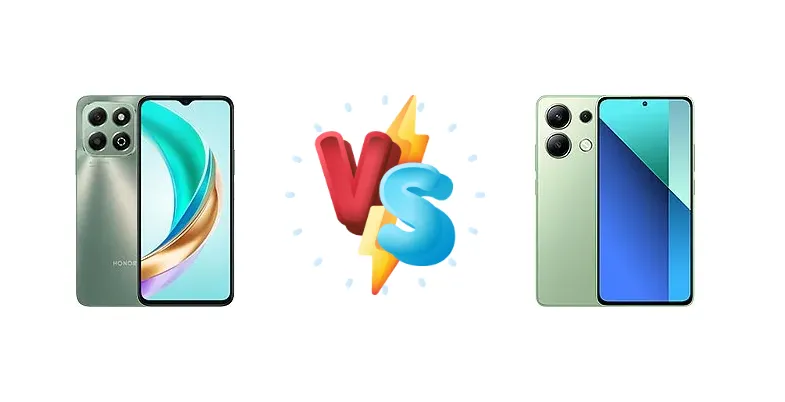
The sub-$200 4G smartphone market is fiercely competitive. Both the Honor X6b and Xiaomi Redmi Note 13 aim to deliver a compelling experience without breaking the bank. However, they take different approaches – Honor prioritizes fast charging, while Xiaomi focuses on display quality and a more efficient chipset. This comparison dissects the key differences to determine which phone offers the best value.
🏆 Quick Verdict
For the average user prioritizing all-day battery life and a brighter, more visible display, the Xiaomi Redmi Note 13 4G is the better choice. Its Snapdragon 685 chipset, while not a performance king, offers superior efficiency, translating to nearly 12 hours of active use. The Honor X6b’s faster charging is appealing, but doesn’t fully compensate for the less efficient Helio G85.
| Network |
|---|
| 2G bands | GSM 850 / 900 / 1800 / 1900 | GSM 850 / 900 / 1800 / 1900 |
| 3G bands | HSDPA 850 / 900 / 1900 / 2100 | HSDPA 850 / 900 / 2100 |
| 4G bands | LTE | 1, 3, 5, 7, 8, 20, 28, 38, 40, 41 |
| Speed | HSPA, LTE | HSPA, LTE |
| Technology | GSM / HSPA / LTE | GSM / HSPA / LTE |
| Launch |
|---|
| Announced | 2024, June 13 | 2024, January 15 |
| Status | Available. Released 2024, June | Available. Released 2024, January 15 |
| Body |
|---|
| Build | - | Glass front (Gorilla Glass 3), plastic frame, plastic back |
| Dimensions | 163.6 x 75.3 x 8.4 mm (6.44 x 2.96 x 0.33 in) | 162.3 x 75.6 x 8 mm (6.39 x 2.98 x 0.31 in) |
| SIM | Nano-SIM + Nano-SIM | Nano-SIM + Nano-SIM |
| Weight | 192 g (6.77 oz) | 188.5 g (6.67 oz) |
| Display |
|---|
| Protection | - | Corning Gorilla Glass 3 |
| Resolution | 720 x 1612 pixels, 20:9 ratio (~269 ppi density) | 1080 x 2400 pixels, 20:9 ratio (~395 ppi density) |
| Size | 6.56 inches, 103.4 cm2 (~83.9% screen-to-body ratio) | 6.67 inches, 107.4 cm2 (~87.5% screen-to-body ratio) |
| Type | TFT LCD, 90Hz, 780 nits (peak) | AMOLED, 120Hz, 960Hz PWM, 1800 nits (peak) |
| Platform |
|---|
| CPU | Octa-core (2x2.0 GHz Cortex-A75 & 6x1.8 GHz Cortex-A55) | Octa-core (4x2.8 GHz Cortex-A73 & 4x1.9 GHz Cortex-A53) |
| Chipset | Mediatek Helio G85 (12 nm) | Qualcomm SM6225 Snapdragon 685 (6 nm) |
| GPU | Mali-G52 MC2 | Adreno 610 |
| OS | Android 14, Magic OS 8 | Android 13, upgradable to Android 15, up to 3 major Android upgrades, HyperOS 2 |
| Memory |
|---|
| Card slot | microSDXC | microSDXC (uses shared SIM slot) |
| Internal | 128GB 4GB RAM, 128GB 6GB RAM, 128GB 8GB RAM, 256GB 4GB RAM, 256GB 6GB RAM, 256GB 8GB RAM | 128GB 6GB RAM, 128GB 8GB RAM, 256GB 6GB RAM, 256GB 8GB RAM, 512GB 8GB RAM |
| Main Camera |
|---|
| Dual | 50 MP, f/1.8, (wide), PDAF
Auxiliary lens | - |
| Features | LED flash, HDR, panorama | LED flash, HDR, panorama |
| Triple | - | 108 MP, f/1.8, 24mm (wide), 1/1.67", 0.64µm, PDAF
8 MP, f/2.2, 120˚, (ultrawide)
2 MP (macro) |
| Video | 1080p@30fps | 1080p@30fps |
| Selfie camera |
|---|
| Single | 5 MP, f/2.2, (wide) | 16 MP, f/2.4, (wide) |
| Video | 1080p@30fps | 1080p@30fps |
| Sound |
|---|
| 35mm jack | Yes | Yes |
| Loudspeaker | Yes | Yes, with stereo speakers |
| Comms |
|---|
| Bluetooth | 5.1, A2DP, LE, aptX HD | 5.1, A2DP, LE |
| Infrared port | - | Yes |
| NFC | Yes (JDY-LX1 only) | Yes (market/region dependent) |
| Positioning | GPS, GLONASS, GALILEO, BDS | GPS, GLONASS, GALILEO, BDS |
| Radio | No | Unspecified |
| USB | USB Type-C 2.0, OTG | USB Type-C 2.0, OTG |
| WLAN | Wi-Fi 802.11 a/b/g/n/ac, dual-band, Wi-Fi Direct | Wi-Fi 802.11 a/b/g/n/ac, dual-band |
| Features |
|---|
| Sensors | Fingerprint (side-mounted), accelerometer, proximity | Fingerprint (under display, optical), accelerometer, gyro, proximity, compass |
| Battery |
|---|
| Charging | 35W wired, 31% in 20 min | 33W wired, 50% in 29 min, 100% in 70 min |
| Type | Li-Po 5200 mAh | 5000 mAh |
| Misc |
|---|
| Colors | Forest Green, Starry Purple, Ocean Cyan, Midnight Black | Midnight Black, Mint Green, Ice Blue, Ocean Sunset |
| Models | JDY-LX1, JDY-LX2 | 23129RAA4G, 23124RA7EO, 23129RA5FL |
| Price | € 110.96 / $ 96.75 | $ 199.99 / £ 119.99 / € 135.52 |
| SAR | - | 0.98 W/kg (head) 0.49 W/kg (body) |
| SAR EU | - | 0.77 W/kg (head) 0.98 W/kg (body) |
Honor X6b 4G
- Faster 35W wired charging
- Potentially lower price point
- Cortex-A75 cores offer burst performance
- Less efficient Helio G85 chipset
- Likely lower display brightness
- Shorter battery life
Xiaomi Redmi Note 13 4G
- More efficient Snapdragon 685 chipset
- Significantly brighter 1313 nit display
- Longer battery life (11:52h active use)
- Slower 33W wired charging
- Potentially higher price point
- Cortex-A73 cores are older generation
Display Comparison
The Xiaomi Redmi Note 13 4G boasts a significantly brighter display, reaching a measured 1313 nits. This is a substantial advantage over what we’d expect from the Honor X6b, making the Redmi Note 13 far more usable outdoors under direct sunlight. While the Honor X6b’s panel specifics are unknown, the Redmi Note 13’s brightness alone is a major selling point. The Redmi Note 13’s panel likely uses a higher-quality glass, contributing to better clarity and viewing angles. We expect both phones to use IPS LCD panels, but the Redmi Note 13’s superior brightness and contrast will provide a more immersive experience.
Camera Comparison
Without detailed camera specs beyond sensor resolution, a direct comparison is difficult. However, the Redmi Note 13’s chipset generally offers better image signal processing (ISP) capabilities, potentially leading to more refined images. The Snapdragon 685’s ISP is known for its accurate color reproduction and effective noise reduction. We anticipate both phones will feature a primary camera, ultrawide, and depth sensor, but the Redmi Note 13’s image processing will likely provide a more consistent and pleasing result, especially in challenging lighting conditions. The presence or absence of Optical Image Stabilization (OIS) on either device is unknown, but would be a significant advantage for video recording.
Performance
The core difference lies in the chipsets. The Xiaomi Redmi Note 13 4G utilizes the Qualcomm Snapdragon 685, fabricated on a 6nm process. This smaller node size translates to improved power efficiency compared to the Honor X6b’s MediaTek Helio G85 (12nm). While the Helio G85 features Cortex-A75 cores clocked at 2.0 GHz, the Redmi Note 13’s Cortex-A73 cores, clocked at 2.8 GHz, offer a performance edge in single-core tasks. The Snapdragon 685’s architecture is also more modern, leading to better sustained performance and less thermal throttling during extended gaming sessions. The Honor X6b may feel snappier for basic tasks, but the Redmi Note 13 will handle demanding apps and multitasking more effectively.
Battery Life
The Xiaomi Redmi Note 13 4G shines in battery performance, achieving an impressive 11:52h of active use. This is likely due to the Snapdragon 685’s superior power efficiency. The Honor X6b, while offering 35W wired charging (reaching 31% in 20 minutes), doesn’t have the same endurance. The Redmi Note 13 takes 29 minutes to reach 50% and 70 minutes for a full charge with its 33W charging, but the longer runtime offsets the slower charging speed for most users. The Redmi Note 13’s efficiency means you’ll be reaching for the charger less often.
Buying Guide
Buy the Honor X6b 4G if you frequently find yourself needing to top up your phone quickly and value the convenience of 35W charging. This is ideal for users who don't mind carrying a charger and prioritize minimizing downtime. Buy the Xiaomi Redmi Note 13 4G if you prioritize long-lasting battery life, a brighter and more pleasant viewing experience, and a more efficient processor that will run cooler under sustained loads. This is the better option for users who want a phone that can comfortably last a full day on a single charge.
Frequently Asked Questions
❓ Does the Snapdragon 685 in the Redmi Note 13 struggle with graphically intensive games like PUBG Mobile?
While the Snapdragon 685 isn't a gaming powerhouse, it can handle PUBG Mobile at medium settings with reasonable frame rates. The 6nm process and improved thermal management will prevent significant throttling during extended gaming sessions, offering a more consistent experience than the Helio G85 in the Honor X6b.
❓ How much faster is the 35W charging on the Honor X6b compared to the 33W charging on the Redmi Note 13 in real-world use?
While the Honor X6b charges faster initially (31% in 20 minutes), the Redmi Note 13’s slower but more efficient charging cycle ultimately provides a more practical solution. The Redmi Note 13 reaches 100% in 70 minutes, while the Honor X6b’s full charge time is not specified, but is likely longer. The Redmi Note 13’s superior battery life means you’ll need to charge it less frequently.
❓ Is the difference in display brightness between the two phones noticeable in everyday use?
Absolutely. The 1313 nits peak brightness of the Redmi Note 13 makes a significant difference, especially outdoors or in brightly lit environments. The Honor X6b’s display will likely appear washed out in comparison, requiring you to seek shade or increase brightness, further impacting battery life.