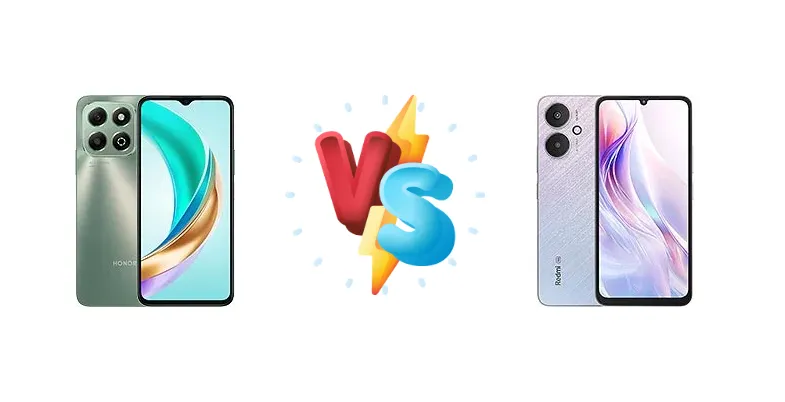
The sub-$200 smartphone market is fiercely competitive. The Honor X6b 4G and Xiaomi Redmi 13C 5G represent compelling options, but cater to different priorities. The X6b focuses on maximizing efficiency with a proven 4G chipset, while the Redmi 13C 5G leaps forward with 5G connectivity and a newer processor. This comparison dissects their strengths and weaknesses to help you choose the right device.
🏆 Quick Verdict
For most users, the Xiaomi Redmi 13C 5G is the better buy. Its Mediatek Dimensity 6100+ chipset offers a noticeable performance uplift and future-proofs with 5G connectivity, despite slower 18W charging. The Honor X6b 4G remains a viable option for those prioritizing a slightly more efficient processor and faster 35W charging, but the 5G advantage is significant.
| Network |
|---|
| 2G bands | GSM 850 / 900 / 1800 / 1900 | GSM 850 / 900 / 1800 / 1900 |
| 3G bands | HSDPA 850 / 900 / 1900 / 2100 | HSDPA 800 / 850 / 900 / 1700(AWS) / 1900 / 2100 - International |
| 4G bands | LTE | 1, 2, 3, 4, 5, 7, 8, 12, 13, 17, 18, 19, 20, 26, 28, 32, 38, 40, 41, 66 - International |
| 5G bands | - | 1, 3, 5, 7, 8, 20, 28, 38, 40, 41, 66, 77, 78 SA/NSA - International |
| Speed | HSPA, LTE | HSPA, LTE, 5G |
| Technology | GSM / HSPA / LTE | GSM / HSPA / LTE / 5G |
| Launch |
|---|
| Announced | 2024, June 13 | 2023, December 06 |
| Status | Available. Released 2024, June | Available. Released 2023, December 16 |
| Body |
|---|
| Build | - | Glass front (Gorilla Glass 3), plastic frame, plastic back |
| Dimensions | 163.6 x 75.3 x 8.4 mm (6.44 x 2.96 x 0.33 in) | 168.1 x 77.9 x 8.2 mm (6.62 x 3.07 x 0.32 in) |
| SIM | Nano-SIM + Nano-SIM | Nano-SIM + Nano-SIM |
| Weight | 192 g (6.77 oz) | 192 g or 195 g (6.77 oz) |
| Display |
|---|
| Protection | - | Corning Gorilla Glass 3 |
| Resolution | 720 x 1612 pixels, 20:9 ratio (~269 ppi density) | 720 x 1600 pixels, 20:9 ratio (~260 ppi density) |
| Size | 6.56 inches, 103.4 cm2 (~83.9% screen-to-body ratio) | 6.74 inches, 109.7 cm2 (~83.8% screen-to-body ratio) |
| Type | TFT LCD, 90Hz, 780 nits (peak) | IPS LCD, 90Hz, 450 nits (typ), 600 nits (HBM) |
| Platform |
|---|
| CPU | Octa-core (2x2.0 GHz Cortex-A75 & 6x1.8 GHz Cortex-A55) | Octa-core (2x2.2 GHz Cortex-A76 & 6x2.0 GHz Cortex-A55) |
| Chipset | Mediatek Helio G85 (12 nm) | Mediatek Dimensity 6100+ (6 nm) |
| GPU | Mali-G52 MC2 | Mali-G57 MC2 |
| OS | Android 14, Magic OS 8 | Android 13, MIUI 14 |
| Memory |
|---|
| Card slot | microSDXC | microSDXC (dedicated slot) |
| Internal | 128GB 4GB RAM, 128GB 6GB RAM, 128GB 8GB RAM, 256GB 4GB RAM, 256GB 6GB RAM, 256GB 8GB RAM | 64GB 4GB RAM, 128GB 4GB RAM, 128GB 6GB RAM, 256GB 8GB RAM |
| Main Camera |
|---|
| Dual | 50 MP, f/1.8, (wide), PDAF
Auxiliary lens | - |
| Features | LED flash, HDR, panorama | LED flash, HDR |
| Single | - | 50 MP, f/1.8, 28mm (wide), 1/2.76", 1.12µm, PDAF
Auxiliary lens |
| Video | 1080p@30fps | 1080p@30fps |
| Selfie camera |
|---|
| Features | - | HDR |
| Single | 5 MP, f/2.2, (wide) | 5 MP, f/2.2, (wide) |
| Video | 1080p@30fps | 1080p@30fps |
| Sound |
|---|
| 35mm jack | Yes | Yes |
| Loudspeaker | Yes | Yes |
| Comms |
|---|
| Bluetooth | 5.1, A2DP, LE, aptX HD | 5.3, A2DP, LE |
| NFC | Yes (JDY-LX1 only) | Yes (market/region dependent) |
| Positioning | GPS, GLONASS, GALILEO, BDS | GPS, GLONASS, GALILEO, BDS |
| Radio | No | FM radio |
| USB | USB Type-C 2.0, OTG | USB Type-C 2.0, OTG |
| WLAN | Wi-Fi 802.11 a/b/g/n/ac, dual-band, Wi-Fi Direct | Wi-Fi 802.11 a/b/g/n/ac, dual-band |
| Features |
|---|
| Sensors | Fingerprint (side-mounted), accelerometer, proximity | Fingerprint (side-mounted), accelerometer, compass |
| Battery |
|---|
| Charging | 35W wired, 31% in 20 min | 18W wired, PD |
| Type | Li-Po 5200 mAh | 5000 mAh |
| Misc |
|---|
| Colors | Forest Green, Starry Purple, Ocean Cyan, Midnight Black | Starry Black, Twilight Blue, Starry Silver, Starlight Black, Startrail Green, Startrail Silver |
| Models | JDY-LX1, JDY-LX2 | 23124RN87G, 23124RN87I, 23124RN87C |
| Price | € 110.96 / $ 96.75 | $ 198.99 / £ 119.00 / € 116.99 / ₹ 10,895 |
| SAR | - | 1.09 W/kg (head) 1.09 W/kg (body) |
| SAR EU | - | 0.98 W/kg (head) 0.98 W/kg (body) |
Honor X6b 4G
- Faster 35W wired charging
- Potentially slightly better power efficiency with Helio G85
- Reliable performance for basic tasks
- Lacks 5G connectivity
- Older chipset architecture
- Less powerful CPU for demanding apps
Xiaomi Redmi 13C 5G
- 5G connectivity for future-proofing
- More powerful Mediatek Dimensity 6100+ chipset
- Improved CPU architecture for smoother performance
- Slower 18W wired charging
- Potentially slightly lower battery life under heavy load
- May require a 5G enabled SIM
Display Comparison
Neither device boasts a standout display. Both likely utilize LCD panels, common in this price bracket. The key difference lies under the hood. While specific display specs are missing, the Redmi 13C 5G’s processor allows for potentially smoother animations. The Honor X6b’s Helio G85, while capable, may exhibit slight stuttering in demanding UI transitions. Bezels are expected to be similar on both, prioritizing cost-effectiveness over premium aesthetics.
Camera Comparison
Without detailed camera specs, it’s difficult to make a definitive judgment. However, both phones likely feature a primary camera paired with depth and macro sensors. Given the price point, image quality will be heavily reliant on software processing. The Redmi 13C 5G’s more powerful processor could potentially enable more sophisticated image processing algorithms, leading to better dynamic range and noise reduction. The Honor X6b’s ISP is adequate for basic photography, but will likely struggle in low-light conditions compared to the Redmi 13C 5G.
Performance
The performance gap is the most significant differentiator. The Xiaomi Redmi 13C 5G’s Mediatek Dimensity 6100+ (6nm) is a clear upgrade over the Honor X6b’s Helio G85 (12nm). The 6nm process node translates to improved power efficiency and thermal management, allowing the Dimensity 6100+ to sustain higher clock speeds for longer. The CPU architecture also favors the Redmi 13C 5G; its Cortex-A76 cores (2x2.2 GHz) outperform the X6b’s Cortex-A75 cores (2x2.0 GHz). This means faster app loading, smoother multitasking, and a better gaming experience. The 5G modem in the Redmi 13C 5G is a crucial advantage for future network compatibility.
Battery Life
The Honor X6b 4G’s 35W wired charging is a significant advantage over the Redmi 13C 5G’s 18W charging. The X6b can achieve a 31% charge in just 20 minutes, offering a quick top-up when time is limited. However, the Dimensity 6100+’s superior power efficiency may offset the slower charging speed in real-world usage. While battery capacity isn’t specified, the Redmi 13C 5G’s more efficient chipset could deliver comparable or even better all-day battery life despite the slower charging.
Buying Guide
Buy the Honor X6b 4G if you primarily need a reliable device for basic tasks, value faster charging speeds, and don't anticipate needing 5G connectivity in the near future. Buy the Xiaomi Redmi 13C 5G if you want a phone that can handle more demanding apps, benefit from 5G networks, and are willing to trade some charging speed for future-proofing and improved performance.
Frequently Asked Questions
❓ Will the Redmi 13C 5G overheat during prolonged gaming sessions?
The Mediatek Dimensity 6100+ is built on a 6nm process, which offers improved thermal efficiency compared to the 12nm Helio G85 in the Honor X6b. While it may get warm, it's less likely to experience significant throttling during extended gaming, providing a more consistent frame rate.
❓ Is the 4G connectivity of the Honor X6b a dealbreaker in 2024?
It depends on your location and network availability. If 5G coverage is limited in your area, the Honor X6b’s 4G connectivity may be sufficient. However, 5G networks are expanding rapidly, and choosing the Redmi 13C 5G future-proofs your device for faster data speeds and improved network performance.
❓ How much faster is the Dimensity 6100+ compared to the Helio G85 in real-world use?
You'll notice a difference in app loading times, multitasking, and overall system responsiveness. The Dimensity 6100+ offers roughly a 20-30% performance increase in CPU tasks and a more substantial improvement in GPU performance, making it better suited for gaming and demanding applications.