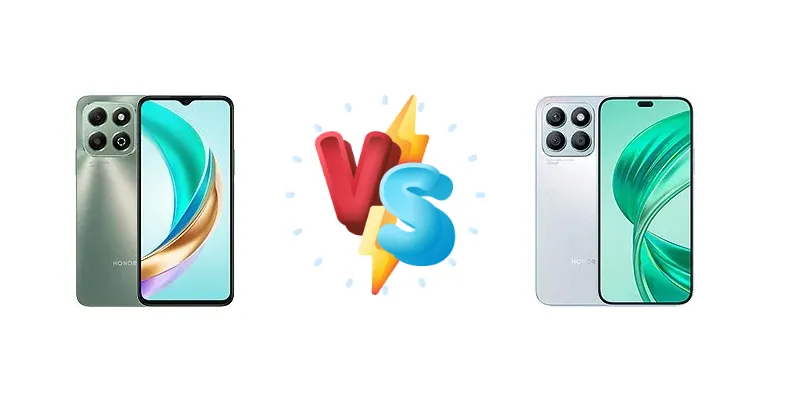
Honor's X series consistently delivers compelling value in the budget segment. The X6b 4G and X8b represent two distinct approaches to affordability. The X6b focuses on a balance of features, while the X8b leverages a more efficient chipset. This comparison dissects their key differences to determine which phone best suits your needs.
🏆 Quick Verdict
For most users, the Honor X8b emerges as the superior choice. Its Snapdragon 680 chipset, built on a 6nm process, offers a noticeable efficiency advantage over the X6b’s Helio G85, translating to better sustained performance and potentially longer battery life. While both charge at 35W, the X8b’s processor provides a smoother overall experience.
| Network |
|---|
| 2G bands | GSM 850 / 900 / 1800 / 1900 | GSM 850 / 900 / 1800 / 1900 |
| 3G bands | HSDPA 850 / 900 / 1900 / 2100 | HSDPA 850 / 900 / 1900 / 2100 |
| 4G bands | LTE | LTE |
| Speed | HSPA, LTE | HSPA, LTE |
| Technology | GSM / HSPA / LTE | GSM / HSPA / LTE |
| Launch |
|---|
| Announced | 2024, June 13 | 2023, December 14 |
| Status | Available. Released 2024, June | Available. Released 2023, December 22 |
| Body |
|---|
| Dimensions | 163.6 x 75.3 x 8.4 mm (6.44 x 2.96 x 0.33 in) | 161.1 x 74.6 x 6.8 mm (6.34 x 2.94 x 0.27 in) |
| SIM | Nano-SIM + Nano-SIM | Nano-SIM + Nano-SIM |
| Weight | 192 g (6.77 oz) | 166 g (5.86 oz) |
| Display |
|---|
| Resolution | 720 x 1612 pixels, 20:9 ratio (~269 ppi density) | 1080 x 2412 pixels, 20:9 ratio (~394 ppi density) |
| Size | 6.56 inches, 103.4 cm2 (~83.9% screen-to-body ratio) | 6.7 inches, 108.0 cm2 (~89.9% screen-to-body ratio) |
| Type | TFT LCD, 90Hz, 780 nits (peak) | AMOLED, 90Hz, 1200 nits (HBM), 2000 nits (peak) |
| Platform |
|---|
| CPU | Octa-core (2x2.0 GHz Cortex-A75 & 6x1.8 GHz Cortex-A55) | Octa-core (4x2.4 GHz Kryo 265 Gold & 4x1.9 GHz Kryo 265 Silver) |
| Chipset | Mediatek Helio G85 (12 nm) | Qualcomm SM6225 Snapdragon 680 4G (6 nm) |
| GPU | Mali-G52 MC2 | Adreno 610 |
| OS | Android 14, Magic OS 8 | Android 13, MagicOS 7.2 |
| Memory |
|---|
| Card slot | microSDXC | No |
| Internal | 128GB 4GB RAM, 128GB 6GB RAM, 128GB 8GB RAM, 256GB 4GB RAM, 256GB 6GB RAM, 256GB 8GB RAM | 128GB 8GB RAM, 256GB 6GB RAM, 256GB 8GB RAM, 512GB 8GB RAM |
| Main Camera |
|---|
| Dual | 50 MP, f/1.8, (wide), PDAF
Auxiliary lens | - |
| Features | LED flash, HDR, panorama | LED flash, HDR, panorama |
| Triple | - | 108 MP, f/1.8, 24mm (wide), 1/1.67", PDAF
5 MP, f/2.2, (ultrawide)
2 MP (macro) |
| Video | 1080p@30fps | 1080p@30fps |
| Selfie camera |
|---|
| Features | - | LED flash |
| Single | 5 MP, f/2.2, (wide) | 50 MP, f/2.1, (wide) |
| Video | 1080p@30fps | 1080p@30fps |
| Sound |
|---|
| 35mm jack | Yes | No |
| Loudspeaker | Yes | Yes |
| Comms |
|---|
| Bluetooth | 5.1, A2DP, LE, aptX HD | 5.0, A2DP, LE |
| NFC | Yes (JDY-LX1 only) | No |
| Positioning | GPS, GLONASS, GALILEO, BDS | GPS, GLONASS, GALILEO, BDS |
| Radio | No | No |
| USB | USB Type-C 2.0, OTG | USB Type-C 2.0, OTG |
| WLAN | Wi-Fi 802.11 a/b/g/n/ac, dual-band, Wi-Fi Direct | Wi-Fi 802.11 a/b/g/n/ac, dual-band, Wi-Fi Direct |
| Features |
|---|
| Sensors | Fingerprint (side-mounted), accelerometer, proximity | Fingerprint (side-mounted), accelerometer, compass |
| Battery |
|---|
| Charging | 35W wired, 31% in 20 min | 35W wired |
| Type | Li-Po 5200 mAh | Li-Po 4500 mAh |
| Misc |
|---|
| Colors | Forest Green, Starry Purple, Ocean Cyan, Midnight Black | Glamorous Green, Titanium Silver, Midnight Black, Blue |
| Models | JDY-LX1, JDY-LX2 | LLY-LX1, LLY-LX2, LLY-LX3 |
| Price | € 110.96 / $ 96.75 | $ 369.00 / € 219.99 |
Honor X6b 4G
- Potentially lower price point
- 35W fast charging
- Decent performance for basic tasks
- Less efficient Helio G85 chipset
- Likely slower app loading times
- Potentially shorter battery life
Honor X8b
- More efficient Snapdragon 680 chipset
- Smoother multitasking and app performance
- Potentially longer battery life
- Improved image processing capabilities
- May be slightly more expensive
- 35W fast charging (same as X6b)
- Still a 4G device
Display Comparison
Both devices lack detailed display specifications in the provided data. However, given their price points, we can anticipate both utilizing LCD panels. The key difference will likely be color calibration and peak brightness. Without further data, it's difficult to definitively state which offers a superior viewing experience, but the X8b's more powerful processor *could* allow for more sophisticated image processing to enhance display quality.
Camera Comparison
Without sensor details, a direct camera comparison is limited. However, the chipset plays a role in image signal processing (ISP). The Snapdragon 680’s ISP is likely more advanced, potentially resulting in better dynamic range and noise reduction in photos and videos captured on the X8b. The absence of information regarding OIS or sensor size suggests both phones will rely heavily on software processing to compensate for limitations. It's reasonable to assume both phones will feature a primary camera and depth/macro sensors, but the X8b’s processing power will likely yield superior results.
Performance
The core difference lies in the chipsets. The Honor X8b’s Qualcomm Snapdragon 680 (6nm) boasts a more modern architecture and a smaller fabrication process compared to the Honor X6b’s MediaTek Helio G85 (12nm). This 6nm process is crucial; it allows for greater transistor density and improved power efficiency. The Snapdragon 680’s CPU configuration – 4x2.4 GHz Kryo 265 Gold & 4x1.9 GHz Kryo 265 Silver – also provides a performance edge over the X6b’s 2x2.0 GHz Cortex-A75 & 6x1.8 GHz Cortex-A55. This translates to faster app loading times and smoother multitasking on the X8b. While both are 4G devices, the Snapdragon’s integrated modem may offer slightly improved connectivity.
Battery Life
Both phones feature 35W wired charging, which is competitive in this price range. The X6b claims a 31% charge in 20 minutes, suggesting a full charge will take approximately 1 hour and 10-15 minutes. While battery capacity isn’t specified, the Snapdragon 680’s superior power efficiency in the X8b will likely result in longer real-world battery life, even if the X6b has a slightly larger battery. The 6nm process allows the X8b to accomplish more per watt, extending usage between charges.
Buying Guide
Buy the Honor X6b 4G if you prioritize a slightly lower upfront cost and are primarily focused on basic smartphone tasks like calling, texting, and light social media use. Buy the Honor X8b if you value smoother multitasking, more responsive app launches, and a chipset designed for better long-term performance, even if it means a small price premium.
Frequently Asked Questions
❓ Will the Snapdragon 680 in the X8b handle demanding games like PUBG Mobile?
While the Snapdragon 680 isn't a gaming powerhouse, it's capable of running PUBG Mobile at medium settings with reasonable frame rates. The 6nm process helps with thermal throttling, allowing for more sustained performance compared to the Helio G85 in the X6b, which is more prone to performance drops during extended gaming sessions.
❓ How much of a difference will the 6nm process make in real-world battery life on the X8b?
The 6nm process is a significant advantage for the X8b. It allows the Snapdragon 680 to operate more efficiently, consuming less power for the same tasks. Expect to see a noticeable improvement in battery life, potentially adding several hours of usage compared to the X6b, especially with moderate to heavy use.
❓ Is the 35W charging on both phones equally fast?
While both phones support 35W charging, the X8b's more efficient power management system might allow it to maintain higher charging speeds for a longer duration. The X6b's 31% charge in 20 minutes provides a baseline, but the X8b could potentially reach a similar percentage slightly faster due to optimized power delivery.