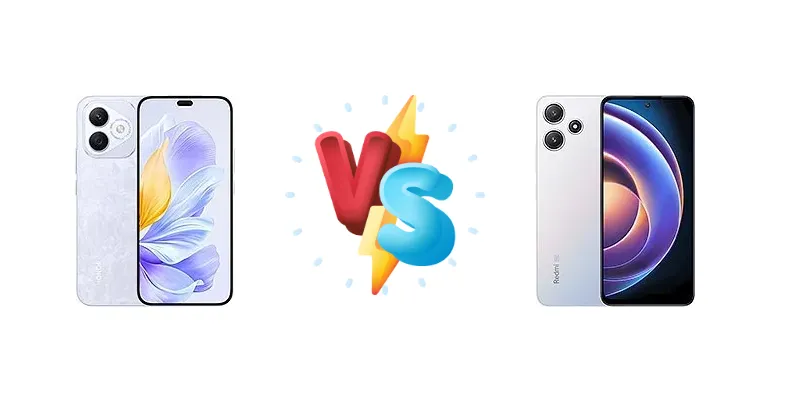
The Honor X60i and Xiaomi Redmi Note 12R represent compelling options in the increasingly competitive sub-$200 smartphone market. While both aim to deliver a solid experience without breaking the bank, they take different approaches to achieving this goal, primarily through their chipset choices and charging implementations. This comparison dissects these key differences to determine which device offers the best value.
🏆 Quick Verdict
For the average user prioritizing sustained performance and future-proofing, the Xiaomi Redmi Note 12R emerges as the stronger contender. Its Snapdragon 4 Gen 2, built on a more efficient 4nm process, offers a slight edge in CPU and GPU performance, alongside the benefit of Power Delivery (PD) charging. However, the Honor X60i’s faster 35W charging is a significant advantage for those who value quick top-ups.
| Network |
|---|
| 2G bands | GSM 850 / 900 / 1800 / 1900 | GSM 850 / 900 / 1800 / 1900 |
| 3G bands | HSDPA 850 / 900 / 1900 / 2100 | HSDPA 850 / 900 / 2100 |
| 4G bands | LTE | 1, 3, 5, 8, 34, 38, 39, 40, 41 |
| 5G bands | SA/NSA | 1, 5, 8, 28, 41, 78 SA/NSA |
| Speed | HSPA, LTE, 5G | HSPA, LTE, 5G |
| Technology | GSM / CDMA / HSPA / EVDO / LTE / 5G | GSM / CDMA / HSPA / EVDO / LTE / 5G |
| Launch |
|---|
| Announced | 2024, July 29 | 2023, June 28 |
| Status | Available. Released 2024, August 11 | Available. Released 2023, June 28 |
| Body |
|---|
| Build | - | Glass front, plastic frame, glass back |
| Dimensions | 161.1 x 74.6 x 7.2 mm (6.34 x 2.94 x 0.28 in) | 168.6 x 76.3 x 8.2 mm (6.64 x 3.00 x 0.32 in) |
| SIM | Nano-SIM + Nano-SIM | Nano-SIM + Nano-SIM |
| Weight | 172 g (6.07 oz) | 199 g (7.02 oz) |
| Display |
|---|
| Resolution | 1080 x 2412 pixels, 20:9 ratio (~394 ppi density) | 1080 x 2460 pixels (~396 ppi density) |
| Size | 6.7 inches, 108.0 cm2 (~89.9% screen-to-body ratio) | 6.79 inches, 109.5 cm2 (~85.1% screen-to-body ratio) |
| Type | AMOLED, 90Hz, 2000 nits (peak) | IPS LCD, 90Hz, 550 nits |
| Platform |
|---|
| CPU | Octa-core (2x2.4 GHz Cortex-A76 & 6x2.0 GHz Cortex-A55) | Octa-core (2x2.2 GHz Cortex-A78 & 6x1.95 GHz Cortex-A55) |
| Chipset | Mediatek Dimensity 6080 (6 nm) | Qualcomm SM4450 Snapdragon 4 Gen 2 (4 nm) |
| GPU | Mali-G57 MC2 | Adreno 613 |
| OS | Android 14, MagicOS 8 | Android 13, MIUI 14 |
| Memory |
|---|
| Card slot | No | microSDXC (uses shared SIM slot) |
| Internal | 256GB 8GB RAM, 256GB 12GB RAM, 512GB 12GB RAM | 128GB 4GB RAM, 128GB 6GB RAM, 128GB 8GB RAM, 256GB 8GB RAM |
| Main Camera |
|---|
| Dual | 50 MP, f/1.8, (wide), PDAF
Auxiliary lens | 50 MP, f/1.8, (wide), PDAF
2 MP (macro) |
| Features | LED flash, HDR, panorama | LED flash, HDR |
| Video | 1080p@30fps | 1080p@30fps |
| Selfie camera |
|---|
| Features | - | HDR |
| Single | 8 MP, f/2.0, (wide) | 5 MP, f/2.2, (wide), 1/5.0", 1.12µm |
| Video | 1080p@30fps | 1080p@30fps |
| Sound |
|---|
| 35mm jack | No | Yes |
| Loudspeaker | Yes | Yes |
| Comms |
|---|
| Bluetooth | 5.1, A2DP, LE, aptX HD | 5.3, A2DP, LE |
| Infrared port | - | Yes |
| NFC | No | Yes (market/region dependent) |
| Positioning | GPS, GLONASS, GALILEO, BDS | GPS, GLONASS, GALILEO, BDS |
| Radio | No | No |
| USB | USB Type-C 2.0, OTG | USB Type-C |
| WLAN | Wi-Fi 802.11 a/b/g/n/ac, dual-band | Wi-Fi 802.11 a/b/g/n/ac, dual-band |
| Features |
|---|
| Sensors | Fingerprint (under display, optical), accelerometer, compass, proximity (ultrasonic) | Fingerprint (side-mounted), accelerometer, compass |
| Battery |
|---|
| Charging | 35W wired
5W reverse wired | 18W wired, PD |
| Type | Li-Po 5000 mAh | Li-Po 5000 mAh |
| Misc |
|---|
| Colors | Black, Blue, Purple, White | Black, Blue, Silver |
| Models | LYN-AN00 | 23076RA4BC |
| Price | About 180 EUR | About 150 EUR |
Honor X60i
- Faster 35W charging for quick top-ups
- Potentially slightly higher CPU peak clock speed
- Competitive price point
- Less efficient 6nm chipset
- Potential for more thermal throttling
- Charging lacks Power Delivery (PD) support
Xiaomi Redmi Note 12R
- More efficient 4nm Snapdragon 4 Gen 2 chipset
- Power Delivery (PD) charging compatibility
- Potentially better sustained performance
- Slower 18W charging
- Slightly lower CPU peak clock speed
- May be marginally more expensive
Display Comparison
Neither device boasts a standout display. Both are likely to feature LCD panels, typical for this price bracket. The absence of detailed display specs necessitates focusing on the core performance differences. Bezels are expected to be comparable, and color accuracy will likely be tuned for vibrant, rather than accurate, reproduction. The real differentiator will be software-based features like eye comfort modes.
Camera Comparison
Without detailed camera specifications, a direct comparison is difficult. Both phones will likely feature a multi-camera setup, but the quality will heavily depend on the main sensor and image processing algorithms. It’s safe to assume both will include a standard wide lens and potentially a depth or macro sensor. The Redmi Note 12R’s image processing, leveraging Qualcomm’s ISP, may offer slightly better dynamic range and noise reduction. The absence of OIS on either device suggests reliance on software stabilization.
Performance
The core of the difference lies in the chipsets. The Honor X60i utilizes the Mediatek Dimensity 6080, a 6nm chip with a dual-core Cortex-A76 setup alongside six Cortex-A55 cores, peaking at 2.4 GHz. The Redmi Note 12R, however, employs the Qualcomm Snapdragon 4 Gen 2 (SM4450), a 4nm chip featuring a dual-core Cortex-A78 configuration and six Cortex-A55 cores, clocked at 2.2 GHz. While the Dimensity 6080 has a slightly higher peak clock speed, the Snapdragon 4 Gen 2’s 4nm process provides superior power efficiency and thermal management. This translates to potentially less throttling during sustained workloads like gaming. The Snapdragon’s Cortex-A78 cores also offer a performance advantage over the A76 cores in the Dimensity 6080. RAM configurations are not specified, but LPDDR4X is likely on both, limiting memory bandwidth.
Battery Life
The Honor X60i’s 35W wired charging is a clear advantage over the Redmi Note 12R’s 18W wired charging with PD. This means significantly faster 0-100% charge times for the Honor device. While battery capacity isn’t specified, the Snapdragon 4 Gen 2’s efficiency could offset a potentially smaller battery in the Redmi Note 12R, resulting in comparable real-world battery life. The Redmi Note 12R’s PD support, however, offers greater charger compatibility and potentially faster charging with a compatible PD adapter.
Buying Guide
Buy the Honor X60i if you prioritize the fastest possible charging speeds and frequently need to quickly replenish your battery. It’s ideal for users who are often on the go and can’t afford lengthy charging times. Buy the Xiaomi Redmi Note 12R if you value a more efficient processor, potentially better long-term performance, and the convenience of Power Delivery charging compatibility with a wider range of chargers and accessories. This phone suits users who engage in moderate gaming or multitasking.
Frequently Asked Questions
❓ Will the Snapdragon 4 Gen 2 in the Redmi Note 12R handle demanding games like PUBG Mobile smoothly?
The Snapdragon 4 Gen 2 is capable of running PUBG Mobile at medium settings with a stable frame rate. While it won't deliver a flagship gaming experience, its efficiency prevents significant throttling, allowing for extended gaming sessions. Expect to adjust graphics settings for optimal performance.
❓ How long does it *actually* take to fully charge the Honor X60i with the 35W charger?
While Honor doesn't provide exact figures, a 35W charger should fully charge the Honor X60i from 0% to 100% in approximately 60-75 minutes, significantly faster than the Redmi Note 12R. This makes it ideal for users who need a quick power boost before heading out.
❓ Does the Redmi Note 12R support fast charging with any standard charger, or do I need a Power Delivery (PD) charger to get the best results?
The Redmi Note 12R will charge with any standard USB-C charger, but you'll only achieve the full 18W charging speed with a Power Delivery (PD) compatible charger. Using a standard charger will result in slower charging times.