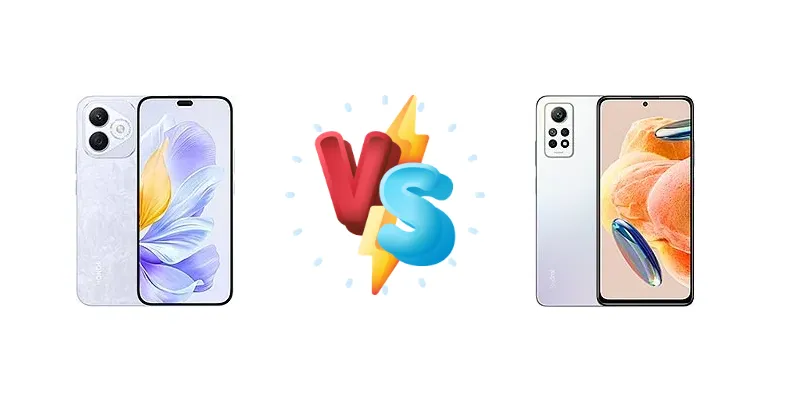
The Honor X60i and Xiaomi Redmi Note 12 Pro 4G represent compelling options in the crowded mid-range smartphone market. Both aim to deliver a balanced experience, but they take different approaches to achieving it. The X60i leverages MediaTek's Dimensity 6080, while the Redmi Note 12 Pro 4G opts for the Qualcomm Snapdragon 732G. This comparison dives deep into the specifics to determine which device offers the best value for your money.
🏆 Quick Verdict
For the average user prioritizing fast charging and a slightly more refined chipset, the Xiaomi Redmi Note 12 Pro 4G is the better choice. Its 67W charging significantly reduces downtime, and the Snapdragon 732G, built on an 8nm process, offers a small efficiency advantage. However, the Honor X60i remains a strong contender for those seeking a cost-effective option.
| Network |
|---|
| 2G bands | GSM 850 / 900 / 1800 / 1900 | GSM 850 / 900 / 1800 / 1900 |
| 3G bands | HSDPA 850 / 900 / 1900 / 2100 | HSDPA 850 / 900 / 1700(AWS) / 1900 / 2100 |
| 4G bands | LTE | 1, 2, 3, 4, 5, 7, 8, 20, 28, 38, 40, 41, 66 |
| 5G bands | SA/NSA | - |
| Speed | HSPA, LTE, 5G | HSPA, LTE |
| Technology | GSM / CDMA / HSPA / EVDO / LTE / 5G | GSM / HSPA / LTE |
| Launch |
|---|
| Announced | 2024, July 29 | 2023, March 03 |
| Status | Available. Released 2024, August 11 | Available. Released 2023, April 11 |
| Body |
|---|
| Dimensions | 161.1 x 74.6 x 7.2 mm (6.34 x 2.94 x 0.28 in) | 164.2 x 76.1 x 8.1 mm (6.46 x 3.00 x 0.32 in) |
| SIM | Nano-SIM + Nano-SIM | Nano-SIM + Nano-SIM |
| Weight | 172 g (6.07 oz) | 201.8 g (7.13 oz) |
| Display |
|---|
| Resolution | 1080 x 2412 pixels, 20:9 ratio (~394 ppi density) | 1080 x 2400 pixels, 20:9 ratio (~395 ppi density) |
| Size | 6.7 inches, 108.0 cm2 (~89.9% screen-to-body ratio) | 6.67 inches, 107.4 cm2 (~86.0% screen-to-body ratio) |
| Type | AMOLED, 90Hz, 2000 nits (peak) | AMOLED, 120Hz, Dolby Vision, 700 nits (HBM), 1100 nits (peak) |
| Platform |
|---|
| CPU | Octa-core (2x2.4 GHz Cortex-A76 & 6x2.0 GHz Cortex-A55) | Octa-core (2x2.2 GHz Kryo 470 Gold & 6x1.8 GHz Kryo 470 Silver) |
| Chipset | Mediatek Dimensity 6080 (6 nm) | Qualcomm SM7150 Snapdragon 732G (8 nm) |
| GPU | Mali-G57 MC2 | Adreno 618 |
| OS | Android 14, MagicOS 8 | Android 11, MIUI 13 |
| Memory |
|---|
| Card slot | No | microSDXC (uses shared SIM slot) |
| Internal | 256GB 8GB RAM, 256GB 12GB RAM, 512GB 12GB RAM | 128GB 6GB RAM, 128GB 8GB RAM, 256GB 8GB RAM |
| | - | UFS 2.2 |
| Main Camera |
|---|
| Dual | 50 MP, f/1.8, (wide), PDAF
Auxiliary lens | - |
| Features | LED flash, HDR, panorama | LED flash, HDR, panorama |
| Quad | - | 108 MP, f/1.9, (wide), 1/1.52", 0.7µm, PDAF
8 MP, 120˚, (ultrawide)
2 MP (macro)
Auxiliary lens |
| Video | 1080p@30fps | 4K@30fps, 1080p@30/60fps |
| Selfie camera |
|---|
| Single | 8 MP, f/2.0, (wide) | 16 MP, f/2.4, (wide) |
| Video | 1080p@30fps | 1080p@30fps |
| Sound |
|---|
| 3.5mm jack | - | Yes |
| 35mm jack | No | Yes |
| Loudspeaker | Yes | Yes, with stereo speakers |
| Comms |
|---|
| Bluetooth | 5.1, A2DP, LE, aptX HD | 5.0, A2DP, LE |
| Infrared port | - | Yes |
| NFC | No | Yes (market/region dependent) |
| Positioning | GPS, GLONASS, GALILEO, BDS | GPS, GLONASS, GALILEO, BDS |
| Radio | No | Unspecified |
| USB | USB Type-C 2.0, OTG | USB Type-C 2.0, OTG |
| WLAN | Wi-Fi 802.11 a/b/g/n/ac, dual-band | Wi-Fi 802.11 a/b/g/n/ac, dual-band |
| Features |
|---|
| Sensors | Fingerprint (under display, optical), accelerometer, compass, proximity (ultrasonic) | Fingerprint (side-mounted), accelerometer, gyro, compass |
| Battery |
|---|
| Charging | 35W wired
5W reverse wired | 67W wired |
| Type | Li-Po 5000 mAh | Li-Po 5000 mAh |
| Misc |
|---|
| Colors | Black, Blue, Purple, White | Star Blue, Graphite Gray, Polar White, Ice blue |
| Models | LYN-AN00 | 2209116AG, 2209116AG |
| Price | About 180 EUR | About 150 EUR |
Honor X60i
- More affordable price point
- 5W reverse wired charging
- Decent performance for everyday tasks
- Slower 35W charging
- Potentially more thermal throttling under load
Xiaomi Redmi Note 12 Pro 4G
- Faster 67W wired charging
- More efficient Snapdragon 732G chipset
- Potentially better sustained performance
- Slightly higher price
- No reverse wireless charging
Display Comparison
Neither device boasts a standout display. While specific display specs (resolution, panel type) are missing, both likely feature FHD+ LCD panels common in this price bracket. The key difference lies elsewhere. The focus here is on the internal components, as display quality is often similar in this segment.
Camera Comparison
Without detailed camera specifications, a direct comparison is difficult. However, both phones likely feature a multi-camera setup with a primary sensor and supporting lenses. The absence of information regarding sensor size and aperture makes it hard to assess image quality. It's reasonable to assume both will perform adequately in good lighting conditions, but low-light performance will depend heavily on sensor size and image processing algorithms. We can expect both to include a 2MP macro lens, which are generally of limited utility.
Performance
The core difference lies in the chipsets. The Honor X60i’s MediaTek Dimensity 6080 (6nm) features a 2x2.4 GHz Cortex-A76 and 6x2.0 GHz Cortex-A55 configuration. The Xiaomi Redmi Note 12 Pro 4G utilizes the Qualcomm Snapdragon 732G (8nm) with 2x2.2 GHz Kryo 470 Gold and 6x1.8 GHz Kryo 470 Silver cores. The Snapdragon 732G’s 8nm process generally translates to better thermal efficiency compared to the Dimensity 6080’s 6nm, potentially leading to less throttling during extended gaming sessions. While clock speeds are close, Qualcomm’s architecture often provides a slight edge in sustained performance. The impact on daily tasks will be minimal, but gamers will likely notice a difference.
Battery Life
The Xiaomi Redmi Note 12 Pro 4G’s 67W wired charging is a significant advantage over the Honor X60i’s 35W charging. This translates to substantially faster charging times – potentially going from 0-100% in under an hour compared to the X60i’s longer charge time. While battery capacity isn't specified, the faster charging speed of the Redmi Note 12 Pro 4G mitigates any potential disadvantage from a slightly smaller battery. The X60i also offers 5W reverse wired charging, a feature absent on the Redmi Note 12 Pro 4G, allowing it to top up accessories.
Buying Guide
Buy the Honor X60i if you need a highly affordable smartphone with a decent processor for everyday tasks and don't mind slower charging speeds. Buy the Xiaomi Redmi Note 12 Pro 4G if you prioritize faster charging, a slightly more efficient chipset, and are willing to spend a bit more for a smoother overall experience, especially during sustained use.
Frequently Asked Questions
❓ Will the Snapdragon 732G in the Redmi Note 12 Pro 4G handle demanding games like PUBG or Call of Duty?
The Snapdragon 732G is capable of running PUBG and Call of Duty, but you'll likely need to use medium graphics settings for a consistently smooth experience. The 8nm process helps with thermal management, reducing the chance of significant frame drops during extended gaming sessions compared to the Dimensity 6080.
❓ How long does it realistically take to fully charge the Honor X60i with the 35W charger?
Expect the Honor X60i to take approximately 1 hour and 45 minutes to 2 hours to fully charge from 0% using the included 35W charger. This is considerably slower than the Redmi Note 12 Pro 4G's 67W charging.
❓ Is the difference in chipset performance between the Dimensity 6080 and Snapdragon 732G noticeable in everyday use?
For typical tasks like browsing, social media, and video streaming, the difference in performance between the two chipsets will be minimal. Both are capable of handling these tasks smoothly. The difference becomes more apparent during more demanding tasks like video editing or gaming.