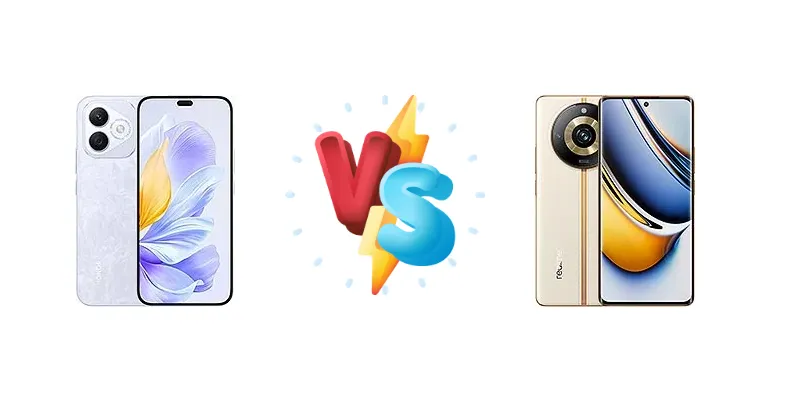
The Realme 11 Pro+ and Honor X60i represent compelling options in the increasingly competitive mid-range smartphone market. The Realme 11 Pro+ aggressively targets users prioritizing rapid charging and a brighter display, while the Honor X60i focuses on delivering a solid all-around experience with a more conservative approach to key features. This comparison dissects their strengths and weaknesses to determine which device best suits your needs.
🏆 Quick Verdict
For most users, the Realme 11 Pro+ emerges as the stronger choice. Its significantly faster 100W charging and brighter 793 nit display offer tangible benefits, especially for power users and those who consume a lot of media. While the Honor X60i provides a respectable experience, it can't match the Realme's speed and visual clarity.
| Network |
|---|
| 2G bands | GSM 850 / 900 / 1800 / 1900 | GSM 850 / 900 / 1800 / 1900 |
| 3G bands | HSDPA 850 / 900 / 1900 / 2100 | HSDPA 850 / 900 / 2100 |
| 4G bands | LTE | 1, 3, 5, 8, 28, 38, 40, 41 - India |
| 5G bands | SA/NSA | 1, 3, 5, 8, 28, 40, 41, 77, 78 SA/NSA - International |
| Speed | HSPA, LTE, 5G | HSPA, LTE, 5G |
| Technology | GSM / CDMA / HSPA / EVDO / LTE / 5G | GSM / CDMA / HSPA / CDMA2000 / LTE / 5G |
| | - | CDMA2000 1x |
| Launch |
|---|
| Announced | 2024, July 29 | 2023, May 10 |
| Status | Available. Released 2024, August 11 | Available. Released 2023, May 15 |
| Body |
|---|
| Build | - | Glass front, leather or plastic back, plastic frame |
| Dimensions | 161.1 x 74.6 x 7.2 mm (6.34 x 2.94 x 0.28 in) | 161.6 x 73.9 x 8.2 mm or 8.7 mm |
| SIM | Nano-SIM + Nano-SIM | Nano-SIM + Nano-SIM |
| Weight | 172 g (6.07 oz) | 183 g or 189 g (6.46 oz) |
| Display |
|---|
| Resolution | 1080 x 2412 pixels, 20:9 ratio (~394 ppi density) | 1080 x 2412 pixels, 20:9 ratio (~394 ppi density) |
| Size | 6.7 inches, 108.0 cm2 (~89.9% screen-to-body ratio) | 6.7 inches, 108.0 cm2 (~90.5% screen-to-body ratio) |
| Type | AMOLED, 90Hz, 2000 nits (peak) | AMOLED, 1B colors, HDR10+, 120Hz, 950 nits (peak) |
| Platform |
|---|
| CPU | Octa-core (2x2.4 GHz Cortex-A76 & 6x2.0 GHz Cortex-A55) | Octa-core (2x2.6 GHz Cortex-A78 & 6x2.0 GHz Cortex-A55) |
| Chipset | Mediatek Dimensity 6080 (6 nm) | Mediatek Dimensity 7050 (6 nm) |
| GPU | Mali-G57 MC2 | Mali-G68 MC4 |
| OS | Android 14, MagicOS 8 | Android 13, up to 2 major Android upgrades, Realme UI 5.0 |
| Memory |
|---|
| Card slot | No | No |
| Internal | 256GB 8GB RAM, 256GB 12GB RAM, 512GB 12GB RAM | 256GB 8GB RAM, 256GB 12GB RAM, 512GB 12GB RAM, 1TB 12GB RAM |
| Main Camera |
|---|
| Dual | 50 MP, f/1.8, (wide), PDAF
Auxiliary lens | - |
| Features | LED flash, HDR, panorama | LED flash, HDR, panorama |
| Triple | - | 200 MP, f/1.7, 23mm (wide), 1/1.4", 0.56µm, PDAF, OIS
8 MP, f/2.2, 16mm, 112˚ (ultrawide)
2 MP (macro) |
| Video | 1080p@30fps | 4K@30fps, 1080p@30/60/120/480fps, 720p@960fps, gyro-EIS |
| Selfie camera |
|---|
| Features | - | Panorama |
| Single | 8 MP, f/2.0, (wide) | 32 MP, f/2.5, 22mm (wide) |
| Video | 1080p@30fps | 1080p@30fps |
| Sound |
|---|
| 3.5mm jack | - | No |
| 35mm jack | No | No |
| Loudspeaker | Yes | Yes, with stereo speakers |
| | - | 24-bit/192kHz audio |
| Comms |
|---|
| Bluetooth | 5.1, A2DP, LE, aptX HD | 5.2, A2DP, LE, aptX HD |
| NFC | No | Yes |
| Positioning | GPS, GLONASS, GALILEO, BDS | GPS, GLONASS, GALILEO, BDS, QZSS, NavIC |
| Radio | No | No |
| USB | USB Type-C 2.0, OTG | USB Type-C 2.0 |
| WLAN | Wi-Fi 802.11 a/b/g/n/ac, dual-band | Wi-Fi 802.11 a/b/g/n/ac/6, dual-band |
| Features |
|---|
| Sensors | Fingerprint (under display, optical), accelerometer, compass, proximity (ultrasonic) | Fingerprint (under display, optical), accelerometer, gyro, proximity, compass |
| Battery |
|---|
| Charging | 35W wired
5W reverse wired | 100W wired |
| Type | Li-Po 5000 mAh | 5000 mAh |
| Misc |
|---|
| Colors | Black, Blue, Purple, White | Astral Black, Sunrise Beige, Oasis Green |
| Models | LYN-AN00 | RMX3740, RMX3741 |
| Price | About 180 EUR | € 399.90 / ₹ 27,990 |
Honor X60i
- Faster 35W charging compared to older standards.
- Potentially more efficient Dimensity 6080 chipset.
- Reverse wired charging for accessories.
- Significantly slower charging than the Realme 11 Pro+.
- Display brightness likely lower than the competition.
- Limited camera information available.
Realme 11 Pro+
- Ultra-fast 100W charging for minimal downtime.
- Brighter 793 nit display for excellent visibility.
- More powerful Dimensity 7050 chipset for smoother performance.
- May experience slightly warmer temperatures during intensive tasks.
- Potentially higher price point than the Honor X60i.
- Camera details beyond 'Photo/Video' are lacking.
Display Comparison
The Realme 11 Pro+ boasts a significantly brighter display, reaching a measured 793 nits, compared to the Honor X60i, for which peak brightness data is unavailable. This difference translates to superior outdoor visibility for the Realme. While both likely utilize AMOLED panels (based on market positioning), the Realme’s higher brightness is a clear advantage. The Honor X60i’s display specifications are less defined, suggesting a focus on cost optimization rather than pushing display boundaries. Bezels are likely comparable, given both phones target similar price brackets, but the Realme’s superior brightness is the defining factor.
Camera Comparison
Detailed camera specifications beyond 'Photo/Video' are absent for both devices. However, given the Realme 11 Pro+'s positioning, it likely features a more sophisticated camera system, potentially including Optical Image Stabilization (OIS) on its main sensor. The Realme brand historically emphasizes camera capabilities, suggesting a larger sensor and more advanced image processing algorithms. The Honor X60i likely employs a more basic camera setup focused on providing acceptable image quality in good lighting conditions. The absence of detailed camera specs makes a definitive comparison difficult, but Realme’s brand focus suggests a stronger camera experience.
Performance
Both devices utilize Mediatek Dimensity chipsets fabricated on a 6nm process, but the Realme 11 Pro+ features the Dimensity 7050, while the Honor X60i uses the Dimensity 6080. The 7050’s CPU configuration – 2x2.6 GHz Cortex-A78 cores – represents a step up in peak performance compared to the X60i’s 2x2.4 GHz Cortex-A76 cores. This translates to snappier application loading and smoother multitasking. While both CPUs share the same Cortex-A55 efficiency cores, the 7050’s more powerful primary cores provide a noticeable advantage in demanding tasks. The Realme 11 Pro+ is likely to exhibit better sustained performance under load due to the more efficient CPU architecture.
Battery Life
The Realme 11 Pro+’s 100W wired charging is its standout feature, allowing for a full charge in a remarkably short time – likely under 30 minutes. The Honor X60i’s 35W charging is considerably slower, requiring significantly longer to reach 100%. While the Realme 11 Pro+ has an endurance rating of 112h, the Honor X60i’s battery capacity and endurance rating are not provided. However, the Realme’s faster charging mitigates concerns about battery life, allowing users to quickly top up throughout the day. The 5W reverse wired charging on the Honor X60i is a niche feature, useful for charging accessories but not a primary selling point.
Buying Guide
Buy the Honor X60i if you prioritize a balanced, reliable experience and are less concerned with blazing-fast charging or a top-tier display. It's ideal for everyday users who value efficiency and a consistent performance profile. Buy the Realme 11 Pro+ if you demand the quickest possible charging speeds, a vibrant and easily viewable screen, and are willing to potentially manage slightly warmer temperatures during intensive tasks. This phone is geared towards users who are always on the go and need to top up quickly.
Frequently Asked Questions
❓ Does the Dimensity 7050 in the Realme 11 Pro+ get noticeably warmer than the Dimensity 6080 in the Honor X60i during prolonged gaming sessions?
Yes, the Dimensity 7050, while more powerful, is likely to generate more heat under sustained load compared to the Dimensity 6080. This is a common trade-off for increased performance. The Realme 11 Pro+ may exhibit some thermal throttling during extended gaming, but the improved cooling system (if present) should mitigate this to some extent. The Honor X60i will likely remain cooler, but at the cost of overall performance.
❓ Is the 100W charging on the Realme 11 Pro+ safe for long-term battery health?
Modern smartphones employ sophisticated charging management systems to protect battery health even with fast charging technologies like 100W. While theoretically, faster charging *could* contribute to slightly faster battery degradation over several years, the Realme 11 Pro+ incorporates safeguards to minimize this effect. The convenience of rapid charging often outweighs the minimal potential impact on long-term battery lifespan.
❓ How does the camera performance differ between these two phones in low-light conditions?
Without detailed camera specifications, it's difficult to provide a definitive answer. However, the Realme 11 Pro+ is likely to perform better in low light due to a potentially larger sensor, wider aperture, and more advanced image processing algorithms. The Honor X60i will likely struggle more in low-light scenarios, producing noisier images with less detail.