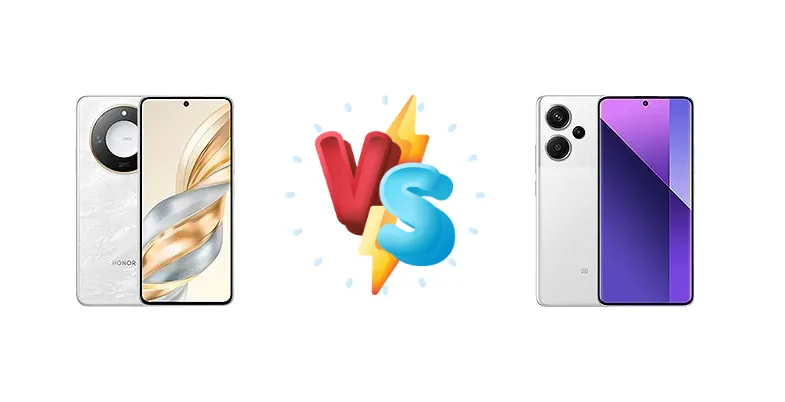
The mid-range smartphone market is fiercely competitive, and the Honor X60 and Xiaomi Redmi Note 13 Pro+ represent compelling options. The X60 focuses on a balanced experience, while the Redmi Note 13 Pro+ aggressively pushes charging technology and display capabilities. This comparison dissects their key differences to help you choose the right device.
🏆 Quick Verdict
For most users, the Xiaomi Redmi Note 13 Pro+ is the superior choice. Its significantly faster 120W charging, brighter display, and more efficient Dimensity 7200 Ultra chipset outweigh the Honor X60’s slightly lower price point, offering a more premium and convenient experience.
| Network |
|---|
| 2G bands | GSM 850 / 900 / 1800 / 1900 | GSM 850 / 900 / 1800 / 1900 |
| 3G bands | HSDPA 850 / 900 / 1700(AWS) / 1900 / 2100 | HSDPA 800 / 850 / 900 / 1700(AWS) / 1900 / 2100 - International |
| 4G bands | LTE | 1, 2, 3, 4, 5, 7, 8, 12, 13, 17, 18, 19, 20, 26, 28, 32, 38, 40, 41, 66 - International |
| 5G bands | SA/NSA | 1, 3, 5, 7, 8, 20, 28, 38, 40, 41, 66, 77, 78 SA/NSA- International |
| Speed | HSPA, LTE, 5G | HSPA, LTE, 5G |
| Technology | GSM / CDMA / HSPA / CDMA2000 / LTE / 5G | GSM / CDMA / HSPA / EVDO / LTE / 5G |
| Launch |
|---|
| Announced | 2024, October 16 | 2023, September 21 |
| Status | Available. Released 2024, October 25 | Available. Released 2023, September 21 |
| Body |
|---|
| Build | - | Glass front (Gorilla Glass Victus), glass back or silicone polymer back (eco leather) |
| Dimensions | 166 x 75.8 x 7.9 mm (6.54 x 2.98 x 0.31 in) | 161.4 x 74.2 x 8.9 mm (6.35 x 2.92 x 0.35 in) |
| SIM | Nano-SIM + Nano-SIM | · Nano-SIM + eSIM· Nano-SIM + Nano-SIM |
| Weight | 189 g (6.67 oz) | 199 g or 204.5 g (7.02 oz) |
| Display |
|---|
| Protection | - | Corning Gorilla Glass Victus |
| Resolution | 1080 x 2412 pixels, 20:9 ratio (~389 ppi density) | 1220 x 2712 pixels, 20:9 ratio (~446 ppi density) |
| Size | 6.8 inches, 111.3 cm2 (~88.4% screen-to-body ratio) | 6.67 inches, 107.4 cm2 (~89.7% screen-to-body ratio) |
| Type | TFT LCD, 120Hz, 850 (HBM) | AMOLED, 68B colors, 120Hz, 1920Hz PWM, Dolby Vision, HDR10+, 1800 nits (peak) |
| Platform |
|---|
| CPU | Octa-core (2x2.5 GHz Cortex-A78 & 6x2.0 GHz Cortex-A55) | Octa-core (2x2.8 GHz Cortex-A715 & 6x2.0 GHz Cortex-A510) |
| Chipset | Mediatek Dimensity 7025 Ultra (6 nm) | Mediatek Dimensity 7200 Ultra (4 nm) |
| GPU | IMG BXM-8-256 | Mali-G610 MC4 |
| OS | Android 14, Magic OS 8 | Android 13, up to 3 major Android upgrades, HyperOS |
| Memory |
|---|
| Card slot | No | No |
| Internal | 128GB 8GB RAM, 256GB 8GB RAM, 256GB 12GB RAM, 512GB 12GB RAM | 256GB 8GB RAM, 256GB 12GB RAM, 512GB 8GB RAM, 512GB 12GB RAM, 512GB 16GB RAM |
| Main Camera |
|---|
| Features | LED flash, panorama, HDR | Dual-LED dual-tone flash, HDR, panorama |
| Single | 108 MP, f/1.8, (wide), 1/1.67", PDAF | - |
| Triple | - | 200 MP, f/1.7, 23mm (wide), 1/1.4", 0.56µm, multi-directional PDAF, OIS
8 MP, f/2.2, 16mm, 120˚ (ultrawide), 1/4.0", 1.12µm
2 MP (macro) |
| Video | 1080p@30fps | 4K@24/30fps, 1080p@30/60/120fps, gyro-EIS |
| Selfie camera |
|---|
| Features | - | HDR, panorama |
| Single | 8 MP, f/2.0, (wide) | 16 MP, f/2.4, (wide) |
| Video | 1080p@30fps | 1080p@30/60fps |
| Sound |
|---|
| 35mm jack | No | No |
| Loudspeaker | Yes | Yes, with stereo speakers |
| Comms |
|---|
| Bluetooth | 5.3, A2DP, LE, aptX HD | 5.3, A2DP, LE |
| Infrared port | - | Yes |
| NFC | No | Yes (market/region dependent) |
| Positioning | GPS, GLONASS, GALILEO, BDS | GPS, GLONASS, BDS, GALILEO, QZSS |
| Radio | No | No |
| USB | USB Type-C 2.0, OTG | USB Type-C 2.0, OTG |
| WLAN | Wi-Fi 802.11 a/b/g/n/ac, dual-band, Wi-Fi Direct | Wi-Fi 802.11 a/b/g/n/ac/6, dual-band, Wi-Fi Direct |
| Features |
|---|
| Sensors | Fingerprint (side-mounted, optical), accelerometer, gyro, proximity (ultrasound), compass | Fingerprint (under display, optical), accelerometer, gyro, proximity, compass |
| Battery |
|---|
| Charging | 35W wired
5W reverse wired | 120W wired, PD3.0, 100% in 19 min |
| Type | Li-Po 5800 mAh | Li-Po 5000 mAh |
| Misc |
|---|
| Colors | Black, Green, Silver | Midnight Black (Fushion Black), Moonlight White (Fushion White), Aurora Purple, Fushion Purple, Camo Green |
| Models | BRC-AN00 | 23090RA98C, 23090RA98G, 23090RA98I |
| Price | About 160 EUR | $ 299.98 / £ 299.00 / € 208.98 / ₹ 24,999 |
| SAR | - | 1.09 W/kg (head) 0.85 W/kg (body) |
| SAR EU | - | 0.98 W/kg (head) 1.00 W/kg (body) |
Honor X60
- Potentially more affordable price point
- Reliable Mediatek Dimensity 7025 Ultra chipset
- 5W reverse wired charging for accessories
- Significantly slower 35W charging
- Less powerful processor compared to the Redmi
- Display brightness likely lower than the Redmi
Xiaomi Redmi Note 13 Pro+
- Ultra-fast 120W charging (0-100% in 19 minutes)
- Brighter 1283 nits display for outdoor visibility
- More efficient and powerful Dimensity 7200 Ultra chipset
- Potentially higher price compared to the Honor X60
- No reverse wireless charging
- Software experience may vary based on MIUI version
Display Comparison
The Redmi Note 13 Pro+ boasts a significantly brighter display, reaching a measured 1283 nits, compared to an unspecified brightness for the Honor X60. This translates to superior visibility outdoors under direct sunlight. While both likely utilize AMOLED panels, the Redmi’s higher peak brightness is a clear advantage. The X60’s display specifications are currently limited, making a detailed comparison of color accuracy and refresh rate difficult, but the Redmi Note 13 Pro+’s brightness alone establishes a strong lead.
Camera Comparison
Without detailed camera specifications for the Honor X60, a direct comparison is challenging. However, the Redmi Note 13 Pro+ is expected to feature a more advanced camera system, potentially including a larger main sensor and more sophisticated image processing algorithms. The Redmi’s focus on camera capabilities within the Note series suggests a stronger emphasis on photography, while the X60 appears to prioritize overall value. The absence of information regarding OIS on the X60 further suggests the Redmi Note 13 Pro+ will offer superior image stabilization.
Performance
The Xiaomi Redmi Note 13 Pro+ utilizes the Mediatek Dimensity 7200 Ultra, fabricated on a more efficient 4nm process, compared to the Honor X60’s Dimensity 7025 Ultra (6nm). This process node difference suggests better thermal management and power efficiency for the Redmi, potentially leading to less throttling during sustained workloads. The Redmi’s CPU features Cortex-A715 cores clocked at 2.8 GHz, offering a performance edge over the X60’s 2.5 GHz Cortex-A78 cores. While both phones feature octa-core CPUs, the architectural improvements and fabrication process of the Dimensity 7200 Ultra give the Redmi Note 13 Pro+ a noticeable performance advantage.
Battery Life
The Redmi Note 13 Pro+’s standout feature is its 120W wired charging, capable of fully charging the device in just 19 minutes. This is a massive advantage over the Honor X60’s 35W charging. While the Redmi Note 13 Pro+’s battery capacity isn’t specified in the provided data, its active use score of 10:38h demonstrates excellent battery life. The Honor X60’s slower charging speed will require significantly more time to replenish the battery, making the Redmi Note 13 Pro+ the clear winner for users who prioritize convenience and minimal downtime.
Buying Guide
Buy the Honor X60 if you prioritize a consistently smooth experience with a reliable chipset and don't mind slower charging speeds. It's ideal for users who value a balanced package and aren't heavily reliant on power-user features. Buy the Xiaomi Redmi Note 13 Pro+ if you demand the fastest possible charging, a vibrant and bright display, and a more powerful processor for demanding tasks and gaming. This phone is for those who want a flagship-like experience without the flagship price.
Frequently Asked Questions
❓ Does the Dimensity 7200 Ultra in the Redmi Note 13 Pro+ get hot during extended gaming sessions?
The Dimensity 7200 Ultra’s 4nm fabrication process is designed for improved thermal efficiency. While some heat generation is inevitable during demanding tasks like gaming, the Redmi Note 13 Pro+ is expected to manage temperatures effectively, minimizing throttling and maintaining consistent performance. The larger surface area of the phone also aids in heat dissipation.
❓ How does the 120W charging of the Redmi Note 13 Pro+ affect battery health over time?
Xiaomi employs charging algorithms and hardware safeguards to mitigate the potential impact of fast charging on battery health. While all batteries degrade over time, the Redmi Note 13 Pro+’s charging system is designed to optimize charging speed while minimizing stress on the battery, ensuring long-term reliability. The phone also likely supports adaptive charging, slowing down the charging rate as the battery nears full capacity.
❓ Is the Honor X60 a good choice for mobile gaming?
The Honor X60’s Dimensity 7025 Ultra is a capable chipset for casual gaming. However, the Redmi Note 13 Pro+’s Dimensity 7200 Ultra offers a performance advantage, particularly in graphically intensive games. The X60 may experience some frame drops or throttling during prolonged gaming sessions, while the Redmi Note 13 Pro+ is better equipped to handle demanding titles.