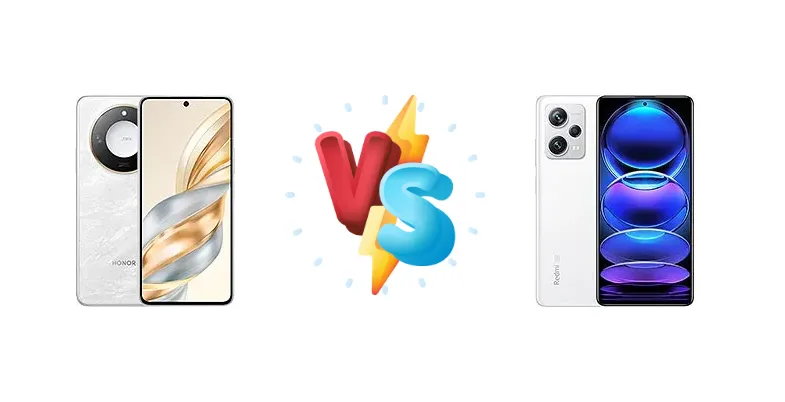
The mid-range smartphone market is fiercely competitive, and the Honor X60 and Xiaomi Redmi Note 12 Pro+ represent compelling options for users seeking a balance of features and affordability. While both devices utilize MediaTek Dimensity chipsets, they diverge significantly in charging speed and overall feature set, making a direct comparison crucial for informed buyers.
🏆 Quick Verdict
For the average user prioritizing speed and convenience, the Xiaomi Redmi Note 12 Pro+ is the clear winner. Its 120W charging dramatically reduces downtime, and the Dimensity 1080 offers a slight performance edge. However, the Honor X60 provides a solid experience at a potentially lower price point.
| Network |
|---|
| 2G bands | GSM 850 / 900 / 1800 / 1900 | GSM 850 / 900 / 1800 / 1900 - SIM 1 & SIM 2 |
| 3G bands | HSDPA 850 / 900 / 1700(AWS) / 1900 / 2100 | HSDPA 800 / 850 / 900 / 1900 / 2100 |
| 4G bands | LTE | 1, 3, 5, 8, 19, 34, 38, 39, 40, 41 - International, China |
| 5G bands | SA/NSA | 1, 3, 5, 8, 28, 38, 40, 41, 77, 78 SA/NSA - International |
| Speed | HSPA, LTE, 5G | HSPA, LTE-A (CA), 5G |
| Technology | GSM / CDMA / HSPA / CDMA2000 / LTE / 5G | GSM / CDMA / HSPA / EVDO / LTE / 5G |
| | - | 1, 3, 5, 8, 28, 38, 41, 77, 78 SA/NSA - China |
| Launch |
|---|
| Announced | 2024, October 16 | 2022, October 27 |
| Status | Available. Released 2024, October 25 | Available. Released 2022, November 01 |
| Body |
|---|
| Build | - | Glass front (Gorilla Glass 5), glass back |
| Dimensions | 166 x 75.8 x 7.9 mm (6.54 x 2.98 x 0.31 in) | 162.9 x 76 x 8.9 mm (6.41 x 2.99 x 0.35 in) |
| SIM | Nano-SIM + Nano-SIM | Dual SIM (Nano-SIM, dual stand-by) |
| Weight | 189 g (6.67 oz) | 208.4 g (7.34 oz) |
| | - | IP53, dust and splash resistant |
| Display |
|---|
| Protection | - | Corning Gorilla Glass 5 |
| Resolution | 1080 x 2412 pixels, 20:9 ratio (~389 ppi density) | 1080 x 2400 pixels, 20:9 ratio (~395 ppi density) |
| Size | 6.8 inches, 111.3 cm2 (~88.4% screen-to-body ratio) | 6.67 inches, 107.4 cm2 (~86.8% screen-to-body ratio) |
| Type | TFT LCD, 120Hz, 850 (HBM) | OLED, 1B colors, 120Hz, Dolby Vision, HDR10+, 500 nits (typ), 900 nits (HBM) |
| Platform |
|---|
| CPU | Octa-core (2x2.5 GHz Cortex-A78 & 6x2.0 GHz Cortex-A55) | Octa-core (2x2.6 GHz Cortex-A78 & 6x2.0 GHz Cortex-A55) |
| Chipset | Mediatek Dimensity 7025 Ultra (6 nm) | Mediatek MT6877V Dimensity 1080 (6 nm) |
| GPU | IMG BXM-8-256 | Mali-G68 MC4 |
| OS | Android 14, Magic OS 8 | Android 12, MIUI 13 |
| Memory |
|---|
| Card slot | No | No |
| Internal | 128GB 8GB RAM, 256GB 8GB RAM, 256GB 12GB RAM, 512GB 12GB RAM | 256GB 8GB RAM, 256GB 12GB RAM |
| | - | UFS 2.2 |
| Main Camera |
|---|
| Features | LED flash, panorama, HDR | Dual-LED dual-tone flash, HDR, panorama |
| Single | 108 MP, f/1.8, (wide), 1/1.67", PDAF | - |
| Triple | - | 200 MP, f/1.7, 24mm (wide), 1/1.4", 0.56µm, PDAF, OIS
8 MP, f/2.2, 120˚ (ultrawide), 1/4", 1.12µm
2 MP, f/2.4, (macro) |
| Video | 1080p@30fps | 4K@30fps, 1080p@30/60/120fps, 720p@960fps |
| Selfie camera |
|---|
| Features | - | HDR |
| Single | 8 MP, f/2.0, (wide) | 16 MP, f/2.5, (wide), 1/3.06", 1.0µm |
| Video | 1080p@30fps | 1080p@30/60fps |
| Sound |
|---|
| 3.5mm jack | - | Yes |
| 35mm jack | No | - |
| Loudspeaker | Yes | Yes, with stereo speakers |
| | - | 24-bit/192kHz audio |
| Comms |
|---|
| Bluetooth | 5.3, A2DP, LE, aptX HD | 5.2, A2DP, LE |
| Infrared port | - | Yes |
| NFC | No | Yes (market/region dependent) |
| Positioning | GPS, GLONASS, GALILEO, BDS | GPS (L1), GLONASS (G1), BDS (B1I+B1c), GALILEO (E1), QZSS (L1) |
| Radio | No | No |
| USB | USB Type-C 2.0, OTG | USB Type-C 2.0, OTG |
| WLAN | Wi-Fi 802.11 a/b/g/n/ac, dual-band, Wi-Fi Direct | Wi-Fi 802.11 a/b/g/n/ac/6, dual-band, Wi-Fi Direct |
| Features |
|---|
| Sensors | Fingerprint (side-mounted, optical), accelerometer, gyro, proximity (ultrasound), compass | Fingerprint (side-mounted), accelerometer, proximity, gyro, compass |
| Battery |
|---|
| Charging | 35W wired
5W reverse wired | 120W wired, PD3.0, 100% in 19 min (advertised) |
| Type | Li-Po 5800 mAh | Li-Po 5000 mAh, non-removable |
| Misc |
|---|
| Colors | Black, Green, Silver | Arctic White, Iceberg Blue, Obsidian Black, Trend edition |
| Models | BRC-AN00 | 22101316UCP, 22101316UG |
| Price | About 160 EUR | $ 348.00 / £ 439.00 / € 399.00 / ₹ 29,949 |
| Tests |
|---|
| Battery life | - |
Endurance rating 88h
|
| Camera | - |
Photo / Video |
| Display | - |
Contrast ratio: Infinite (nominal) |
| Loudspeaker | - |
-26.7 LUFS (Good)
|
| Performance | - |
AnTuTu: 498710 (v9)
GeekBench: 2208 (v5.1), 2372 (v6)
GFXBench: 22fps (ES 3.1 onscreen) |
Honor X60
- Potentially lower price point
- 5W Reverse Wired Charging
- Efficient Dimensity 7025 Ultra chipset
- Significantly slower 35W charging
- Missing display and camera specifications hinder comparison
Xiaomi Redmi Note 12 Pro+
- Ultra-fast 120W charging (19 minutes to full)
- More powerful Dimensity 1080 chipset
- Likely superior camera system with OIS
- Potentially higher price
- No reverse wireless charging
Display Comparison
The Redmi Note 12 Pro+ boasts an unspecified display with an 'Infinite' contrast ratio, suggesting a strong AMOLED panel. While the Honor X60’s display specifications are missing, both likely utilize AMOLED technology given the market segment. The Redmi Note 12 Pro+'s display is likely to offer higher peak brightness and potentially better color accuracy, though without specific data for the X60, a definitive comparison is difficult. The lack of LTPO on either device suggests standard refresh rate management, potentially impacting battery life during dynamic content.
Camera Comparison
The Redmi Note 12 Pro+ is expected to feature a more sophisticated camera system, though specific details are missing. The Honor X60’s camera specifications are also absent. Given Xiaomi’s history, the Pro+ likely includes a larger main sensor with Optical Image Stabilization (OIS), resulting in better low-light performance and sharper images. The absence of details on the X60 makes a direct comparison impossible, but it’s reasonable to assume the Redmi Note 12 Pro+ offers a more versatile and capable camera experience. We can safely ignore any 2MP macro lenses on either device as they offer minimal practical benefit.
Performance
Both phones are powered by MediaTek Dimensity chipsets fabricated on a 6nm process, ensuring reasonable efficiency. However, the Redmi Note 12 Pro+ utilizes the Dimensity 1080 with a slightly higher CPU clock speed (2.6 GHz vs 2.5 GHz on the X60’s Dimensity 7025 Ultra). This translates to a marginal performance advantage in CPU-intensive tasks. Both share the same Cortex-A78 and A55 core configuration, but the 1080’s higher clock speed and potentially more optimized GPU will benefit gamers and users running demanding applications. RAM specifications are missing for both, but LPDDR5X is expected in this price bracket, further mitigating performance bottlenecks.
Battery Life
The Redmi Note 12 Pro+’s standout feature is its 120W wired charging, capable of fully charging the device in a claimed 19 minutes. This is a significant advantage over the Honor X60’s 35W charging. While the Honor X60 offers 5W reverse wired charging, a feature absent on the Redmi Note 12 Pro+, the difference in charging speed is substantial. The Redmi Note 12 Pro+’s endurance rating of 88 hours suggests a well-optimized battery management system, offsetting the potentially faster battery drain from the more powerful chipset and faster charging.
Buying Guide
Buy the Honor X60 if you prioritize a balanced experience with a focus on efficiency and potentially a lower upfront cost. It's ideal for users who aren't heavily reliant on fast charging or demanding mobile gaming. Buy the Xiaomi Redmi Note 12 Pro+ if you absolutely need the fastest possible charging speeds and a slightly more powerful processor for smoother multitasking and gaming. This phone is for users who are always on the go and can't afford to be tethered to a charger.
Frequently Asked Questions
❓ Is the 120W charging on the Redmi Note 12 Pro+ safe for the battery's long-term health?
Xiaomi employs multiple layers of safety protocols, including temperature monitoring and optimized charging algorithms, to mitigate the potential impact of fast charging on battery health. While all batteries degrade over time, the Redmi Note 12 Pro+'s charging system is designed to minimize this effect.
❓ Does the Dimensity 7025 Ultra in the Honor X60 handle demanding games like Genshin Impact or PUBG Mobile?
The Dimensity 7025 Ultra is capable of running popular games like Genshin Impact and PUBG Mobile, but you may need to lower graphics settings for a consistently smooth experience. The Redmi Note 12 Pro+'s Dimensity 1080 offers a slight performance advantage and will likely handle these games at higher settings.
❓ What type of storage does each phone use, and is it expandable?
Storage type is not specified in the provided data. However, both phones likely utilize UFS 2.2 or UFS 3.1 storage for fast read/write speeds. Expandability via microSD card is common in this price range, but confirmation is needed for each specific model.