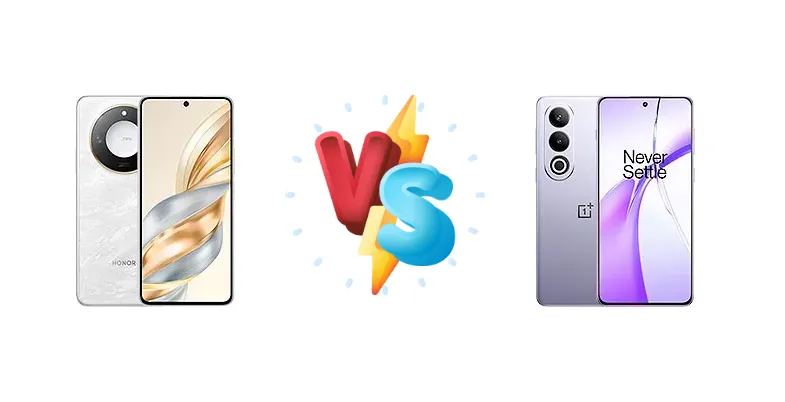
The mid-range smartphone market is fiercely competitive, and the Honor X60 and OnePlus Ace 3V represent compelling options for users seeking a balance of features and affordability. The X60 focuses on a streamlined experience with a respectable chipset, while the Ace 3V aggressively targets performance with a newer Snapdragon platform and blazing-fast charging. This comparison dissects their key differences to determine which device best suits your needs.
🏆 Quick Verdict
For the average user prioritizing raw performance and charging speed, the OnePlus Ace 3V is the clear winner. Its Snapdragon 7+ Gen 3 chipset delivers a noticeable performance uplift over the Dimensity 7025 in the Honor X60, and the 100W charging is a game-changer. However, the X60 remains a viable option for those on a tighter budget.
| Network |
|---|
| 2G bands | GSM 850 / 900 / 1800 / 1900 | GSM 850 / 900 / 1800 / 1900 |
| 3G bands | HSDPA 850 / 900 / 1700(AWS) / 1900 / 2100 | HSDPA 850 / 900 / 1700(AWS) / 2100 |
| 4G bands | LTE | 1, 3, 4, 5, 8, 28, 34, 38, 39, 40, 41 |
| 5G bands | SA/NSA | 1, 5, 8, 28, 41, 77, 78 SA/NSA |
| Speed | HSPA, LTE, 5G | HSPA, LTE, 5G |
| Technology | GSM / CDMA / HSPA / CDMA2000 / LTE / 5G | GSM / CDMA / HSPA / LTE / 5G |
| Launch |
|---|
| Announced | 2024, October 16 | 2024, March 21 |
| Status | Available. Released 2024, October 25 | Available. Released 2024, March 25 |
| Body |
|---|
| Build | - | Glass front, glass back, plastic frame |
| Dimensions | 166 x 75.8 x 7.9 mm (6.54 x 2.98 x 0.31 in) | 162.7 x 75.2 x 8.5 mm (6.41 x 2.96 x 0.33 in) |
| SIM | Nano-SIM + Nano-SIM | Nano-SIM + Nano-SIM |
| Weight | 189 g (6.67 oz) | 200 g (7.05 oz) |
| Display |
|---|
| Resolution | 1080 x 2412 pixels, 20:9 ratio (~389 ppi density) | 1240 x 2772 pixels, 20:9 ratio (~451 ppi density) |
| Size | 6.8 inches, 111.3 cm2 (~88.4% screen-to-body ratio) | 6.74 inches, 109.2 cm2 (~89.3% screen-to-body ratio) |
| Type | TFT LCD, 120Hz, 850 (HBM) | AMOLED, 1B colors, 120Hz, 1100 nits (HBM), 2150 nits (peak) |
| Platform |
|---|
| CPU | Octa-core (2x2.5 GHz Cortex-A78 & 6x2.0 GHz Cortex-A55) | Octa-core (1x2.8 GHz Cortex-X4 & 4x2.6 GHz Cortex-A720 & 3x1.9 GHz Cortex-A520) |
| Chipset | Mediatek Dimensity 7025 Ultra (6 nm) | Qualcomm SM7675 Snapdragon 7+ Gen 3 (4 nm) |
| GPU | IMG BXM-8-256 | Adreno 732 |
| OS | Android 14, Magic OS 8 | Android 14, ColorOS 14 |
| Memory |
|---|
| Card slot | No | No |
| Internal | 128GB 8GB RAM, 256GB 8GB RAM, 256GB 12GB RAM, 512GB 12GB RAM | 256GB 12GB RAM, 512GB 12GB RAM, 512GB 16GB RAM |
| Main Camera |
|---|
| Dual | - | 50 MP, f/1.8, 26mm (wide), 1/1.95", 0.8µm, PDAF, OIS
8 MP, f/2.2, 16mm, 112˚ (ultrawide), 1/4.0", 1.12µm |
| Features | LED flash, panorama, HDR | LED flash, HDR, panorama |
| Single | 108 MP, f/1.8, (wide), 1/1.67", PDAF | - |
| Video | 1080p@30fps | 4K@30/60fps, 1080p@30/60/120fps, gyro-EIS, OIS |
| Selfie camera |
|---|
| Single | 8 MP, f/2.0, (wide) | 16 MP, f/2.4, 26mm (wide), 1/3", 1.0µm |
| Video | 1080p@30fps | 1080p@30fps |
| Sound |
|---|
| 35mm jack | No | No |
| Loudspeaker | Yes | Yes, with stereo speakers |
| Comms |
|---|
| Bluetooth | 5.3, A2DP, LE, aptX HD | 5.4, A2DP, LE, aptX HD, LHDC |
| Infrared port | - | Yes |
| NFC | No | Yes |
| Positioning | GPS, GLONASS, GALILEO, BDS | GPS (L1+L5), BDS (B1I+B1c+B2a), GALILEO (E1+E5a), QZSS (L1+L5), GLONASS |
| Radio | No | No |
| USB | USB Type-C 2.0, OTG | USB Type-C 2.0 |
| WLAN | Wi-Fi 802.11 a/b/g/n/ac, dual-band, Wi-Fi Direct | Wi-Fi 802.11 a/b/g/n/ac/6, dual-band |
| Features |
|---|
| Sensors | Fingerprint (side-mounted, optical), accelerometer, gyro, proximity (ultrasound), compass | Fingerprint (under display, optical), accelerometer, gyro, proximity, compass |
| Battery |
|---|
| Charging | 35W wired
5W reverse wired | 100W wired, 100% in 26 min |
| Type | Li-Po 5800 mAh | 5500 mAh |
| Misc |
|---|
| Colors | Black, Green, Silver | Purple, Gray |
| Models | BRC-AN00 | PJF110 |
| Price | About 160 EUR | About 260 EUR |
Honor X60
- Potentially more affordable price point
- Efficient Mediatek Dimensity 7025 chipset for everyday tasks
- 5W reverse wired charging for accessories
- Slower 35W charging
- Less powerful chipset compared to the Snapdragon 7+ Gen 3
OnePlus Ace 3V
- Blazing-fast 100W charging (0-100% in 26 minutes)
- Powerful Snapdragon 7+ Gen 3 chipset for gaming and demanding apps
- Superior thermal management due to 4nm process
- Likely a higher price tag
- Potentially less battery life if heavily used due to increased performance
Display Comparison
Neither device boasts a flagship-level display, but both are adequate for their price points. Specific display specs (resolution, panel type, brightness) are missing for the X60, but we can assume it's a standard LCD or AMOLED panel. The Ace 3V, while also lacking detailed display information, benefits from OnePlus’s generally good color calibration. The absence of LTPO technology on either device suggests refresh rates are likely fixed, impacting smoothness compared to higher-end phones. Bezels are expected to be moderate on both, typical for this segment.
Camera Comparison
Without detailed camera specifications, a direct comparison is difficult. However, the market positioning suggests the Ace 3V likely features a more sophisticated camera system. While both phones may include multiple lenses, the Ace 3V’s Snapdragon ISP (Image Signal Processor) generally offers superior image processing capabilities. We can expect better dynamic range, noise reduction, and overall image quality from the Ace 3V, particularly in challenging lighting conditions. The X60 will likely suffice for casual photography, but the Ace 3V is the better choice for enthusiasts.
Performance
The core difference lies in the chipsets. The OnePlus Ace 3V’s Qualcomm SM7675 Snapdragon 7+ Gen 3 (4nm) is a significant upgrade over the Honor X60’s Mediatek Dimensity 7025 Ultra (6nm). The 4nm process node of the Snapdragon translates to improved power efficiency and thermal management, meaning sustained performance during demanding tasks. The Snapdragon 7+ Gen 3’s CPU configuration – a 1x2.8 GHz Cortex-X4 prime core alongside 4x2.6 GHz Cortex-A720 cores – provides a substantial advantage in single-core and multi-core performance compared to the X60’s 2x2.5 GHz Cortex-A78 and 6x2.0 GHz Cortex-A55 setup. Gamers and power users will see a tangible benefit from the Ace 3V.
Battery Life
The Honor X60 offers 35W wired charging and 5W reverse wired charging, a respectable but not exceptional charging speed. The OnePlus Ace 3V, however, boasts a class-leading 100W wired charging capability, capable of fully charging the device in just 26 minutes. While battery capacity isn’t specified for either device, the Ace 3V’s faster charging significantly mitigates any potential disadvantage in battery size. Users who frequently find themselves needing a quick top-up will greatly appreciate the Ace 3V’s charging speed.
Buying Guide
Buy the Honor X60 if you need a reliable daily driver with a focus on efficiency and a more conservative design. It’s ideal for users who prioritize battery life over peak performance and appreciate a more understated aesthetic. Buy the OnePlus Ace 3V if you prefer a phone that can handle demanding tasks, gaming, and benefits from incredibly fast charging. This is the choice for power users and those who value convenience.
Frequently Asked Questions
❓ Will the Dimensity 7025 in the Honor X60 struggle with graphically intensive games like Genshin Impact?
The Dimensity 7025 is capable of running Genshin Impact, but you'll likely need to lower the graphics settings to achieve a smooth frame rate. The Snapdragon 7+ Gen 3 in the Ace 3V offers a significantly better gaming experience, allowing for higher settings and more consistent performance.
❓ How much faster is the 100W charging on the OnePlus Ace 3V compared to the 35W charging on the Honor X60 in real-world use?
The difference is substantial. The Ace 3V can go from 0% to 100% in approximately 26 minutes, while the X60 will take considerably longer – likely over an hour. This means you can quickly top up the Ace 3V during a short break, whereas the X60 requires a more significant charging period.
❓ Does the OnePlus Ace 3V get noticeably hot during extended gaming sessions?
The Snapdragon 7+ Gen 3’s 4nm process helps mitigate heat generation. While some warmth is expected during prolonged gaming, the Ace 3V is designed to manage thermal throttling effectively, maintaining consistent performance for longer periods compared to the 6nm Dimensity 7025.