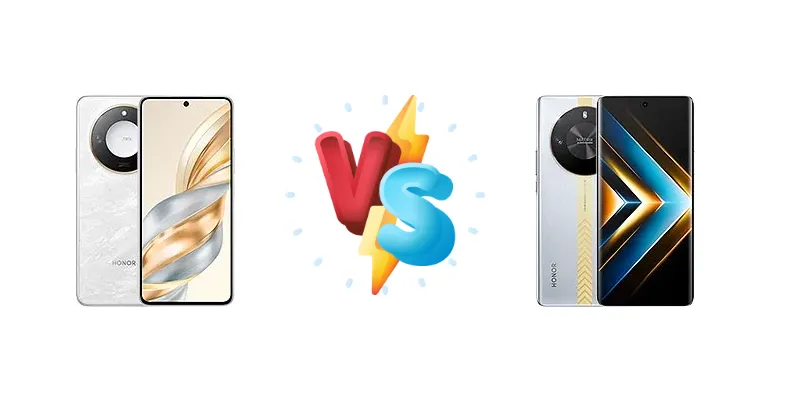
Honor's X series consistently delivers strong value, but the X50 GT and X60 represent diverging paths. The X60 focuses on a balanced experience with the Dimensity 7025 Ultra, while the X50 GT aggressively targets performance with the older, but still potent, Snapdragon 8+ Gen 1. This comparison dissects the trade-offs to help you choose the right phone for your needs.
🏆 Quick Verdict
For users prioritizing raw performance and gaming, the Honor X50 GT is the clear winner. The Snapdragon 8+ Gen 1 offers a significant leap in processing power. However, the Honor X60 provides a more efficient experience for everyday tasks and benefits from a slightly more refined power management profile, making it ideal for less demanding users.
| Network |
|---|
| 2G bands | GSM 850 / 900 / 1800 / 1900 | GSM 850 / 900 / 1800 / 1900 |
| 3G bands | HSDPA 850 / 900 / 1700(AWS) / 1900 / 2100 | HSDPA 850 / 900 / 1700(AWS) / 1900 / 2100 |
| 4G bands | LTE | LTE |
| 5G bands | SA/NSA | SA/NSA |
| Speed | HSPA, LTE, 5G | HSPA, LTE, 5G |
| Technology | GSM / CDMA / HSPA / CDMA2000 / LTE / 5G | GSM / CDMA / HSPA / CDMA2000 / LTE / 5G |
| Launch |
|---|
| Announced | 2024, October 16 | 2024, January 04 |
| Status | Available. Released 2024, October 25 | Available. Released 2024, January 09 |
| Body |
|---|
| Dimensions | 166 x 75.8 x 7.9 mm (6.54 x 2.98 x 0.31 in) | 163.6 x 75.5 x 8 mm (6.44 x 2.97 x 0.31 in) |
| SIM | Nano-SIM + Nano-SIM | Nano-SIM + Nano-SIM |
| Weight | 189 g (6.67 oz) | 192 g (6.77 oz) |
| Display |
|---|
| Resolution | 1080 x 2412 pixels, 20:9 ratio (~389 ppi density) | 1220 x 2652 pixels, 19.5:9 ratio (~431 ppi density) |
| Size | 6.8 inches, 111.3 cm2 (~88.4% screen-to-body ratio) | 6.78 inches, 112.6 cm2 (~91.2% screen-to-body ratio) |
| Type | TFT LCD, 120Hz, 850 (HBM) | AMOLED, 1B colors, 120Hz |
| Platform |
|---|
| CPU | Octa-core (2x2.5 GHz Cortex-A78 & 6x2.0 GHz Cortex-A55) | Octa-core (1x3.0 GHz Cortex-X2 & 3x2.5 GHz Cortex-A710 & 4x1.80 GHz Cortex-A510) |
| Chipset | Mediatek Dimensity 7025 Ultra (6 nm) | Qualcomm SM8475 Snapdragon 8+ Gen 1 (4 nm) |
| GPU | IMG BXM-8-256 | Adreno 730 |
| OS | Android 14, Magic OS 8 | Android 13, MagicOS 7.2 |
| Memory |
|---|
| Card slot | No | No |
| Internal | 128GB 8GB RAM, 256GB 8GB RAM, 256GB 12GB RAM, 512GB 12GB RAM | 256GB 12GB RAM, 256GB 16GB RAM, 512GB 16GB RAM, 1TB 16GB RAM |
| Main Camera |
|---|
| Dual | - | 108 MP, f/1.8, (wide), 1/1.67", PDAF
Auxiliary lens |
| Features | LED flash, panorama, HDR | LED flash, panorama, HDR |
| Single | 108 MP, f/1.8, (wide), 1/1.67", PDAF | - |
| Video | 1080p@30fps | 4K@30fps, 1080p@30fps |
| Selfie camera |
|---|
| Single | 8 MP, f/2.0, (wide) | 8 MP, f/2.0, (wide) |
| Video | 1080p@30fps | 1080p@30fps |
| Sound |
|---|
| 35mm jack | No | No |
| Loudspeaker | Yes | Yes |
| Comms |
|---|
| Bluetooth | 5.3, A2DP, LE, aptX HD | 5.2, A2DP, LE, aptX HD |
| NFC | No | Yes |
| Positioning | GPS, GLONASS, GALILEO, BDS | GPS, GLONASS, GALILEO, BDS |
| Radio | No | No |
| USB | USB Type-C 2.0, OTG | USB Type-C 2.0, OTG |
| WLAN | Wi-Fi 802.11 a/b/g/n/ac, dual-band, Wi-Fi Direct | Wi-Fi 802.11 a/b/g/n/ac/6, dual-band, Wi-Fi Direct |
| Features |
|---|
| Sensors | Fingerprint (side-mounted, optical), accelerometer, gyro, proximity (ultrasound), compass | Fingerprint (under display, optical), accelerometer, gyro, ultrasound proximity, compass |
| Battery |
|---|
| Charging | 35W wired
5W reverse wired | 35W wired
7.5W reverse wired |
| Type | Li-Po 5800 mAh | Li-Po 5800 mAh |
| Misc |
|---|
| Colors | Black, Green, Silver | Black, Silver |
| Models | BRC-AN00 | ALP-AN00 |
| Price | About 160 EUR | About 260 EUR |
Honor X60
- More efficient chipset for daily tasks
- Potentially better battery life due to Dimensity's efficiency
- Slightly lower price point (likely)
- Significantly lower peak performance
- Less capable gaming performance
- Inferior image processing capabilities
Honor X50 GT
- Superior processing power with Snapdragon 8+ Gen 1
- Enhanced gaming performance and multitasking
- Better image processing and low-light camera performance
- Potentially lower battery life under heavy load
- May run warmer under sustained workloads
- Likely a higher price point
Display Comparison
Both phones lack detailed display specifications in the provided data, but given their market positioning, we can infer similar LCD panels. The key difference lies in the processing power driving them. The X50 GT’s Snapdragon 8+ Gen 1 will handle graphically intensive content more smoothly. While neither is likely to feature LTPO technology, the X50 GT’s superior GPU will translate to higher, more consistent frame rates in games.
Camera Comparison
Without detailed camera specs, a direct comparison is difficult. However, the X50 GT’s more powerful ISP (Image Signal Processor) within the Snapdragon 8+ Gen 1 will likely result in better image processing, particularly in low-light conditions. The chipset’s ability to handle more complex algorithms will improve dynamic range and noise reduction. While both phones likely feature similar primary sensors, the X50 GT has the processing power to extract more detail and clarity from them. We anticipate the X50 GT will offer a more versatile and capable camera experience.
Performance
The core difference here is the chipset. The Qualcomm Snapdragon 8+ Gen 1 (4nm) in the X50 GT is a substantial upgrade over the MediaTek Dimensity 7025 Ultra (6nm) in the X60. The Snapdragon’s Cortex-X2 prime core, clocked at 3.0 GHz, provides a significant single-core performance boost, crucial for responsiveness and app loading times. The Dimensity 7025 Ultra’s Cortex-A78 cores, while capable, are less efficient and offer lower peak performance. The 4nm process node of the Snapdragon also contributes to better thermal efficiency, reducing the likelihood of throttling during sustained workloads. This means the X50 GT will maintain higher performance for longer periods, particularly during gaming.
Battery Life
Both phones offer 35W wired charging, but the X50 GT’s 7.5W reverse wired charging is a slight advantage over the X60’s 5W. The impact of battery capacity isn’t specified, but the Snapdragon 8+ Gen 1, despite its power, is more efficient than the Dimensity 7025 Ultra. This means the X50 GT could potentially offer comparable or even better real-world battery life despite potentially having a similar or smaller battery capacity. The faster charging speed on the X50 GT also means less time tethered to a wall.
Buying Guide
Buy the Honor X60 if you need a reliable daily driver with good battery life and don't prioritize demanding mobile gaming. It's perfect for social media, streaming, and general productivity. Buy the Honor X50 GT if you prefer a phone capable of handling graphically intensive games, multitasking, and demanding applications without compromise. It's the choice for power users and mobile gamers.
Frequently Asked Questions
❓ Will the Snapdragon 8+ Gen 1 in the X50 GT overheat during prolonged gaming sessions?
While the Snapdragon 8+ Gen 1 is a powerful chip, its 4nm process node is relatively efficient. Honor likely implements thermal management solutions to mitigate overheating. However, expect some degree of warmth during extended gaming, which is normal for high-performance phones. The X60, with its Dimensity 7025 Ultra, will run cooler but at the cost of performance.
❓ Is the difference in charging speed (35W vs 35W with different reverse charging) noticeable in everyday use?
The 35W wired charging is the same on both, so 0-100% times will be similar. The difference lies in reverse charging: 7.5W on the X50 GT versus 5W on the X60. This means the X50 GT can top up accessories like earbuds or smartwatches slightly faster, but it's not a game-changing difference.
❓ How much of a performance difference will I see in everyday tasks like browsing and social media?
For basic tasks, the performance difference will be minimal. Both phones are more than capable of handling everyday use. However, the X50 GT’s Snapdragon 8+ Gen 1 will feel snappier and more responsive when switching between apps or loading complex web pages. The X60 will still be perfectly adequate, but the X50 GT offers a smoother, more fluid experience.