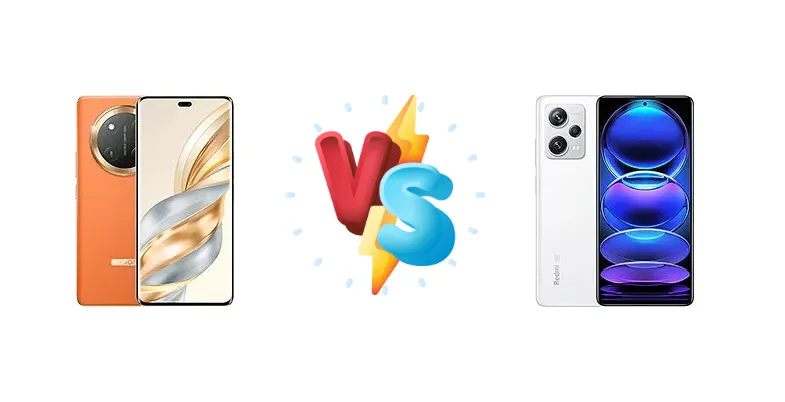
The Honor X60 Pro and Xiaomi Redmi Note 12 Pro+ represent compelling options in the increasingly competitive mid-range smartphone market. While both aim to deliver a premium experience without the flagship price tag, they take distinctly different approaches – Honor prioritizing efficiency with a Snapdragon 6 Gen 1, while Xiaomi focuses on raw speed and charging prowess with a Dimensity 1080. This comparison dissects their strengths and weaknesses to help you choose the right device.
🏆 Quick Verdict
For the average user prioritizing all-day battery life and a smooth, efficient experience, the Xiaomi Redmi Note 12 Pro+ emerges as the winner. Its significantly faster 120W charging and strong Dimensity 1080 performance outweigh the Honor X60 Pro’s slightly more efficient chipset.
| Network |
|---|
| 2G bands | GSM 850 / 900 / 1800 / 1900 | GSM 850 / 900 / 1800 / 1900 - SIM 1 & SIM 2 |
| 3G bands | HSDPA 850 / 900 / 1700(AWS) / 1900 / 2100 | HSDPA 800 / 850 / 900 / 1900 / 2100 |
| 4G bands | LTE | 1, 3, 5, 8, 19, 34, 38, 39, 40, 41 - International, China |
| 5G bands | SA/NSA | 1, 3, 5, 8, 28, 38, 40, 41, 77, 78 SA/NSA - International |
| Speed | HSPA, LTE, 5G | HSPA, LTE-A (CA), 5G |
| Technology | GSM / CDMA / HSPA / CDMA2000 / LTE / 5G | GSM / CDMA / HSPA / EVDO / LTE / 5G |
| | - | 1, 3, 5, 8, 28, 38, 41, 77, 78 SA/NSA - China |
| Launch |
|---|
| Announced | 2024, October 16 | 2022, October 27 |
| Status | Available. Released 2024, October 25 | Available. Released 2022, November 01 |
| Body |
|---|
| Build | Glass front, plastic back | Glass front (Gorilla Glass 5), glass back |
| Dimensions | 162.8 x 75.5 x 8 mm (6.41 x 2.97 x 0.31 in) | 162.9 x 76 x 8.9 mm (6.41 x 2.99 x 0.35 in) |
| SIM | Nano-SIM + Nano-SIM | Dual SIM (Nano-SIM, dual stand-by) |
| Weight | 188 g (6.63 oz) | 208.4 g (7.34 oz) |
| | - | IP53, dust and splash resistant |
| Display |
|---|
| Protection | Tempered glass | Corning Gorilla Glass 5 |
| Resolution | 1224 x 2700 pixels (~437 ppi density) | 1080 x 2400 pixels, 20:9 ratio (~395 ppi density) |
| Size | 6.78 inches, 111.5 cm2 (~90.7% screen-to-body ratio) | 6.67 inches, 107.4 cm2 (~86.8% screen-to-body ratio) |
| Type | AMOLED, 1B colors, 120Hz, 3000 (peak) | OLED, 1B colors, 120Hz, Dolby Vision, HDR10+, 500 nits (typ), 900 nits (HBM) |
| Platform |
|---|
| CPU | Octa-core (4x2.2 GHz Cortex-A78 & 4x1.8 GHz Cortex-A55) | Octa-core (2x2.6 GHz Cortex-A78 & 6x2.0 GHz Cortex-A55) |
| Chipset | Qualcomm SM6450 Snapdragon 6 Gen 1 (4 nm) | Mediatek MT6877V Dimensity 1080 (6 nm) |
| GPU | Adreno 710 | Mali-G68 MC4 |
| OS | Android 14, Magic OS 8 | Android 12, MIUI 13 |
| Memory |
|---|
| Card slot | No | No |
| Internal | 128GB 8GB RAM, 256GB 8GB RAM, 256GB 12GB RAM, 512GB 12GB RAM | 256GB 8GB RAM, 256GB 12GB RAM |
| | - | UFS 2.2 |
| Main Camera |
|---|
| Features | LED flash, panorama, HDR | Dual-LED dual-tone flash, HDR, panorama |
| Single | 108 MP, f/1.8, (wide), 1/1.67", PDAF | - |
| Triple | - | 200 MP, f/1.7, 24mm (wide), 1/1.4", 0.56µm, PDAF, OIS
8 MP, f/2.2, 120˚ (ultrawide), 1/4", 1.12µm
2 MP, f/2.4, (macro) |
| Video | 4K@30fps, 1080p@30fps | 4K@30fps, 1080p@30/60/120fps, 720p@960fps |
| Selfie camera |
|---|
| Features | - | HDR |
| Single | 8 MP, f/2.0, (wide) | 16 MP, f/2.5, (wide), 1/3.06", 1.0µm |
| Video | 1080p@30fps | 1080p@30/60fps |
| Sound |
|---|
| 3.5mm jack | - | Yes |
| 35mm jack | No | - |
| Loudspeaker | Yes, with stereo speakers | Yes, with stereo speakers |
| | - | 24-bit/192kHz audio |
| Comms |
|---|
| Bluetooth | 5.1, A2DP, LE, aptX HD | 5.2, A2DP, LE |
| Infrared port | - | Yes |
| NFC | No | Yes (market/region dependent) |
| Positioning | GPS, GLONASS, GALILEO, BDS | GPS (L1), GLONASS (G1), BDS (B1I+B1c), GALILEO (E1), QZSS (L1) |
| Radio | No | No |
| USB | USB Type-C 2.0, OTG | USB Type-C 2.0, OTG |
| WLAN | Wi-Fi 802.11 a/b/g/n/ac, dual-band, Wi-Fi Direct | Wi-Fi 802.11 a/b/g/n/ac/6, dual-band, Wi-Fi Direct |
| Features |
|---|
| Sensors | Fingerprint (under display, optical), accelerometer, gyro, proximity (ultrasound), compass | Fingerprint (side-mounted), accelerometer, proximity, gyro, compass |
| Battery |
|---|
| Charging | 66W wired
5W reverse wired | 120W wired, PD3.0, 100% in 19 min (advertised) |
| Type | Si/C Li-Ion 6600 mAh | Li-Po 5000 mAh, non-removable |
| Misc |
|---|
| Colors | Black, Green, Silver, Orange | Arctic White, Iceberg Blue, Obsidian Black, Trend edition |
| Models | BRP-AN00 | 22101316UCP, 22101316UG |
| Price | About 200 EUR | $ 348.00 / £ 439.00 / € 399.00 / ₹ 29,949 |
| Tests |
|---|
| Battery life | - |
Endurance rating 88h
|
| Camera | - |
Photo / Video |
| Display | - |
Contrast ratio: Infinite (nominal) |
| Loudspeaker | - |
-26.7 LUFS (Good)
|
| Performance | - |
AnTuTu: 498710 (v9)
GeekBench: 2208 (v5.1), 2372 (v6)
GFXBench: 22fps (ES 3.1 onscreen) |
Honor X60 Pro
- More power-efficient chipset (Snapdragon 6 Gen 1)
- 5W Reverse Wired Charging
- Potentially longer battery life during moderate use
- Slower charging speed (66W vs 120W)
- Less powerful CPU for demanding tasks
- Missing display specifications
Xiaomi Redmi Note 12 Pro+
- Blazing-fast 120W charging (0-100% in 19 mins)
- More powerful Dimensity 1080 chipset
- Likely superior display quality
- Potentially lower battery efficiency
- No reverse wired charging
- Missing detailed camera specifications
Display Comparison
The Redmi Note 12 Pro+ boasts an unspecified, but likely high-quality, display with an 'Infinite' contrast ratio, suggesting a vibrant viewing experience. While the Honor X60 Pro’s display specs are absent, both devices likely utilize AMOLED panels common in this price bracket. The key differentiator here is likely peak brightness and color accuracy, areas where Xiaomi often excels. Without specific nit ratings for the Honor X60 Pro, it’s difficult to definitively declare a winner, but the Redmi Note 12 Pro+’s marketing suggests a more visually striking display.
Camera Comparison
The Redmi Note 12 Pro+ is expected to feature a more sophisticated camera system, though specific details are missing. The Honor X60 Pro’s camera specs are also unavailable. Given Xiaomi’s history, the Redmi Note 12 Pro+ likely includes Optical Image Stabilization (OIS) on its main sensor, a feature that significantly improves low-light photography and video stabilization. Without knowing the sensor sizes and apertures of both devices, a definitive camera comparison is impossible. However, Xiaomi’s focus on camera technology suggests a more feature-rich and capable imaging experience.
Performance
The core difference lies in the chipsets. The Xiaomi Redmi Note 12 Pro+’s Mediatek Dimensity 1080 (6nm) features a more aggressive CPU configuration with 2x2.6 GHz Cortex-A78 cores compared to the Honor X60 Pro’s Qualcomm Snapdragon 6 Gen 1 (4nm) which has 4x2.2 GHz Cortex-A78 cores. This translates to a noticeable performance advantage for the Redmi Note 12 Pro+ in CPU-intensive tasks and gaming. However, the Snapdragon 6 Gen 1’s 4nm process offers superior power efficiency, potentially leading to longer battery life during sustained use. The Redmi Note 12 Pro+ benefits from the 6nm process, but the core count and clock speeds give it the edge in raw power. The absence of LPDDR5X RAM specifications for either device makes a direct memory bandwidth comparison impossible, but both likely utilize fast RAM configurations.
Battery Life
The Redmi Note 12 Pro+’s 120W wired charging is a game-changer, promising a full charge in a mere 19 minutes (advertised). This is a significant advantage over the Honor X60 Pro’s 66W charging. While the Honor X60 Pro also offers 5W reverse wired charging, a feature absent in the Redmi Note 12 Pro+, the sheer speed of the Xiaomi’s charging capability is a major draw. The Redmi Note 12 Pro+ also boasts an endurance rating of 88 hours, suggesting excellent battery optimization despite the faster charging. The actual battery capacity of both devices is unknown, but the charging speed difference is substantial.
Buying Guide
Buy the Honor X60 Pro if you prioritize long-term battery health and a consistently smooth experience over peak performance. Its 66W charging is respectable, and the Snapdragon 6 Gen 1 offers excellent efficiency. Buy the Xiaomi Redmi Note 12 Pro+ if you demand the fastest possible charging speeds, a more powerful processor for gaming and demanding apps, and don't mind potentially slightly shorter battery life between charges.
Frequently Asked Questions
❓ Is the Dimensity 1080 in the Redmi Note 12 Pro+ prone to overheating during extended gaming sessions?
While the Dimensity 1080 is a capable chipset, sustained high loads can generate heat. However, Xiaomi typically implements effective thermal management solutions, including vapor chamber cooling, to mitigate throttling. Real-world performance will depend on ambient temperature and game settings, but it's unlikely to experience severe overheating.
❓ How does the 66W charging on the Honor X60 Pro compare to typical slow charging speeds?
66W charging is still considerably faster than standard 18W or 25W charging. While not as rapid as the Redmi Note 12 Pro+'s 120W, it can still top up the battery from 0-50% in around 30 minutes, providing a convenient boost when needed.
❓ Does the Redmi Note 12 Pro+ support high refresh rate gaming, like 90fps or 120fps in popular titles?
The Dimensity 1080 chipset is capable of supporting high refresh rate gaming, but performance will vary depending on the game and graphics settings. Many popular titles will likely run at 60fps with high graphics, while some may achieve 90fps with optimized settings. 120fps is less likely without significant compromises in visual fidelity.
❓ Is the lack of detailed camera specs on the Honor X60 Pro a major concern?
The absence of specific camera details is concerning. It suggests that the camera system may not be a primary selling point of the device. Without knowing the sensor size, aperture, and image processing capabilities, it's difficult to assess its performance relative to the Redmi Note 12 Pro+.