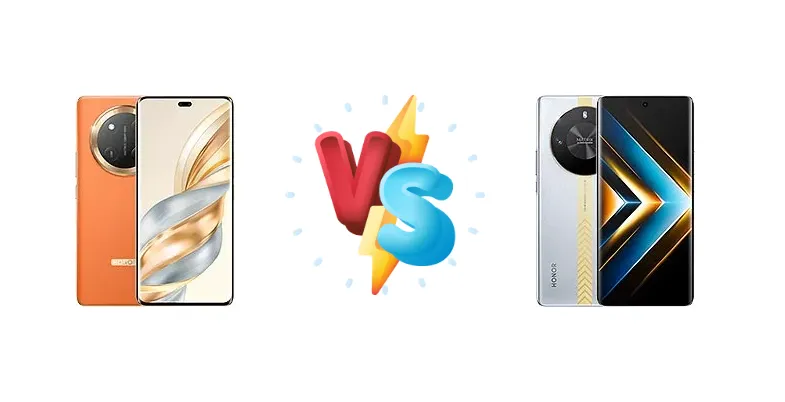
Honor has been aggressively targeting the mid-range market with compelling devices. The X50 GT and X60 Pro represent two distinct approaches: the X50 GT prioritizes raw processing power with the Snapdragon 8+ Gen 1, while the X60 Pro aims for efficiency and a balanced experience with the Snapdragon 6 Gen 1. This comparison dissects the key differences to help you determine which phone best suits your needs.
🏆 Quick Verdict
For users prioritizing gaming and demanding tasks, the Honor X50 GT is the clear winner thanks to its significantly more powerful Snapdragon 8+ Gen 1 chipset. However, the Honor X60 Pro offers a compelling value proposition for everyday users who prioritize efficiency and don't need top-tier performance.
| Network |
|---|
| 2G bands | GSM 850 / 900 / 1800 / 1900 | GSM 850 / 900 / 1800 / 1900 |
| 3G bands | HSDPA 850 / 900 / 1700(AWS) / 1900 / 2100 | HSDPA 850 / 900 / 1700(AWS) / 1900 / 2100 |
| 4G bands | LTE | LTE |
| 5G bands | SA/NSA | SA/NSA |
| Speed | HSPA, LTE, 5G | HSPA, LTE, 5G |
| Technology | GSM / CDMA / HSPA / CDMA2000 / LTE / 5G | GSM / CDMA / HSPA / CDMA2000 / LTE / 5G |
| Launch |
|---|
| Announced | 2024, October 16 | 2024, January 04 |
| Status | Available. Released 2024, October 25 | Available. Released 2024, January 09 |
| Body |
|---|
| Build | Glass front, plastic back | - |
| Dimensions | 162.8 x 75.5 x 8 mm (6.41 x 2.97 x 0.31 in) | 163.6 x 75.5 x 8 mm (6.44 x 2.97 x 0.31 in) |
| SIM | Nano-SIM + Nano-SIM | Nano-SIM + Nano-SIM |
| Weight | 188 g (6.63 oz) | 192 g (6.77 oz) |
| Display |
|---|
| Protection | Tempered glass | - |
| Resolution | 1224 x 2700 pixels (~437 ppi density) | 1220 x 2652 pixels, 19.5:9 ratio (~431 ppi density) |
| Size | 6.78 inches, 111.5 cm2 (~90.7% screen-to-body ratio) | 6.78 inches, 112.6 cm2 (~91.2% screen-to-body ratio) |
| Type | AMOLED, 1B colors, 120Hz, 3000 (peak) | AMOLED, 1B colors, 120Hz |
| Platform |
|---|
| CPU | Octa-core (4x2.2 GHz Cortex-A78 & 4x1.8 GHz Cortex-A55) | Octa-core (1x3.0 GHz Cortex-X2 & 3x2.5 GHz Cortex-A710 & 4x1.80 GHz Cortex-A510) |
| Chipset | Qualcomm SM6450 Snapdragon 6 Gen 1 (4 nm) | Qualcomm SM8475 Snapdragon 8+ Gen 1 (4 nm) |
| GPU | Adreno 710 | Adreno 730 |
| OS | Android 14, Magic OS 8 | Android 13, MagicOS 7.2 |
| Memory |
|---|
| Card slot | No | No |
| Internal | 128GB 8GB RAM, 256GB 8GB RAM, 256GB 12GB RAM, 512GB 12GB RAM | 256GB 12GB RAM, 256GB 16GB RAM, 512GB 16GB RAM, 1TB 16GB RAM |
| Main Camera |
|---|
| Dual | - | 108 MP, f/1.8, (wide), 1/1.67", PDAF
Auxiliary lens |
| Features | LED flash, panorama, HDR | LED flash, panorama, HDR |
| Single | 108 MP, f/1.8, (wide), 1/1.67", PDAF | - |
| Video | 4K@30fps, 1080p@30fps | 4K@30fps, 1080p@30fps |
| Selfie camera |
|---|
| Single | 8 MP, f/2.0, (wide) | 8 MP, f/2.0, (wide) |
| Video | 1080p@30fps | 1080p@30fps |
| Sound |
|---|
| 35mm jack | No | No |
| Loudspeaker | Yes, with stereo speakers | Yes |
| Comms |
|---|
| Bluetooth | 5.1, A2DP, LE, aptX HD | 5.2, A2DP, LE, aptX HD |
| NFC | No | Yes |
| Positioning | GPS, GLONASS, GALILEO, BDS | GPS, GLONASS, GALILEO, BDS |
| Radio | No | No |
| USB | USB Type-C 2.0, OTG | USB Type-C 2.0, OTG |
| WLAN | Wi-Fi 802.11 a/b/g/n/ac, dual-band, Wi-Fi Direct | Wi-Fi 802.11 a/b/g/n/ac/6, dual-band, Wi-Fi Direct |
| Features |
|---|
| Sensors | Fingerprint (under display, optical), accelerometer, gyro, proximity (ultrasound), compass | Fingerprint (under display, optical), accelerometer, gyro, ultrasound proximity, compass |
| Battery |
|---|
| Charging | 66W wired
5W reverse wired | 35W wired
7.5W reverse wired |
| Type | Si/C Li-Ion 6600 mAh | Li-Po 5800 mAh |
| Misc |
|---|
| Colors | Black, Green, Silver, Orange | Black, Silver |
| Models | BRP-AN00 | ALP-AN00 |
| Price | About 200 EUR | About 260 EUR |
Honor X60 Pro
- Faster 66W wired charging
- More power-efficient chipset for longer battery life during typical use
- Potentially lower price point
- Significantly lower processing power compared to the X50 GT
- Less capable GPU for gaming
- Slower app loading and multitasking
Honor X50 GT
- Much faster Snapdragon 8+ Gen 1 processor
- Superior GPU performance for gaming and graphics-intensive tasks
- Better image processing capabilities
- Slower 35W wired charging
- Potentially higher price
- May experience more thermal throttling under sustained load
Display Comparison
While both devices likely feature similar LCD or OLED panels (data not provided), the core difference lies in the processing power driving them. Display quality will be more dependent on panel calibration and brightness, which are not specified. However, the X50 GT’s superior chipset will allow for smoother rendering of complex animations and faster response times in games, indirectly enhancing the visual experience.
Camera Comparison
Without specific camera sensor details, it’s difficult to make a definitive comparison. However, the X50 GT’s more powerful ISP (Image Signal Processor) within the Snapdragon 8+ Gen 1 will likely result in better image processing, particularly in low-light conditions. Faster processing allows for more sophisticated noise reduction and dynamic range optimization. The X60 Pro’s ISP, while capable, will be limited by the overall processing power of the Snapdragon 6 Gen 1. Expect the X50 GT to handle complex computational photography features more effectively.
Performance
The Snapdragon 8+ Gen 1 in the Honor X50 GT represents a massive leap in performance over the Snapdragon 6 Gen 1 found in the X60 Pro. The 8+ Gen 1’s Cortex-X2 prime core, clocked at 3.0 GHz, significantly outperforms the Cortex-A78 cores (2.2 GHz) in the 6 Gen 1. This translates to faster app loading times, smoother multitasking, and a far superior gaming experience. The 8+ Gen 1’s Adreno 730 GPU also dwarfs the Adreno 643 in the 6 Gen 1. While both chipsets are built on a 4nm process, the architectural differences and higher clock speeds of the 8+ Gen 1 provide a substantial advantage. The X50 GT will likely exhibit less frame rate drops and maintain higher average FPS in demanding titles.
Battery Life
The Honor X60 Pro’s 66W wired charging is faster than the X50 GT’s 35W charging. This means the X60 Pro will achieve a 0-100% charge in a shorter timeframe. However, the Snapdragon 8+ Gen 1 in the X50 GT is more power-efficient than the Snapdragon 6 Gen 1. This efficiency could offset the slower charging speed in real-world usage, potentially resulting in comparable or even slightly better battery life despite a potentially smaller battery capacity (not specified). The 5W/7.5W reverse wired charging on both devices is primarily for convenience, offering a slow trickle charge for accessories.
Buying Guide
Buy the Honor X60 Pro if you need a reliable daily driver with good battery life and don't plan on intensive gaming or demanding applications. Its Snapdragon 6 Gen 1 provides sufficient power for typical tasks. Buy the Honor X50 GT if you prefer a phone capable of handling graphically intensive games, video editing, or other resource-heavy workloads. The Snapdragon 8+ Gen 1 delivers a substantial performance boost, making it ideal for power users.
Frequently Asked Questions
❓ Will the Snapdragon 8+ Gen 1 in the X50 GT overheat during prolonged gaming sessions?
The Snapdragon 8+ Gen 1 is known to generate heat under sustained load. While Honor likely implements thermal management solutions, some throttling is possible during extended gaming. However, the improved efficiency of the 4nm process and the chipset's architecture mitigate this issue compared to older Snapdragon 8 Gen 1 variants.
❓ Is the difference in charging speed between 66W and 35W noticeable in everyday use?
Yes, the 66W charging on the X60 Pro will significantly reduce charging times. A full charge will take considerably less time compared to the X50 GT. For users who frequently need to top up their phone quickly, the X60 Pro’s faster charging is a significant advantage.
❓ How much of a performance difference will I see in everyday tasks like browsing and social media?
For basic tasks like browsing, social media, and email, the performance difference between the two phones will be minimal. Both chipsets are more than capable of handling these workloads smoothly. The benefits of the Snapdragon 8+ Gen 1 will be most apparent in demanding applications and games.
❓ Does the Honor X50 GT support high refresh rate gaming?
While not explicitly stated, the Snapdragon 8+ Gen 1 is capable of driving high refresh rate displays. Whether the Honor X50 GT’s display supports a high refresh rate (e.g., 120Hz or 144Hz) will determine its ability to deliver a smoother gaming experience. The chipset itself is not a limiting factor.