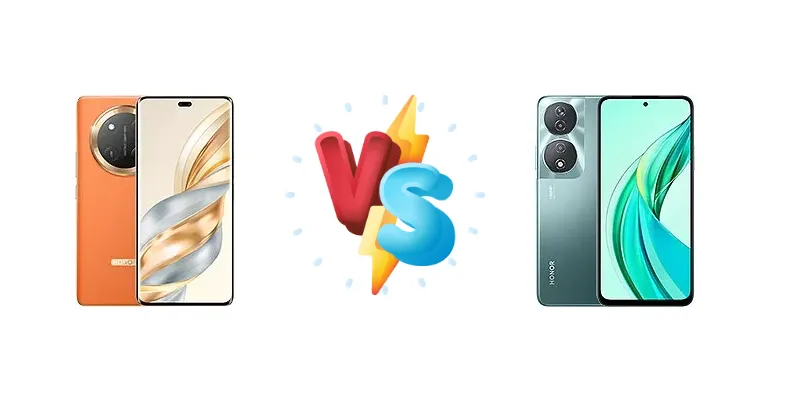
Honor's mid-range offerings, the X60 Pro and 90 Smart, present a compelling choice for budget-conscious consumers. The X60 Pro leverages Qualcomm's 4nm Snapdragon 6 Gen 1, while the 90 Smart opts for MediaTek's 7nm Dimensity 6020. This comparison dissects the key differences, focusing on performance, charging, and overall user experience to determine which device delivers the best value.
🏆 Quick Verdict
For most users, the Honor X60 Pro emerges as the stronger contender. Its more efficient 4nm Snapdragon 6 Gen 1 chipset promises better sustained performance and thermal management, coupled with faster 66W charging. While the 90 Smart offers a competitive package, the X60 Pro's edge in processing power and charging speed justifies its slight price premium.
| Network |
|---|
| 2G bands | GSM 850 / 900 / 1800 / 1900 | GSM 850 / 900 / 1800 / 1900 |
| 3G bands | HSDPA 850 / 900 / 1700(AWS) / 1900 / 2100 | HSDPA 850 / 900 / 1900 / 2100 |
| 4G bands | LTE | LTE |
| 5G bands | SA/NSA | SA/NSA |
| Speed | HSPA, LTE, 5G | HSPA, LTE, 5G |
| Technology | GSM / CDMA / HSPA / CDMA2000 / LTE / 5G | GSM / HSPA / LTE / 5G |
| Launch |
|---|
| Announced | 2024, October 16 | 2024, April 09 |
| Status | Available. Released 2024, October 25 | Available. Released 2024, April 12 |
| Body |
|---|
| Build | Glass front, plastic back | - |
| Dimensions | 162.8 x 75.5 x 8 mm (6.41 x 2.97 x 0.31 in) | 166.7 x 76.5 x 8.2 mm (6.56 x 3.01 x 0.32 in) |
| SIM | Nano-SIM + Nano-SIM | Nano-SIM + Nano-SIM |
| Weight | 188 g (6.63 oz) | 199 g (7.02 oz) |
| Display |
|---|
| Protection | Tempered glass | - |
| Resolution | 1224 x 2700 pixels (~437 ppi density) | 1080 x 2412 pixels, 20:9 ratio (~389 ppi density) |
| Size | 6.78 inches, 111.5 cm2 (~90.7% screen-to-body ratio) | 6.8 inches, 111.3 cm2 (~87.3% screen-to-body ratio) |
| Type | AMOLED, 1B colors, 120Hz, 3000 (peak) | IPS LCD, 90Hz, 850 nits (peak) |
| Platform |
|---|
| CPU | Octa-core (4x2.2 GHz Cortex-A78 & 4x1.8 GHz Cortex-A55) | Octa-core (2x2.2 GHz Cortex-A76 & 6x2.0 GHz Cortex-A55) |
| Chipset | Qualcomm SM6450 Snapdragon 6 Gen 1 (4 nm) | Mediatek Dimensity 6020 (7 nm) |
| GPU | Adreno 710 | Mali-G57 MC2 |
| OS | Android 14, Magic OS 8 | Android 13, Magic OS 7.2 |
| Memory |
|---|
| Card slot | No | No |
| Internal | 128GB 8GB RAM, 256GB 8GB RAM, 256GB 12GB RAM, 512GB 12GB RAM | 128GB 4GB RAM, 256GB 4GB RAM, 256GB 6GB RAM |
| Main Camera |
|---|
| Features | LED flash, panorama, HDR | LED flash, HDR, panorama |
| Single | 108 MP, f/1.8, (wide), 1/1.67", PDAF | - |
| Triple | - | 108 MP, f/1.8, (wide), PDAF
2 MP (macro)
Auxiliary lens |
| Video | 4K@30fps, 1080p@30fps | 1080p@30fps |
| Selfie camera |
|---|
| Single | 8 MP, f/2.0, (wide) | 8 MP, f/2.0, (wide) |
| Video | 1080p@30fps | 1080p@30fps |
| Sound |
|---|
| 35mm jack | No | Yes |
| Loudspeaker | Yes, with stereo speakers | Yes, with stereo speakers |
| Comms |
|---|
| Bluetooth | 5.1, A2DP, LE, aptX HD | 5.1, A2DP, LE |
| NFC | No | Yes |
| Positioning | GPS, GLONASS, GALILEO, BDS | GPS, GLONASS, GALILEO, BDS |
| Radio | No | No |
| USB | USB Type-C 2.0, OTG | USB Type-C 2.0, OTG |
| WLAN | Wi-Fi 802.11 a/b/g/n/ac, dual-band, Wi-Fi Direct | Wi-Fi 802.11 a/b/g/n/ac, dual-band, Wi-Fi Direct |
| Features |
|---|
| Sensors | Fingerprint (under display, optical), accelerometer, gyro, proximity (ultrasound), compass | Fingerprint (side-mounted), accelerometer, compass |
| Battery |
|---|
| Charging | 66W wired
5W reverse wired | 35W wired |
| Type | Si/C Li-Ion 6600 mAh | Li-Po 5330 mAh |
| Misc |
|---|
| Colors | Black, Green, Silver, Orange | Emerald Green, Midnight Black |
| Models | BRP-AN00 | CLK-NX1, CLK-NX3 |
| Price | About 200 EUR | About 170 EUR |
Honor X60 Pro
- Faster 66W charging for quicker top-ups
- More efficient 4nm Snapdragon 6 Gen 1 chipset
- Potentially better sustained performance for gaming
- May be slightly more expensive than the 90 Smart
- Specific battery capacity is unknown
Honor 90 Smart
- Potentially lower price point
- Decent performance for everyday tasks
- MediaTek Dimensity 6020 offers good power efficiency for basic use
- Slower 35W charging
- Less powerful chipset compared to the Snapdragon 6 Gen 1
Display Comparison
While display specifications are missing, both phones likely feature LCD panels typical of this price bracket. However, the chipset differences indirectly impact display experience. The Snapdragon 6 Gen 1's superior GPU could translate to smoother scrolling and animations, even on a similar panel. The 7nm Dimensity 6020, while capable, may exhibit slightly more strain during graphically intensive tasks, potentially impacting perceived smoothness. Without knowing the panel technology (IPS, TFT) or refresh rates, a definitive display winner is impossible to declare.
Camera Comparison
Without detailed camera specifications, a direct comparison is limited. However, the chipset's image signal processor (ISP) plays a crucial role. Qualcomm's ISPs generally offer superior image processing capabilities, potentially resulting in better dynamic range and noise reduction in the X60 Pro. The 7nm Dimensity 6020's ISP is adequate, but may not match the Snapdragon's performance in challenging lighting conditions. The presence or absence of Optical Image Stabilization (OIS) on either device would be a significant differentiator, but is currently unknown.
Performance
The core difference lies in the chipsets. The Honor X60 Pro’s Qualcomm Snapdragon 6 Gen 1 (4nm) boasts a more modern architecture with four Cortex-A78 cores clocked at 2.2 GHz, offering a performance advantage over the Honor 90 Smart’s MediaTek Dimensity 6020 (7nm) which uses older Cortex-A76 cores at the same clock speed. The 4nm process node of the Snapdragon is significantly more efficient, leading to lower heat generation and potentially less throttling under sustained load. This benefits gamers and users running multiple applications simultaneously. The Dimensity 6020, however, is still a capable performer for everyday tasks, but will likely show its limitations in demanding scenarios.
Battery Life
The Honor X60 Pro’s 66W wired charging is a clear advantage over the 90 Smart’s 35W charging. This translates to significantly faster charging times – potentially reaching 100% in under 45 minutes for the X60 Pro versus potentially over an hour for the 90 Smart. While battery capacity is unknown for both devices, the Snapdragon 6 Gen 1’s 4nm efficiency could offset a potentially smaller battery size in the X60 Pro, resulting in comparable or even better real-world battery life.
Buying Guide
Buy the Honor X60 Pro if you prioritize sustained performance for gaming or multitasking, and value faster charging speeds for minimal downtime. It's ideal for users who frequently use demanding apps or enjoy extended gaming sessions. Buy the Honor 90 Smart if you prefer a slightly more power-efficient chipset for everyday tasks and prioritize a potentially lower price point. It's a solid choice for users focused on social media, streaming, and basic productivity.
Frequently Asked Questions
❓ Will the Dimensity 6020 in the Honor 90 Smart struggle with graphically demanding games like Genshin Impact?
While the Dimensity 6020 can run Genshin Impact, you'll likely need to lower the graphics settings to medium or low to maintain a stable frame rate. The Snapdragon 6 Gen 1 in the X60 Pro offers a more comfortable gaming experience at higher settings due to its more powerful GPU and efficient architecture.
❓ How much faster is the 66W charging on the Honor X60 Pro compared to the 35W charging on the Honor 90 Smart?
The 66W charging on the X60 Pro can potentially charge the phone from 0% to 100% in around 40-45 minutes, while the 35W charging on the 90 Smart will likely take over an hour. This difference is significant for users who frequently need to quickly top up their battery.
❓ Does the Snapdragon 6 Gen 1 in the X60 Pro get noticeably warmer during extended gaming sessions compared to the Dimensity 6020?
Despite the Snapdragon 6 Gen 1 being more powerful, its 4nm process node actually contributes to *less* heat generation under load compared to the Dimensity 6020's 7nm process. This means the X60 Pro is likely to experience less thermal throttling and maintain higher performance for longer periods during gaming.