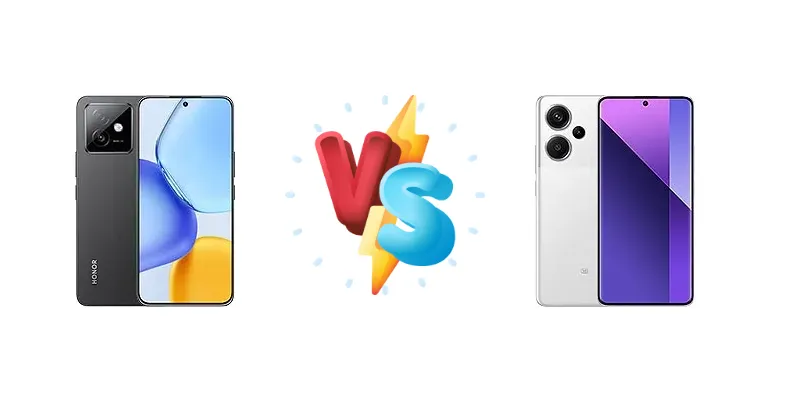
The Honor X60 GT and Xiaomi Redmi Note 13 Pro+ represent compelling options in the increasingly competitive mid-range smartphone market. The X60 GT leverages the older, but still potent, Snapdragon 8+ Gen 1, while the Redmi Note 13 Pro+ opts for the newer Mediatek Dimensity 7200 Ultra. This comparison dissects the key differences to determine which device delivers the best overall experience.
🏆 Quick Verdict
For the average user prioritizing all-around usability and convenience, the Xiaomi Redmi Note 13 Pro+ is the better choice. Its significantly faster 120W charging, coupled with respectable battery life, outweighs the X60 GT’s slightly more powerful, but older, chipset. Gamers may find the X60 GT appealing, but thermal management needs consideration.
| Network |
|---|
| 2G bands | GSM 850 / 900 / 1800 / 1900 | GSM 850 / 900 / 1800 / 1900 |
| 3G bands | HSDPA 850 / 900 / 1900 / 2100 | HSDPA 800 / 850 / 900 / 1700(AWS) / 1900 / 2100 - International |
| 4G bands | LTE | 1, 2, 3, 4, 5, 7, 8, 12, 13, 17, 18, 19, 20, 26, 28, 32, 38, 40, 41, 66 - International |
| 5G bands | SA/NSA | 1, 3, 5, 7, 8, 20, 28, 38, 40, 41, 66, 77, 78 SA/NSA- International |
| Speed | HSPA, LTE, 5G | HSPA, LTE, 5G |
| Technology | GSM / CDMA / HSPA / EVDO / LTE / 5G | GSM / CDMA / HSPA / EVDO / LTE / 5G |
| Launch |
|---|
| Announced | 2025, April 22 | 2023, September 21 |
| Status | Available. Released 2025, April 22 | Available. Released 2023, September 21 |
| Body |
|---|
| Build | - | Glass front (Gorilla Glass Victus), glass back or silicone polymer back (eco leather) |
| Dimensions | 161 x 74.2 x 7.7 mm (6.34 x 2.92 x 0.30 in) | 161.4 x 74.2 x 8.9 mm (6.35 x 2.92 x 0.35 in) |
| SIM | Nano-SIM + Nano-SIM | · Nano-SIM + eSIM· Nano-SIM + Nano-SIM |
| Weight | 193 g (6.81 oz) | 199 g or 204.5 g (7.02 oz) |
| Display |
|---|
| Protection | Aluminosilicate glass | Corning Gorilla Glass Victus |
| Resolution | 1200 x 2664 pixels (~436 ppi density) | 1220 x 2712 pixels, 20:9 ratio (~446 ppi density) |
| Size | 6.7 inches, 108.5 cm2 (~90.8% screen-to-body ratio) | 6.67 inches, 107.4 cm2 (~89.7% screen-to-body ratio) |
| Type | AMOLED, 1B colors, 120Hz, HDR, 5000 nits (peak) | AMOLED, 68B colors, 120Hz, 1920Hz PWM, Dolby Vision, HDR10+, 1800 nits (peak) |
| Platform |
|---|
| CPU | Octa-core (1x3.2 GHz Cortex-X2 & 3x2.75 GHz Cortex-A710 & 4x2.0 GHz Cortex-A510) | Octa-core (2x2.8 GHz Cortex-A715 & 6x2.0 GHz Cortex-A510) |
| Chipset | Qualcomm SM8475 Snapdragon 8+ Gen 1 (4 nm) | Mediatek Dimensity 7200 Ultra (4 nm) |
| GPU | Adreno 730 | Mali-G610 MC4 |
| OS | Android 15, MagicOS 9 | Android 13, up to 3 major Android upgrades, HyperOS |
| Memory |
|---|
| Card slot | No | No |
| Internal | 256GB 12GB RAM, 512GB 12GB RAM, 512GB 16GB RAM | 256GB 8GB RAM, 256GB 12GB RAM, 512GB 8GB RAM, 512GB 12GB RAM, 512GB 16GB RAM |
| Main Camera |
|---|
| Dual | 50 MP, f/1.9, (wide), PDAF, OIS
Auxiliary lens, AF | - |
| Features | LED flash, HDR, panorama | Dual-LED dual-tone flash, HDR, panorama |
| Triple | - | 200 MP, f/1.7, 23mm (wide), 1/1.4", 0.56µm, multi-directional PDAF, OIS
8 MP, f/2.2, 16mm, 120˚ (ultrawide), 1/4.0", 1.12µm
2 MP (macro) |
| Video | 4K@30fps, 1080p@30fps, gyro-EIS, OIS | 4K@24/30fps, 1080p@30/60/120fps, gyro-EIS |
| Selfie camera |
|---|
| Features | - | HDR, panorama |
| Single | 16 MP, f/2.5, (wide) | 16 MP, f/2.4, (wide) |
| Video | 1080p@30fps, gyro-EIS | 1080p@30/60fps |
| Sound |
|---|
| 35mm jack | No | No |
| Loudspeaker | Yes, with stereo speakers | Yes, with stereo speakers |
| Comms |
|---|
| Bluetooth | 5.3, A2DP, LE, aptX HD | 5.3, A2DP, LE |
| Infrared port | Yes | Yes |
| NFC | Yes | Yes (market/region dependent) |
| Positioning | GPS, GALILEO, GLONASS, BDS, QZSS | GPS, GLONASS, BDS, GALILEO, QZSS |
| Radio | No | No |
| USB | USB Type-C 2.0, OTG | USB Type-C 2.0, OTG |
| WLAN | Wi-Fi 802.11 a/b/g/n/ac/6, dual-band | Wi-Fi 802.11 a/b/g/n/ac/6, dual-band, Wi-Fi Direct |
| Features |
|---|
| Sensors | Fingerprint (under display, optical), accelerometer, gyro, compass, proximity (ultrasonic) | Fingerprint (under display, optical), accelerometer, gyro, proximity, compass |
| Battery |
|---|
| Charging | 80W wired, 47% in 15 min
5W reverse wired | 120W wired, PD3.0, 100% in 19 min |
| Type | Si/C Li-Ion 6300 mAh | Li-Po 5000 mAh |
| Misc |
|---|
| Colors | Silver, Blue, Black | Midnight Black (Fushion Black), Moonlight White (Fushion White), Aurora Purple, Fushion Purple, Camo Green |
| Models | AGI-AN00 | 23090RA98C, 23090RA98G, 23090RA98I |
| Price | About 210 EUR | $ 299.98 / £ 299.00 / € 208.98 / ₹ 24,999 |
| SAR | - | 1.09 W/kg (head) 0.85 W/kg (body) |
| SAR EU | - | 0.98 W/kg (head) 1.00 W/kg (body) |
Honor X60 GT
- Potentially higher peak gaming performance due to Snapdragon 8+ Gen 1
- Strong single-core CPU performance
- 80W fast charging is still respectable
- Potential for thermal throttling under sustained load
- Charging speed slower than Redmi Note 13 Pro+
- Display brightness likely lower than Redmi Note 13 Pro+
Xiaomi Redmi Note 13 Pro+
- Ultra-fast 120W charging (0-100% in 19 minutes)
- Excellent battery life (10:38h active use)
- Brighter display (1283 nits)
- Slightly less raw CPU/GPU power compared to Snapdragon 8+ Gen 1
- Dimensity 7200 Ultra is a newer architecture, long-term software support is a question
- Camera performance relies heavily on software optimization
Display Comparison
The Redmi Note 13 Pro+ boasts a significantly brighter display, reaching a measured 1283 nits, making it far more usable in direct sunlight compared to the Honor X60 GT (brightness data unavailable). While both utilize 4nm chipsets, the display’s brightness impacts outdoor visibility. The Redmi Note 13 Pro+ likely employs a more advanced panel technology to achieve this peak brightness, potentially including LTPO for variable refresh rate efficiency, though this isn't confirmed. Bezels and color accuracy are assumed to be comparable given the market segment, but the Redmi’s brightness is a clear advantage.
Camera Comparison
Camera details beyond the main sensors are limited. The Redmi Note 13 Pro+ is expected to feature a more sophisticated camera system, potentially with a larger main sensor and improved image processing algorithms, typical of Xiaomi’s flagship-lite strategy. The X60 GT’s camera performance is likely good, but may not match the Redmi’s in dynamic range or low-light conditions. The presence of Optical Image Stabilization (OIS) on the Redmi Note 13 Pro+ is highly probable, further enhancing image quality, while the X60 GT’s OIS status is unknown. We’ll disregard the likely inclusion of low-resolution macro lenses on both devices.
Performance
The Honor X60 GT’s Qualcomm Snapdragon 8+ Gen 1 (4nm) features a Cortex-X2 prime core clocked at 3.2 GHz, promising strong single-core performance. However, the Xiaomi Redmi Note 13 Pro+’s Dimensity 7200 Ultra (4nm) utilizes a dual Cortex-A715 core at 2.8 GHz. While clock speeds differ, the architectural improvements in the Dimensity 7200 Ultra, combined with its efficient 4nm process, close the performance gap. The X60 GT’s Adreno 730 GPU offers a theoretical advantage in graphics, but the Dimensity 7200 Ultra’s Mali-G610 MC4 is competitive. Thermal management will be crucial for the X60 GT, as the 8+ Gen 1 is known to generate heat under sustained load, potentially leading to throttling. The Redmi Note 13 Pro+’s newer chipset may offer better thermal efficiency.
Battery Life
The Redmi Note 13 Pro+ shines with its 120W wired charging, achieving a full charge in just 19 minutes. This is a significant advantage over the Honor X60 GT’s 80W charging, which takes 15 minutes to reach 47%. The Redmi Note 13 Pro+ also demonstrates excellent battery life, achieving 10:38 hours of active use. While the X60 GT’s battery capacity is unknown, the Redmi’s faster charging and solid endurance make it the more convenient option for users who frequently need to top up their device.
Buying Guide
Buy the Honor X60 GT if you prioritize raw processing power for demanding tasks and gaming, and are comfortable with potentially managing thermal throttling. Its Snapdragon 8+ Gen 1 offers a performance edge. Buy the Xiaomi Redmi Note 13 Pro+ if you value fast charging, a bright and vibrant display, and a more balanced overall experience. It’s the better daily driver for most users.
Frequently Asked Questions
❓ Will the Snapdragon 8+ Gen 1 in the Honor X60 GT overheat during prolonged gaming sessions?
The Snapdragon 8+ Gen 1 is known to generate heat under sustained load. While the Honor X60 GT likely incorporates cooling solutions, users may experience thermal throttling during extended gaming, potentially leading to reduced performance. Monitoring temperatures and adjusting graphics settings may be necessary.
❓ How does the Dimensity 7200 Ultra's charging speed impact daily use on the Redmi Note 13 Pro+?
The Redmi Note 13 Pro+'s 120W charging is a game-changer for convenience. A full charge in just 19 minutes means minimal downtime, even with heavy usage. This is particularly beneficial for users who frequently travel or have limited access to charging outlets.
❓ Is the difference in CPU performance between the Snapdragon 8+ Gen 1 and Dimensity 7200 Ultra noticeable in everyday tasks?
For typical daily tasks like browsing, social media, and video streaming, the difference in CPU performance between these two chipsets will be minimal. Both processors are more than capable of handling these workloads smoothly. The Snapdragon 8+ Gen 1 will show its advantage in more demanding applications like video editing or graphically intensive games.
❓ Does the Redmi Note 13 Pro+ support features like HDR10+ for video playback?
While not explicitly stated in the provided data, Xiaomi typically includes HDR10+ support in its Pro and Pro+ models. This would enhance the viewing experience with wider color gamut and improved contrast when streaming HDR content from platforms like Netflix and YouTube.