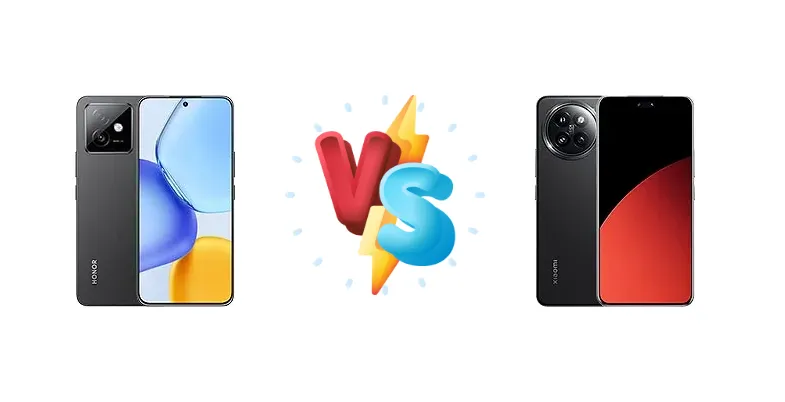
The Honor X60 GT and Xiaomi Civi 4 Pro represent compelling options in the increasingly competitive mid-range flagship space. The X60 GT leverages the proven Snapdragon 8+ Gen 1, while the Civi 4 Pro debuts with the newer Snapdragon 8s Gen 3. This comparison dissects the key differences, focusing on performance, charging, and which device best suits your needs.
🏆 Quick Verdict
For users prioritizing raw gaming performance and faster charging, the Honor X60 GT emerges as the winner. Its Snapdragon 8+ Gen 1, coupled with 80W charging, delivers a noticeable edge. However, the Xiaomi Civi 4 Pro offers a more modern chipset architecture and a refined user experience.
| Network |
|---|
| 2G bands | GSM 850 / 900 / 1800 / 1900 | GSM 850 / 900 / 1800 / 1900 |
| 3G bands | HSDPA 850 / 900 / 1900 / 2100 | HSDPA 800 / 850 / 900 / 1700(AWS) / 1900 / 2100 |
| 4G bands | LTE | 1, 3, 4, 5, 8, 18, 19, 26, 28, 34, 38, 39, 40, 41, 42, 48, 66 |
| 5G bands | SA/NSA | 1, 3, 5, 8, 28, 38, 40, 41, 48, 66, 77, 78 SA/NSA |
| Speed | HSPA, LTE, 5G | HSPA, LTE, 5G |
| Technology | GSM / CDMA / HSPA / EVDO / LTE / 5G | GSM / CDMA / HSPA / CDMA2000 / LTE / 5G |
| Launch |
|---|
| Announced | 2025, April 22 | 2024, March 21 |
| Status | Available. Released 2025, April 22 | Available. Released 2024, March 21 |
| Body |
|---|
| Build | - | Glass front (Gorilla Glass Victus 2), glass back or silicone polymer back (eco leather), aluminum frame |
| Dimensions | 161 x 74.2 x 7.7 mm (6.34 x 2.92 x 0.30 in) | 157.2 x 72.8 x 7.5 mm or 7.8 mm |
| SIM | Nano-SIM + Nano-SIM | Nano-SIM + Nano-SIM |
| Weight | 193 g (6.81 oz) | 177.6 or 179.3 g or 180.9 g (6.28 oz) |
| Display |
|---|
| Protection | Aluminosilicate glass | Corning Gorilla Glass Victus 2 |
| Resolution | 1200 x 2664 pixels (~436 ppi density) | 1236 x 2750 pixels, 20:9 ratio (~460 ppi density) |
| Size | 6.7 inches, 108.5 cm2 (~90.8% screen-to-body ratio) | 6.55 inches, 103.5 cm2 (~90.4% screen-to-body ratio) |
| Type | AMOLED, 1B colors, 120Hz, HDR, 5000 nits (peak) | AMOLED, 68B colors, 120Hz, Dolby Vision, HDR10+, 3000 nits (peak) |
| Platform |
|---|
| CPU | Octa-core (1x3.2 GHz Cortex-X2 & 3x2.75 GHz Cortex-A710 & 4x2.0 GHz Cortex-A510) | Octa-core (1x3.0 GHz Cortex-X4 & 4x2.8 GHz Cortex-A720 & 3x2.0 GHz Cortex-A520) |
| Chipset | Qualcomm SM8475 Snapdragon 8+ Gen 1 (4 nm) | Qualcomm SM8635 Snapdragon 8s Gen 3 (4 nm) |
| GPU | Adreno 730 | Adreno 735 |
| OS | Android 15, MagicOS 9 | Android 14, HyperOS |
| Memory |
|---|
| Card slot | No | No |
| Internal | 256GB 12GB RAM, 512GB 12GB RAM, 512GB 16GB RAM | 256GB 12GB RAM, 512GB 12GB RAM, 512GB 16GB RAM |
| Main Camera |
|---|
| Dual | 50 MP, f/1.9, (wide), PDAF, OIS
Auxiliary lens, AF | - |
| Features | LED flash, HDR, panorama | Color spectrum sensor, Dual-LED flash, HDR, panorama, Leica lenses |
| Triple | - | 50 MP, f/1.6, 25mm (wide), 1/1.55", 1.0µm, PDAF, OIS
50 MP, f/2.0, 50mm (telephoto), 0.64µm, PDAF, 2x optical zoom
12 MP, f/2.2, 15mm, 120˚ (ultrawide), 1.12µm |
| Video | 4K@30fps, 1080p@30fps, gyro-EIS, OIS | 4K@24/30/60fps, 1080p@30/60/120/240/960fps, 720p@1920fps, HDR10+, BT.2020, 10-bit video, gyro-EIS |
| Selfie camera |
|---|
| Dual | - | 32 MP, f/2.0, 26mm (wide), 1/2.8", 0.8µm, AF
32 MP, f/2.4, 100˚ (ultrawide), 1/2.8", 0.8µm |
| Features | - | HDR, panorama |
| Single | 16 MP, f/2.5, (wide) | - |
| Video | 1080p@30fps, gyro-EIS | 4K@30fps, 1080p@30/60fps; gyro-EIS |
| Sound |
|---|
| 35mm jack | No | No |
| Loudspeaker | Yes, with stereo speakers | Yes, with stereo speakers |
| Comms |
|---|
| Bluetooth | 5.3, A2DP, LE, aptX HD | 5.4, A2DP, LE, LHDC |
| Infrared port | Yes | Yes |
| NFC | Yes | Yes |
| Positioning | GPS, GALILEO, GLONASS, BDS, QZSS | GPS (L1), GLONASS (G1), BDS (B1I+B1c), GALILEO (E1), QZSS (L1) |
| Radio | No | No |
| USB | USB Type-C 2.0, OTG | USB Type-C 2.0, OTG |
| WLAN | Wi-Fi 802.11 a/b/g/n/ac/6, dual-band | Wi-Fi 802.11 a/b/g/n/ac/6, dual-band, Wi-Fi Direct |
| Features |
|---|
| Sensors | Fingerprint (under display, optical), accelerometer, gyro, compass, proximity (ultrasonic) | Fingerprint (under display, optical), accelerometer, gyro, proximity, compass |
| Battery |
|---|
| Charging | 80W wired, 47% in 15 min
5W reverse wired | 67W wired, PD3.0, 100% in 40 minutes |
| Type | Si/C Li-Ion 6300 mAh | Li-Po 4700 mAh |
| Misc |
|---|
| Colors | Silver, Blue, Black | Black, Pink, Blue, Green |
| Models | AGI-AN00 | 24053PY09C |
| Price | About 210 EUR | About 380 EUR |
Honor X60 GT
- Faster 80W charging for quick top-ups
- Snapdragon 8+ Gen 1 offers strong gaming performance
- Potentially better thermal management due to larger chassis
- Older chipset architecture compared to the 8s Gen 3
- May receive fewer software updates than the Civi 4 Pro
Xiaomi Civi 4 Pro
- Newer Snapdragon 8s Gen 3 chipset with improved efficiency
- Potentially better camera system, especially for selfies
- Likely more refined software experience
- Slower 67W charging compared to the X60 GT
- Snapdragon 8s Gen 3 may not match the 8+ Gen 1 in sustained gaming
Display Comparison
Display specifications are not provided, so we must infer. Both devices likely feature AMOLED panels given their market positioning. However, the Civi 4 Pro, being a newer release, may benefit from advancements in panel technology like higher peak brightness and potentially LTPO for adaptive refresh rates, leading to improved power efficiency. Bezels are likely comparable, but the Civi 4 Pro’s design language often prioritizes a more premium aesthetic. Color accuracy will depend on calibration, but both brands generally offer decent color profiles.
Camera Comparison
Camera details are absent, but we can speculate. Both phones likely feature multi-camera systems. The Xiaomi Civi series traditionally emphasizes selfie cameras, so the Civi 4 Pro may excel in front-facing image quality. The Honor X60 GT, given its gaming focus, might prioritize a more versatile main camera setup. Sensor size and aperture are critical; a larger sensor with a wider aperture will perform better in low light. OIS (Optical Image Stabilization) is essential for video recording and sharper photos. We can assume both will offer standard features like HDR and night mode, but image processing algorithms will differentiate the final results.
Performance
The core difference lies in the chipsets. The Honor X60 GT’s Snapdragon 8+ Gen 1 (4nm) utilizes a 1+3+4 core configuration with a Cortex-X2 prime core clocked at 3.2 GHz. This is a mature, highly optimized chip known for its strong sustained performance. The Xiaomi Civi 4 Pro’s Snapdragon 8s Gen 3 (4nm) features a 1+4+3 configuration with a Cortex-X4 prime core at 3.0 GHz. While the X4 core is newer and more efficient, the 8s Gen 3 is a slightly down-clocked version of the 8 Gen 3, and the 8+ Gen 1’s larger cache and mature optimization give it an edge in many gaming scenarios. Both utilize LPDDR5x RAM, but the speed and configuration will impact real-world performance. Thermal management will be crucial; the X60 GT’s larger chassis may offer better cooling potential.
Battery Life
Battery capacity is not specified, but the charging speeds are a key differentiator. The Honor X60 GT boasts 80W wired charging, claiming a 47% charge in 15 minutes. The Xiaomi Civi 4 Pro offers 67W wired charging with PD3.0, taking 40 minutes for a full charge. While the Civi 4 Pro supports the more versatile PD3.0 standard, the X60 GT’s higher wattage translates to significantly faster top-ups. A larger battery capacity on either device would offset the charging speed difference, but without that information, the X60 GT’s charging speed is a clear advantage for users who frequently need to quickly replenish their battery.
Buying Guide
Buy the Honor X60 GT if you need uncompromising gaming performance on a budget and value the fastest possible charging speeds. It’s ideal for mobile gamers and power users. Buy the Xiaomi Civi 4 Pro if you prefer a more balanced experience with a newer chipset architecture, potentially better long-term software support, and a focus on overall refinement, even if it means slightly less peak performance.
Frequently Asked Questions
❓ Will the Snapdragon 8+ Gen 1 in the Honor X60 GT throttle during extended gaming sessions?
The Snapdragon 8+ Gen 1 is known for its relatively good thermal performance, but throttling can still occur. The Honor X60 GT’s larger chassis *may* provide better cooling than the Civi 4 Pro, mitigating throttling, but sustained performance will depend on the phone’s thermal design and ambient temperature.
❓ Does the Xiaomi Civi 4 Pro support high refresh rate gaming, and what frame rates can be expected in demanding titles like Genshin Impact?
While the Civi 4 Pro’s display specifications are unknown, it likely supports a high refresh rate (90Hz or 120Hz). However, achieving consistently high frame rates in Genshin Impact will depend on the game’s optimization and the phone’s thermal management. Expect to be able to run the game at medium settings with stable frame rates, but pushing for maximum graphics may result in frame drops.
❓ Is the 67W charging on the Xiaomi Civi 4 Pro still considered fast charging in 2024?
67W charging is still considered fast, but it's being surpassed by faster technologies like 80W and 120W. While it won't be as quick as the Honor X60 GT's 80W, 67W is still capable of fully charging the phone in under an hour, which is sufficient for most users.