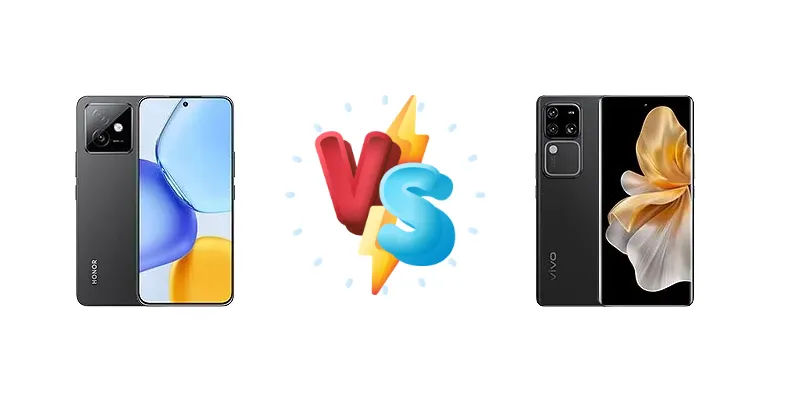
The Honor X60 GT and vivo S18 Pro represent compelling options in the increasingly competitive mid-range to upper-mid-range smartphone market. Both devices prioritize fast 80W charging, but diverge significantly in their core processing power, utilizing Qualcomm’s Snapdragon 8+ Gen 1 and MediaTek’s Dimensity 9200+ respectively. This comparison will dissect these differences to determine which phone best suits your needs.
🏆 Quick Verdict
For the average user prioritizing raw performance and sustained gaming, the vivo S18 Pro with its Dimensity 9200+ chipset emerges as the winner. While the Honor X60 GT offers a strong value proposition, the Dimensity 9200+'s Cortex-X3 core and improved efficiency provide a noticeable edge in demanding tasks.
| Network |
|---|
| 2G bands | GSM 850 / 900 / 1800 / 1900 | GSM 850 / 900 / 1800 / 1900 |
| 3G bands | HSDPA 850 / 900 / 1900 / 2100 | HSDPA 850 / 900 / 1700(AWS) / 1900 / 2100 |
| 4G bands | LTE | 1, 3, 4, 5, 7, 8, 18, 19, 26, 28, 34, 38, 39, 40, 41 |
| 5G bands | SA/NSA | 1, 3, 5, 8, 28, 38, 40, 41, 77, 78 SA/NSA |
| Speed | HSPA, LTE, 5G | HSPA, LTE, 5G |
| Technology | GSM / CDMA / HSPA / EVDO / LTE / 5G | GSM / CDMA / HSPA / CDMA2000 / LTE / 5G |
| Launch |
|---|
| Announced | 2025, April 22 | 2023, December 14 |
| Status | Available. Released 2025, April 22 | Available. Released 2023, January 13 |
| Body |
|---|
| Build | - | Glass front, plastic frame |
| Dimensions | 161 x 74.2 x 7.7 mm (6.34 x 2.92 x 0.30 in) | 164.4 x 75.1 x 7.5 mm (6.47 x 2.96 x 0.30 in) |
| SIM | Nano-SIM + Nano-SIM | Nano-SIM + Nano-SIM |
| Weight | 193 g (6.81 oz) | 188 g (6.63 oz) |
| Display |
|---|
| Protection | Aluminosilicate glass | - |
| Resolution | 1200 x 2664 pixels (~436 ppi density) | 1260 x 2800 pixels, 20:9 ratio (~453 ppi density) |
| Size | 6.7 inches, 108.5 cm2 (~90.8% screen-to-body ratio) | 6.78 inches, 111.0 cm2 (~89.9% screen-to-body ratio) |
| Type | AMOLED, 1B colors, 120Hz, HDR, 5000 nits (peak) | AMOLED, 1B colors, 120Hz, 2800 nits (peak) |
| Platform |
|---|
| CPU | Octa-core (1x3.2 GHz Cortex-X2 & 3x2.75 GHz Cortex-A710 & 4x2.0 GHz Cortex-A510) | Octa-core (1x3.35 GHz Cortex-X3 & 3x3.0 GHz Cortex-A715 & 4x2.0 GHz Cortex-A510) |
| Chipset | Qualcomm SM8475 Snapdragon 8+ Gen 1 (4 nm) | Mediatek Dimensity 9200+ (4 nm) |
| GPU | Adreno 730 | Immortalis-G715 MC11 |
| OS | Android 15, MagicOS 9 | Android 14, OriginOS 4 |
| Memory |
|---|
| Card slot | No | No |
| Internal | 256GB 12GB RAM, 512GB 12GB RAM, 512GB 16GB RAM | 256GB 12GB RAM, 256GB 16GB RAM, 512GB 16GB RAM |
| Main Camera |
|---|
| Dual | 50 MP, f/1.9, (wide), PDAF, OIS
Auxiliary lens, AF | - |
| Features | LED flash, HDR, panorama | Ring-LED flash, panorama, HDR |
| Triple | - | 50 MP, f/1.9, (wide), 1/1.49", PDAF, OIS
12 MP, f/2.0, (telephoto), PDAF, 2x optical zoom
50 MP, f/2.0, (ultrawide), 1/2.76" |
| Video | 4K@30fps, 1080p@30fps, gyro-EIS, OIS | 4K@30fps, 1080p@30fps |
| Selfie camera |
|---|
| Features | - | Dual-LED flash, HDR |
| Single | 16 MP, f/2.5, (wide) | 50 MP, f/2.0, 22mm (wide), AF |
| Video | 1080p@30fps, gyro-EIS | 4K@30fps, 1080p@30fps |
| Sound |
|---|
| 35mm jack | No | No |
| Loudspeaker | Yes, with stereo speakers | Yes |
| Comms |
|---|
| Bluetooth | 5.3, A2DP, LE, aptX HD | 5.3, A2DP, LE, aptX HD |
| Infrared port | Yes | - |
| NFC | Yes | Yes |
| Positioning | GPS, GALILEO, GLONASS, BDS, QZSS | GPS (L1+L5), GLONASS, BDS (B1I+B1c+B2a), GALILEO (E1+E5a), QZSS (L1+L5), NavIC (L5) |
| Radio | No | No |
| USB | USB Type-C 2.0, OTG | USB Type-C 2.0, OTG |
| WLAN | Wi-Fi 802.11 a/b/g/n/ac/6, dual-band | Wi-Fi 802.11 a/b/g/n/ac/6/7, dual-band, Wi-Fi Direct |
| Features |
|---|
| Sensors | Fingerprint (under display, optical), accelerometer, gyro, compass, proximity (ultrasonic) | Fingerprint (under display, optical), accelerometer, gyro, proximity, compass |
| Battery |
|---|
| Charging | 80W wired, 47% in 15 min
5W reverse wired | 80W wired, PD
Reverse wired |
| Type | Si/C Li-Ion 6300 mAh | 5000 mAh |
| Misc |
|---|
| Colors | Silver, Blue, Black | Black, Blue, Silver |
| Models | AGI-AN00 | V2344A |
| Price | About 210 EUR | About 410 EUR |
Honor X60 GT
- Excellent value for money
- Fast 80W wired charging
- Capable Snapdragon 8+ Gen 1 performance
- Snapdragon 8+ Gen 1 can throttle under sustained load
- Potentially less refined camera system
vivo S18 Pro
- Superior performance with Dimensity 9200+
- More efficient thermal management
- PD support for wider charger compatibility
- Likely a higher price point
- May not offer a dramatically different camera experience for casual users
Display Comparison
Neither device's display specifications are provided, so a direct comparison is limited. However, given the market positioning, we can infer both likely utilize AMOLED panels. The vivo S18 Pro, being positioned slightly higher, may benefit from a higher peak brightness and potentially LTPO technology for adaptive refresh rates, leading to improved power efficiency. Color accuracy is likely comparable, with both brands aiming for vibrant and accurate displays.
Camera Comparison
Camera details are absent, but the vivo S18 Pro, historically, places a greater emphasis on camera capabilities. We can anticipate a more sophisticated image processing pipeline and potentially larger sensor sizes. While the Honor X60 GT will likely offer a competent camera system, the vivo S18 Pro is expected to deliver superior image quality, particularly in low-light conditions. The absence of information prevents a detailed analysis of OIS or lens apertures.
Performance
The core difference lies in the chipsets. The vivo S18 Pro’s MediaTek Dimensity 9200+ features a single Cortex-X3 prime core clocked at 3.35 GHz, offering a significant architectural advantage over the Snapdragon 8+ Gen 1’s Cortex-X2 core at 3.2 GHz. The Dimensity 9200+ also utilizes more efficient Cortex-A715 cores (3x3.0 GHz) compared to the Snapdragon’s A710 cores (3x2.75 GHz). Both chips are fabricated on a 4nm process, but the Dimensity 9200+ generally exhibits superior thermal management and sustained performance. The Snapdragon 8+ Gen 1, while still powerful, is more prone to throttling under prolonged heavy load. Both devices share the same Cortex-A510 efficiency cores (4x2.0 GHz).
Battery Life
Both phones feature 80W wired charging, with the Honor X60 GT claiming 47% charge in 15 minutes. The vivo S18 Pro adds PD (Power Delivery) support, offering broader compatibility with chargers. While battery capacity isn’t specified, the combination of the Dimensity 9200+'s efficiency and 80W charging on the vivo S18 Pro suggests a potentially better overall battery experience, despite a potentially similar mAh rating. The 5W reverse wired charging on the Honor X60 GT is a useful, albeit slow, feature for topping up accessories.
Buying Guide
Buy the Honor X60 GT if you need a capable all-rounder with fast charging and a focus on value. It’s ideal for users who enjoy mobile gaming but aren’t pushing for absolute maximum frame rates or extended, uninterrupted sessions. Buy the vivo S18 Pro if you prioritize peak performance, smoother multitasking, and a more future-proof chipset, especially if you frequently engage in graphically intensive games or content creation.
Frequently Asked Questions
❓ Will the Snapdragon 8+ Gen 1 in the Honor X60 GT struggle with demanding games like Genshin Impact?
While the Snapdragon 8+ Gen 1 is capable, it may exhibit throttling after extended gaming sessions in graphically intensive titles like Genshin Impact. Expect playable frame rates, but potentially with some dips in performance over time. The vivo S18 Pro’s Dimensity 9200+ is better equipped to handle sustained gaming without significant throttling.
❓ Does the vivo S18 Pro's Dimensity 9200+ support advanced cooling solutions like vapor chambers?
While not explicitly stated in the provided data, phones utilizing the Dimensity 9200+ often incorporate advanced cooling solutions like vapor chambers to maximize sustained performance. This is crucial for maintaining peak performance during prolonged gaming or demanding tasks. The Honor X60 GT's cooling solution is unknown, but may be less sophisticated.
❓ Is the 80W charging on both phones truly fast in real-world usage?
Yes, 80W charging is exceptionally fast. Both phones should be able to charge from 0% to 50% in under 20 minutes. The vivo S18 Pro’s addition of PD support ensures compatibility with a wider range of chargers, potentially offering even faster charging speeds with compatible power adapters.