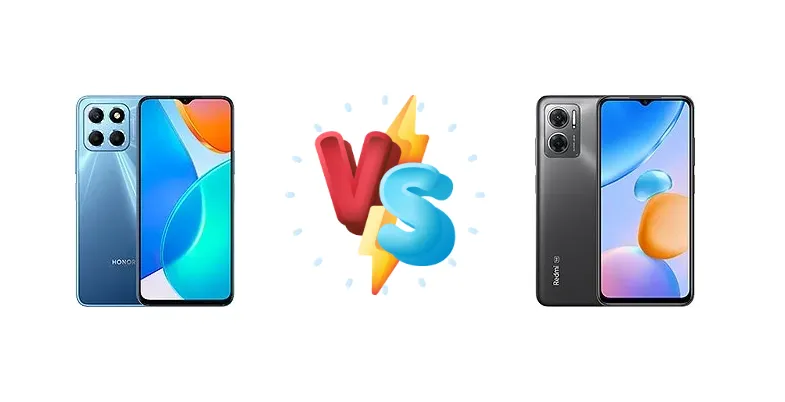
The sub-$200 5G smartphone market is fiercely competitive. The Honor X6 and Xiaomi Redmi 10 5G represent compelling options for users seeking affordable connectivity. However, they take distinctly different approaches: the Honor X6 prioritizes a potentially longer lifespan with a conservative chipset, while the Redmi 10 5G aims for a more responsive experience with a more powerful processor. This comparison dissects the key differences to determine which phone best suits your needs.
🏆 Quick Verdict
For the average user prioritizing responsiveness and future-proofing, the Xiaomi Redmi 10 5G is the clear winner. Its Dimensity 700 chipset delivers significantly better performance than the Honor X6’s Helio G25, making it more suitable for multitasking, gaming, and demanding applications. While the Honor X6 may offer slightly better battery endurance due to its less powerful processor, the Redmi 10 5G’s 18W charging mitigates this difference.
| Network |
|---|
| 2G bands | GSM 850 / 900 / 1800 / 1900 | GSM 850 / 900 / 1800 / 1900 |
| 3G bands | HSDPA 850 / 900 / 1900 / 2100 | HSDPA 850 / 900 / 1700(AWS) / 1900 / 2100 |
| 4G bands | LTE | 1, 2, 3, 4, 5, 7, 8, 20, 28, 38, 40, 41 |
| 5G bands | - | 1, 3, 5, 7, 8, 20, 28, 38, 40, 41, 77, 78 SA/NSA |
| Speed | HSPA, LTE | HSPA, LTE, 5G |
| Technology | GSM / HSPA / LTE | GSM / HSPA / LTE / 5G |
| Launch |
|---|
| Announced | 2022, September 21 | 2022, March 29 |
| Status | Available. Released 2022, September 21 | Available. Released 2022, September 23 |
| Body |
|---|
| Dimensions | 163.7 x 75.1 x 8.7 mm (6.44 x 2.96 x 0.34 in) | 164 x 76.1 x 8.9 mm (6.46 x 3.00 x 0.35 in) |
| SIM | Nano-SIM + Nano-SIM | Nano-SIM + Nano-SIM |
| Weight | 194 g (6.84 oz) | 200 g (7.05 oz) |
| Display |
|---|
| Protection | - | Corning Gorilla Glass 3 |
| Resolution | 720 x 1600 pixels, 20:9 ratio (~270 ppi density) | 1080 x 2408 pixels, 20:9 ratio (~401 ppi density) |
| Size | 6.5 inches, 102.0 cm2 (~83.0% screen-to-body ratio) | 6.58 inches, 104.3 cm2 (~83.6% screen-to-body ratio) |
| Type | TFT LCD | IPS LCD, 90Hz |
| Platform |
|---|
| CPU | Octa-core (4x2.0 GHz Cortex-A53 & 4x1.5 GHz Cortex-A53) | Octa-core (2x2.2 GHz Cortex-A76 & 6x2.0 GHz Cortex-A55) |
| Chipset | Mediatek MT6762G Helio G25 (12 nm) | Mediatek Dimensity 700 (7 nm) |
| GPU | PowerVR GE8320 | Mali-G57 MC2 |
| OS | Android 12, Magic UI 6.1 | Android 12, MIUI 13 |
| Memory |
|---|
| Card slot | microSDXC | microSDXC (dedicated slot) |
| Internal | 64GB 4GB RAM, 128GB 4GB RAM | 64GB 4GB RAM, 128GB 4GB RAM, 128GB 6GB RAM |
| | - | UFS 2.2 |
| Main Camera |
|---|
| Dual | - | 50 MP, f/1.8, (wide), PDAF
Auxiliary lens |
| Features | LED flash, HDR, panorama | LED flash, HDR, panorama |
| Single | - | 5 MP, f/2.2 |
| Triple | 50 MP, f/1.8, (wide), PDAF
2 MP (macro)
Auxiliary lens | - |
| Video | 1080p@30fps | 1080p@30fps |
| Selfie camera |
|---|
| Features | - | HDR |
| Single | 5 MP, f/2.2, (wide) | 5 MP, f/2.2 |
| Video | 1080p@30fps | 1080p@30fps |
| Sound |
|---|
| 3.5mm jack | Yes | Yes |
| 35mm jack | Yes | Yes |
| Loudspeaker | Yes | Yes |
| | - | 24-bit/192kHz audio |
| Comms |
|---|
| Bluetooth | 5.1, A2DP, LE | 5.1, A2DP, LE |
| Infrared port | - | Yes |
| NFC | Yes (VNE-LX1 only) | Yes (market/region dependent) |
| Positioning | GPS, GLONASS, GALILEO, BDS | GPS, GLONASS, BDS, GALILEO |
| Radio | Unspecified | FM radio |
| USB | USB Type-C 2.0, OTG | USB Type-C 2.0, OTG |
| WLAN | Wi-Fi 802.11 a/b/g/n/ac, dual-band, Wi-Fi Direct | Wi-Fi 802.11 a/b/g/n/ac, dual-band, Wi-Fi Direct |
| Features |
|---|
| Sensors | Fingerprint (side-mounted), accelerometer, proximity | Fingerprint (side-mounted), accelerometer, proximity, compass |
| Battery |
|---|
| Charging | 10W wired | 18W wired |
| Type | Li-Po 5000 mAh | Li-Po 5000 mAh |
| Misc |
|---|
| Colors | Ocean Blue, Titanium Silver, Midnight Black | Graphite Gray, Chrome Silver, Aurora Green |
| Models | VNE-LX1, VNE-LX2, VNE-LX3 | 22041219G, 22041219NY |
| Price | About 100 EUR | About 100 EUR |
| SAR | - | 1.09 W/kg (head) 1.09 W/kg (body) |
| SAR EU | - | 0.60 W/kg (head) 0.99 W/kg (body) |
Honor X6
- Potentially longer battery life under light use.
- Simpler user experience for basic tasks.
- May be more affordable (depending on region).
- Significantly slower performance.
- Slow 10W charging.
- Less capable for multitasking and gaming.
Xiaomi Redmi 10 5G
- Much faster performance with the Dimensity 700.
- Faster 18W charging.
- Better 5G connectivity and responsiveness.
- Battery life may be slightly shorter under heavy use.
- Potentially higher price point.
- May experience more heat during prolonged gaming.
Display Comparison
Neither device boasts a standout display. Both likely utilize LCD panels, a common trait in this price bracket. However, the lack of detailed display specs necessitates a focus on the chipset’s ability to drive the UI smoothly. The Redmi 10 5G’s more powerful GPU, integrated within the Dimensity 700, will likely result in a more fluid scrolling experience and better responsiveness in graphically intensive apps, even if the resolution and refresh rates are similar.
Camera Comparison
Without detailed camera specifications, a direct comparison is difficult. However, the Redmi 10 5G likely benefits from the improved image signal processor (ISP) within the Dimensity 700 chipset, potentially leading to better image processing and noise reduction. Both phones likely feature a primary camera and depth/macro sensors, but the Redmi 10 5G’s ISP will likely extract more detail and dynamic range from its main sensor. The Honor X6’s camera will likely be sufficient for casual snapshots, but the Redmi 10 5G offers a more capable imaging experience.
Performance
The performance gap is the most significant differentiator. The Xiaomi Redmi 10 5G’s Mediatek Dimensity 700 (7nm) is a substantial upgrade over the Honor X6’s Mediatek Helio G25 (12nm). The Dimensity 700 features Cortex-A76 performance cores clocked at 2.2 GHz, compared to the X6’s Cortex-A53 cores at 2.0 GHz. This architectural difference, combined with the smaller 7nm process node, translates to a roughly 30-50% performance increase in CPU-intensive tasks and a more noticeable improvement in GPU performance. This means faster app loading times, smoother multitasking, and a better gaming experience on the Redmi 10 5G. The Helio G25 in the Honor X6 is adequate for basic tasks, but will struggle with demanding applications.
Battery Life
The Honor X6, with its less power-hungry Helio G25 chipset, *may* offer slightly longer battery life under light usage. However, the Redmi 10 5G’s 18W wired charging significantly reduces the inconvenience of a potentially faster battery drain. The Honor X6’s 10W charging will take considerably longer to replenish the battery from 0-100%. In real-world scenarios, the faster charging of the Redmi 10 5G will likely be more appreciated by users who frequently use their phones throughout the day.
Buying Guide
Buy the Honor X6 if you need a phone primarily for basic communication – calls, texts, and light social media – and value potential longevity over immediate performance. You’ll appreciate its simplicity and potentially lower running costs. Buy the Xiaomi Redmi 10 5G if you prefer a smoother, more responsive experience for everyday tasks, enjoy occasional gaming, and want the benefits of faster 5G connectivity. The Redmi 10 5G is the better choice for users who want a phone that can keep up with their digital lives.
Frequently Asked Questions
❓ Will the Redmi 10 5G’s Dimensity 700 overheat during extended gaming sessions?
While the Dimensity 700 is more powerful, it's also more efficient than older chipsets. The Redmi 10 5G likely incorporates basic thermal management solutions. Expect some warmth during prolonged gaming, but significant throttling is unlikely. Performance will likely remain consistent for moderate gaming sessions.
❓ Is the 5G connectivity on the Redmi 10 5G actually useful, or is it just a marketing gimmick?
The usefulness of 5G depends on your location and carrier coverage. However, even in areas with limited 5G availability, the Redmi 10 5G’s 5G modem provides future-proofing and potentially faster speeds when 5G networks expand. It also supports 4G LTE, ensuring compatibility in areas without 5G.
❓ How much faster will app loading times be on the Redmi 10 5G compared to the Honor X6?
Expect app loading times on the Redmi 10 5G to be roughly 30-50% faster than on the Honor X6, thanks to the Dimensity 700’s superior CPU and faster storage interface. This difference will be most noticeable with larger, more complex applications.