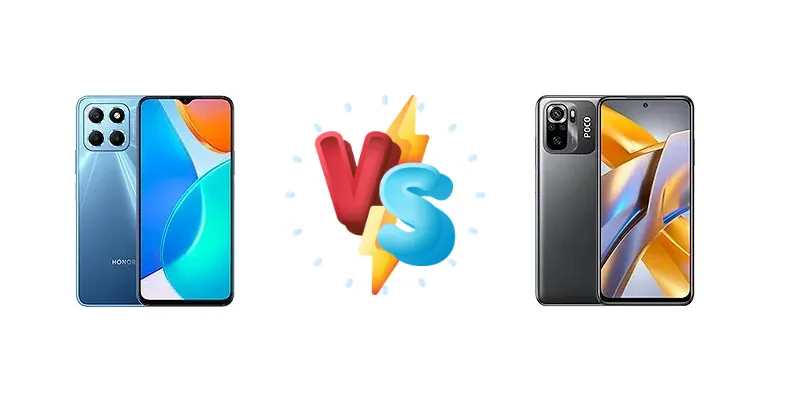
The sub-$200 smartphone market is fiercely competitive, and the Honor X6 and Xiaomi Poco M5s are two contenders vying for your attention. While both aim to deliver essential smartphone functionality at an accessible price, they diverge significantly in key areas like processing power and charging speed. This comparison dissects their specifications to determine which device offers the best value for different user needs.
🏆 Quick Verdict
For the average user prioritizing performance and convenience, the Xiaomi Poco M5s is the clear winner. Its Helio G95 chipset and 33W fast charging provide a noticeably smoother experience and quicker top-ups compared to the Honor X6’s Helio G25 and 10W charging. However, the X6 remains a viable option for those on a very tight budget.
| Network |
|---|
| 2G bands | GSM 850 / 900 / 1800 / 1900 | GSM 850 / 900 / 1800 / 1900 |
| 3G bands | HSDPA 850 / 900 / 1900 / 2100 | HSDPA 850 / 900 / 1700(AWS) / 1900 / 2100 |
| 4G bands | LTE | 1, 2, 3, 4, 5, 7, 8, 20, 28, 38, 40, 41 |
| Speed | HSPA, LTE | HSPA, LTE |
| Technology | GSM / HSPA / LTE | GSM / HSPA / LTE |
| Launch |
|---|
| Announced | 2022, September 21 | 2022, September 05 |
| Status | Available. Released 2022, September 21 | Available. Released 2022, September 06 |
| Body |
|---|
| Build | - | Glass front (Gorilla Glass 3), plastic frame, plastic back |
| Dimensions | 163.7 x 75.1 x 8.7 mm (6.44 x 2.96 x 0.34 in) | 160.5 x 74.5 x 8.3 mm (6.32 x 2.93 x 0.33 in) |
| SIM | Nano-SIM + Nano-SIM | Nano-SIM + Nano-SIM |
| Weight | 194 g (6.84 oz) | 178.8 g (6.31 oz) |
| | - | IP53, dust and splash resistant |
| Display |
|---|
| Protection | - | Corning Gorilla Glass 3 |
| Resolution | 720 x 1600 pixels, 20:9 ratio (~270 ppi density) | 1080 x 2400 pixels, 20:9 ratio (~409 ppi density) |
| Size | 6.5 inches, 102.0 cm2 (~83.0% screen-to-body ratio) | 6.43 inches, 99.8 cm2 (~83.5% screen-to-body ratio) |
| Type | TFT LCD | AMOLED, 450 nits (typ), 700 nits (HBM), 1100 nits (peak) |
| Platform |
|---|
| CPU | Octa-core (4x2.0 GHz Cortex-A53 & 4x1.5 GHz Cortex-A53) | Octa-core (2x2.05 GHz Cortex-A76 & 6x2.0 GHz Cortex-A55) |
| Chipset | Mediatek MT6762G Helio G25 (12 nm) | Mediatek MT6785V/CD Helio G95 (12 nm) |
| GPU | PowerVR GE8320 | Mali-G76 MC4 |
| OS | Android 12, Magic UI 6.1 | Android 12, MIUI 13 |
| Memory |
|---|
| Card slot | microSDXC | microSDXC (dedicated slot) |
| Internal | 64GB 4GB RAM, 128GB 4GB RAM | 64GB 4GB RAM, 128GB 4GB RAM, 128GB 6GB RAM, 256GB 8GB RAM |
| | - | UFS 2.2 |
| Main Camera |
|---|
| Features | LED flash, HDR, panorama | LED flash, HDR, panorama |
| Quad | - | 64 MP, f/1.8, 26mm (wide), 1/1.97", 0.7µm, PDAF
8 MP, f/2.2, 118˚ (ultrawide), 1/4.0", 1.12µm
2 MP (macro)
Auxiliary lens |
| Triple | 50 MP, f/1.8, (wide), PDAF
2 MP (macro)
Auxiliary lens | - |
| Video | 1080p@30fps | 4K@30fps, 1080p@30/60/120fps, 720p@960fps |
| Selfie camera |
|---|
| Features | - | HDR |
| Single | 5 MP, f/2.2, (wide) | 13 MP, f/2.4, (wide), 1/3.06", 1.12µm |
| Video | 1080p@30fps | 1080p@30fps |
| Sound |
|---|
| 3.5mm jack | Yes | Yes |
| 35mm jack | Yes | Yes |
| Loudspeaker | Yes | Yes, with stereo speakers |
| Comms |
|---|
| Bluetooth | 5.1, A2DP, LE | 5.0, A2DP, LE |
| Infrared port | - | Yes |
| NFC | Yes (VNE-LX1 only) | Yes |
| Positioning | GPS, GLONASS, GALILEO, BDS | GPS, GLONASS, GALILEO, BDS |
| Radio | Unspecified | FM radio |
| USB | USB Type-C 2.0, OTG | USB Type-C 2.0 |
| WLAN | Wi-Fi 802.11 a/b/g/n/ac, dual-band, Wi-Fi Direct | Wi-Fi 802.11 a/b/g/n/ac, dual-band, Wi-Fi Direct |
| Features |
|---|
| Sensors | Fingerprint (side-mounted), accelerometer, proximity | Fingerprint (side-mounted), accelerometer, gyro, compass |
| | - | Virtual proximity sensing |
| Battery |
|---|
| Charging | 10W wired | 33W wired, 64% in 30 min |
| Type | Li-Po 5000 mAh | Li-Po 5000 mAh |
| Misc |
|---|
| Colors | Ocean Blue, Titanium Silver, Midnight Black | Gray, Blue, White |
| Models | VNE-LX1, VNE-LX2, VNE-LX3 | 2207117BPG |
| Price | About 100 EUR | About 120 EUR |
| SAR | - | 1.00 W/kg (head) 0.65 W/kg (body) |
| SAR EU | - | 0.60 W/kg (head) 0.87 W/kg (body) |
| Tests |
|---|
| Battery life | - |
Endurance rating 132h
|
| Camera | - |
Photo / Video |
| Display | - |
Contrast ratio: Infinite (nominal) |
| Loudspeaker | - |
-25.4 LUFS (Very good)
|
| Performance | - |
AnTuTu: 360681 (v9)
GeekBench: 1831 (v5.1)
GFXBench: 18fps (ES 3.1 onscreen) |
Honor X6
- Extremely affordable price point
- Decent battery endurance (132h)
- Simple and easy-to-use interface
- Slow 10W charging
- Underpowered Helio G25 processor
- Basic display specifications
Xiaomi Poco M5s
- Faster Helio G95 processor for smoother performance
- 33W fast charging (64% in 30 mins)
- Brighter display for better outdoor visibility
- Slightly higher price than the Honor X6
- May not have the absolute longest battery life due to more powerful processor
- Software experience can be cluttered with Xiaomi's MIUI
Display Comparison
The Poco M5s boasts a significantly brighter display, reaching a measured peak brightness of 756 nits, compared to an unspecified brightness for the Honor X6. This makes the M5s far more usable outdoors under direct sunlight. While both displays have an 'infinite' contrast ratio (typical for IPS LCDs), the higher brightness of the Poco M5s is a tangible advantage. The X6’s display specifications are minimal, suggesting a more basic panel likely optimized for power efficiency rather than visual fidelity.
Camera Comparison
Both phones feature photo and video capabilities, but detailed camera specifications are limited. Without sensor size or aperture information, it’s difficult to make a definitive judgment. However, the Poco M5s’s more powerful processor likely enables more sophisticated image processing algorithms, potentially resulting in better image quality, especially in low-light conditions. The inclusion of a dedicated night mode on the M5s (based on typical Poco features) is also likely. The Honor X6’s camera system is likely more basic, focusing on simplicity rather than advanced features.
Performance
The core difference between these two phones lies in their chipsets. The Poco M5s utilizes the Mediatek Helio G95, featuring a combination of 2x2.05 GHz Cortex-A76 and 6x2.0 GHz Cortex-A55 cores. This is a substantial upgrade over the Honor X6’s Helio G25, which employs 4x2.0 GHz Cortex-A53 and 4x1.5 GHz Cortex-A53 cores. The G95’s Cortex-A76 cores offer significantly better single-core performance, crucial for app launch speeds and general responsiveness. The G25, while adequate for basic tasks, will struggle with more demanding applications. The Poco M5s will provide a smoother experience for gaming and multitasking.
Battery Life
Both devices achieve an endurance rating of 132 hours, suggesting similar overall battery life under typical usage. However, the Poco M5s’s 33W wired charging is a game-changer. It can reach 64% charge in just 30 minutes, a significant time saving compared to the Honor X6’s slow 10W charging. While the X6 might last a similar amount of time on a single charge, the M5s’s faster charging mitigates the inconvenience of needing to top up, making it more practical for users who are frequently on the go.
Buying Guide
Buy the Honor X6 if you need a basic smartphone for essential tasks like calls, texts, and light social media use, and prioritize maximum affordability. Buy the Xiaomi Poco M5s if you prefer a more responsive experience for gaming, streaming, and multitasking, and value the convenience of fast charging. The M5s is the better choice for users who don't want to compromise on performance.
Frequently Asked Questions
❓ Is the Poco M5s’s Helio G95 chipset capable of handling demanding games like PUBG or Call of Duty?
Yes, the Helio G95 is a capable gaming chipset for its price range. While it won't deliver flagship-level performance, it can handle PUBG and Call of Duty at medium settings with reasonable frame rates. The Honor X6’s Helio G25 will struggle with these titles, requiring significantly lower settings and potentially experiencing lag.
❓ How long does it realistically take to fully charge the Honor X6 with its 10W charger?
With a 10W charger, fully charging the Honor X6 will likely take over 3 hours, potentially closer to 4 hours depending on the battery level. This is a significant drawback compared to the Poco M5s’s 33W fast charging, which can reach a substantial charge in just 30 minutes.
❓ Does the Poco M5s’s MIUI software come with a lot of bloatware?
Xiaomi’s MIUI is known for including pre-installed apps (bloatware). While the amount has decreased in recent versions, you can expect to find several apps you may not need. Fortunately, many of these can be uninstalled or disabled.
❓ What type of USB port do both phones use?
Both the Honor X6 and the Poco M5s utilize a USB-C port for charging and data transfer, which is the current standard and offers faster transfer speeds and reversible connectivity.