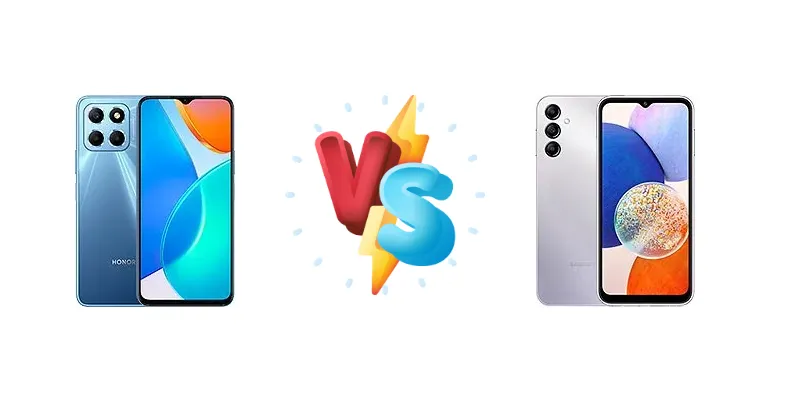
The sub-$200 5G smartphone market is fiercely competitive. The Honor X6 and Samsung Galaxy A14 5G represent compelling options, but cater to slightly different priorities. The X6 focuses on affordability, while the A14 5G aims for a more balanced experience with a newer chipset and slightly faster charging. This comparison dissects their key differences to determine which device delivers the best value.
🏆 Quick Verdict
For most users, the Samsung Galaxy A14 5G is the better choice. Its Exynos 1330 (or Dimensity 700 depending on region) offers significantly improved CPU and GPU performance compared to the Honor X6’s Helio G25, translating to a smoother user experience and better app responsiveness. While the X6 is cheaper, the A14 5G’s performance uplift justifies the price difference.
| Network |
|---|
| 2G bands | GSM 850 / 900 / 1800 / 1900 | GSM 850 / 900 / 1800 / 1900 |
| 3G bands | HSDPA 850 / 900 / 1900 / 2100 | HSDPA 850 / 900 / 1700(AWS) / 1900 / 2100 |
| 4G bands | LTE | 1, 2, 3, 4, 5, 7, 8, 12, 17, 20, 26, 28, 38, 40, 41, 66 - International |
| 5G bands | - | 2, 5, 66, 77 Sub6/mmWave - USA |
| Speed | HSPA, LTE | HSPA, LTE, 5G |
| Technology | GSM / HSPA / LTE | GSM / HSPA / LTE / 5G |
| | - | 1, 3, 5, 7, 8, 20, 28, 40, 41, 78 SA/NSA/Sub6 - India |
| Launch |
|---|
| Announced | 2022, September 21 | 2023, January 04 |
| Status | Available. Released 2022, September 21 | Available. Released 2023, January 12 |
| Body |
|---|
| Build | - | Glass front, plastic back, plastic frame |
| Dimensions | 163.7 x 75.1 x 8.7 mm (6.44 x 2.96 x 0.34 in) | 167.7 x 78 x 9.1 mm (6.60 x 3.07 x 0.36 in) |
| SIM | Nano-SIM + Nano-SIM | · Nano-SIM· Nano-SIM + Nano-SIM |
| Weight | 194 g (6.84 oz) | 202 g (7.13 oz) |
| Display |
|---|
| Resolution | 720 x 1600 pixels, 20:9 ratio (~270 ppi density) | 1080 x 2408 pixels, 20:9 ratio (~400 ppi density) |
| Size | 6.5 inches, 102.0 cm2 (~83.0% screen-to-body ratio) | 6.6 inches, 104.9 cm2 (~80.2% screen-to-body ratio) |
| Type | TFT LCD | PLS LCD, 90Hz |
| Platform |
|---|
| CPU | Octa-core (4x2.0 GHz Cortex-A53 & 4x1.5 GHz Cortex-A53) | Octa-core (2x2.4 GHz Cortex-A78 & 6x2.0 GHz Cortex-A55) - SM-A146BOcta-core (2x2.2 GHz Cortex-A76 & 6x2.0 GHz Cortex-A55) - SM-A146P |
| Chipset | Mediatek MT6762G Helio G25 (12 nm) | Exynos 1330 (5 nm) - SM-A146BMediatek Dimensity 700 (7 nm) - SM-A146P |
| GPU | PowerVR GE8320 | Mali-G68 MP2 - SM-A146BMali-G57 MC2 - SM-A146P |
| OS | Android 12, Magic UI 6.1 | Android 13, upgradable to Android 15, One UI Core 7 |
| Memory |
|---|
| Card slot | microSDXC | microSDXC (uses shared SIM slot) - USA onlymicroSDXC (dedicated slot) - International |
| Internal | 64GB 4GB RAM, 128GB 4GB RAM | 64GB 4GB RAM, 128GB 4GB RAM, 128GB 6GB RAM, 128GB 8GB RAM |
| Main Camera |
|---|
| Features | LED flash, HDR, panorama | LED flash, panorama, HDR |
| Single | - | 13 MP, f/2.0, (wide) |
| Triple | 50 MP, f/1.8, (wide), PDAF
2 MP (macro)
Auxiliary lens | 50 MP, f/1.8, 26mm (wide), 1/2.76", 0.64µm, PDAF
2 MP (macro)
Auxiliary lens |
| Video | 1080p@30fps | 1080p@30fps |
| Selfie camera |
|---|
| Single | 5 MP, f/2.2, (wide) | 13 MP, f/2.0, 26mm (wide), 1.12µm |
| Video | 1080p@30fps | 1080p@30fps |
| Sound |
|---|
| 3.5mm jack | Yes | Yes |
| 35mm jack | Yes | Yes |
| Loudspeaker | Yes | Yes |
| Comms |
|---|
| Bluetooth | 5.1, A2DP, LE | 5.2, A2DP, LE |
| NFC | Yes (VNE-LX1 only) | Yes |
| Positioning | GPS, GLONASS, GALILEO, BDS | GPS, GLONASS, GALILEO |
| Radio | Unspecified | FM radio (Exynos 1330 chipset only), recording |
| USB | USB Type-C 2.0, OTG | USB Type-C 2.0 |
| WLAN | Wi-Fi 802.11 a/b/g/n/ac, dual-band, Wi-Fi Direct | Wi-Fi 802.11 a/b/g/n/ac, dual-band, Wi-Fi Direct |
| Features |
|---|
| Sensors | Fingerprint (side-mounted), accelerometer, proximity | Fingerprint (side-mounted), accelerometer, gyro, proximity, compass, barometer (USA only) |
| Battery |
|---|
| Charging | 10W wired | 15W wired |
| Type | Li-Po 5000 mAh | Li-Po 5000 mAh |
| Misc |
|---|
| Colors | Ocean Blue, Titanium Silver, Midnight Black | Black, Light Green, Dark Red, Silver |
| Models | VNE-LX1, VNE-LX2, VNE-LX3 | SM-A146B, SM-A146B/DS, SM-A146P, SM-A146P/DS, SM-A146U, SM-A146U1, SM-A146U1/DS, SM-A146W, SM-A146P/N, SM-A146P/DSN, SM-S146VL, SM-A146M |
| Price | About 100 EUR | $ 77.63 / C$ 151.00 / £ 97.00 / € 159.79 / ₹ 14,990 |
| SAR | - | 1.00 W/kg (head) 1.00 W/kg (body) |
| SAR EU | - | 0.56 W/kg (head) 1.28 W/kg (body) |
| Tests |
|---|
| Battery life | - |
Endurance rating 130h
|
| Camera | - |
Photo / Video |
| Display | - |
Contrast ratio: 1334:1 (nominal) |
| Loudspeaker | - |
-26.8 LUFS (Good)
|
| Performance | - |
AnTuTu: 307886 (v9)
GeekBench: 1727 (v5.1)
GFXBench: 12fps (ES 3.1 onscreen) |
Honor X6
- Most affordable option
- Decent battery endurance
- Simple and easy-to-use interface
- Outdated and slow processor
- Slow 10W charging
- Display brightness likely lower than A14 5G
Samsung Galaxy A14 5G
- Significantly faster processor (Exynos 1330 or Dimensity 700)
- Faster 15W charging
- Brighter display for better outdoor visibility
- Slightly higher price
- May still struggle with very demanding games
- Software updates may be slower than Honor
Display Comparison
Both the Honor X6 and Samsung Galaxy A14 5G feature displays with a 1334:1 contrast ratio, suggesting similar visual pop. However, the A14 5G boasts a measured peak brightness of 519 nits, a notable advantage over the X6’s unspecified brightness. This means the A14 5G will be more legible outdoors under direct sunlight. While neither phone is expected to have high refresh rates, the A14 5G’s brighter panel provides a superior viewing experience overall.
Camera Comparison
Both phones offer a 'Photo / Video' camera experience, but details are sparse. Without specific sensor sizes or aperture information, it’s difficult to make a definitive judgment. However, the A14 5G’s likely more advanced image signal processor (ISP) within the Exynos 1330 or Dimensity 700 chipset will likely result in better image processing, particularly in low-light conditions. The presence of a 2MP macro camera on both devices is largely a marketing gimmick and shouldn’t be a deciding factor.
Performance
The performance gap is the most significant differentiator. The Samsung Galaxy A14 5G utilizes either the Exynos 1330 (SM-A146B) or the Mediatek Dimensity 700 (SM-A146P), both built on more efficient 5nm and 7nm processes respectively, compared to the Honor X6’s 12nm Mediatek Helio G25. The Exynos 1330’s Cortex-A78 cores provide a substantial CPU performance boost, while the Dimensity 700 offers a solid mid-range experience. The X6’s Cortex-A53 cores, while efficient, are significantly older architecture and will struggle with demanding tasks. This translates to faster app loading times, smoother multitasking, and better gaming performance on the A14 5G.
Battery Life
Both devices achieve an endurance rating of 130 hours, indicating comparable battery life under similar usage patterns. However, the Samsung Galaxy A14 5G supports 15W wired charging, while the Honor X6 is limited to 10W. This means the A14 5G will recharge significantly faster, reducing downtime. While the mAh capacity isn’t specified for either device, the more efficient chipset in the A14 5G may contribute to slightly better real-world battery performance.
Buying Guide
Buy the Honor X6 if you prioritize absolute affordability and basic smartphone functionality – calls, texts, and light social media use. It’s ideal for first-time smartphone users or those on a very tight budget. Buy the Samsung Galaxy A14 5G if you value a more responsive experience, better performance for gaming and multitasking, and the benefits of a more modern chipset, even if it means spending a little more.
Frequently Asked Questions
❓ Does the Exynos 1330 (or Dimensity 700) in the Galaxy A14 5G overheat during prolonged gaming sessions?
While not a flagship-level chip, the Exynos 1330 and Dimensity 700 are relatively efficient. Thermal throttling is possible during extended, graphically intensive gaming, but the 5nm and 7nm manufacturing processes help mitigate this compared to the Honor X6’s 12nm Helio G25. Expect some performance reduction after a long gaming session, but it shouldn't be severe.
❓ Is the 2MP macro camera on either phone actually useful for taking detailed close-up photos?
Generally, no. 2MP macro cameras on budget phones typically lack the resolution and optics to produce truly detailed close-up shots. They often result in blurry or noisy images. They are primarily included as a marketing feature and shouldn't be a primary consideration when choosing between these devices.
❓ Can the Samsung Galaxy A14 5G handle popular games like PUBG Mobile at acceptable frame rates?
The Galaxy A14 5G, depending on the variant (Exynos or Dimensity), can run PUBG Mobile at medium settings with reasonably stable frame rates. Don't expect to max out the graphics settings, but a playable experience is achievable. The Honor X6 will likely struggle to maintain consistent frame rates even at lower settings.
❓ How long does it realistically take to fully charge the Honor X6 with its 10W charger?
With a 10W charger, a full charge from 0% on the Honor X6 will likely take around 3-4 hours. This is significantly slower than the Samsung Galaxy A14 5G’s 15W charging, which should complete a full charge in approximately 2-2.5 hours.