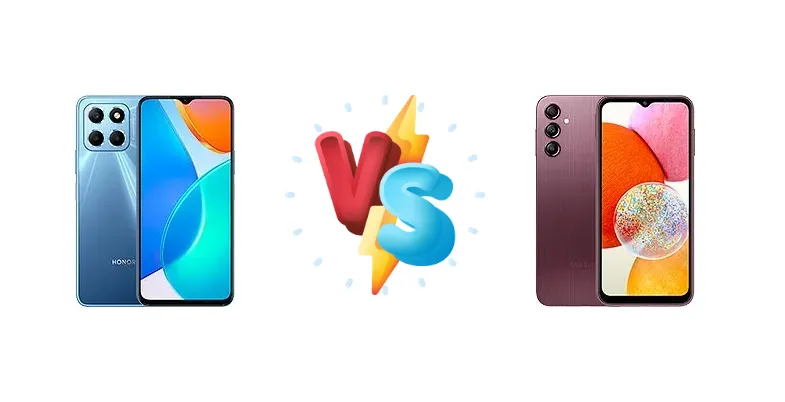
The budget smartphone market is fiercely competitive, offering incredible value for your money. Today, we're pitting two popular contenders against each other: the Honor X6 and the Samsung Galaxy A14. Let's dive into a comprehensive comparison to see which phone reigns supreme.
🏆 Quick Verdict
The Samsung Galaxy A14 generally wins due to its significantly more powerful chipset (especially the Exynos version), better camera capabilities, and faster charging. While the Honor X6 offers a more affordable entry point, the A14 provides a more well-rounded and future-proof experience.
| Network |
|---|
| 2G bands | GSM 850 / 900 / 1800 / 1900 | GSM 850 / 900 / 1800 / 1900 |
| 3G bands | HSDPA 850 / 900 / 1900 / 2100 | HSDPA 850 / 900 / 2100 |
| 4G bands | LTE | 1, 3, 5, 7, 8, 20, 28, 38, 40, 41 |
| Speed | HSPA, LTE | HSPA, LTE |
| Technology | GSM / HSPA / LTE | GSM / HSPA / LTE |
| Launch |
|---|
| Announced | 2022, September 21 | 2023, February 28 |
| Status | Available. Released 2022, September 21 | Available. Released 2023, March 27 |
| Body |
|---|
| Build | - | Glass front, plastic back, plastic frame |
| Dimensions | 163.7 x 75.1 x 8.7 mm (6.44 x 2.96 x 0.34 in) | 167.7 x 78 x 9.1 mm (6.60 x 3.07 x 0.36 in) |
| SIM | Nano-SIM + Nano-SIM | · Nano-SIM· Nano-SIM + Nano-SIM |
| Weight | 194 g (6.84 oz) | 201 g (7.09 oz) |
| Display |
|---|
| Resolution | 720 x 1600 pixels, 20:9 ratio (~270 ppi density) | 1080 x 2408 pixels, 20:9 ratio (~400 ppi density) |
| Size | 6.5 inches, 102.0 cm2 (~83.0% screen-to-body ratio) | 6.6 inches, 104.9 cm2 (~80.2% screen-to-body ratio) |
| Type | TFT LCD | PLS LCD |
| Platform |
|---|
| CPU | Octa-core (4x2.0 GHz Cortex-A53 & 4x1.5 GHz Cortex-A53) | Octa-core (2x2.0 GHz Cortex-A75 & 6x1.8 GHz Cortex-A55) - Version AOcta-core (4x2.0 GHz Cortex-A55 & 4x2.0 GHz Cortex-A55) - Version B |
| Chipset | Mediatek MT6762G Helio G25 (12 nm) | Mediatek MT6769 Helio G80 (12 nm) - Version AExynos 850 (8 nm) - Version B |
| GPU | PowerVR GE8320 | Mali-G52 MC2 |
| OS | Android 12, Magic UI 6.1 | Android 13, upgradable to Android 15, One UI 7 |
| Memory |
|---|
| Card slot | microSDXC | microSDXC (dedicated slot) |
| Internal | 64GB 4GB RAM, 128GB 4GB RAM | 64GB 4GB RAM, 128GB 4GB RAM, 128GB 6GB RAM |
| Main Camera |
|---|
| Features | LED flash, HDR, panorama | LED flash, panorama, HDR |
| Single | - | 13 MP, f/2.0, (wide) |
| Triple | 50 MP, f/1.8, (wide), PDAF
2 MP (macro)
Auxiliary lens | 50 MP, f/1.8, 26mm (wide), 1/2.75", 0.64µm, PDAF
5 MP, f/2.2, 17mm (ultrawide), 1/5.0", 1.12µm
2 MP (macro) |
| Video | 1080p@30fps | 1080p@30fps |
| Selfie camera |
|---|
| Single | 5 MP, f/2.2, (wide) | 13 MP, f/2.0, 26mm (wide), 1/3.1", 1.12µm |
| Video | 1080p@30fps | 1080p@30fps |
| Sound |
|---|
| 3.5mm jack | Yes | Yes |
| 35mm jack | Yes | Yes |
| Loudspeaker | Yes | Yes |
| Comms |
|---|
| Bluetooth | 5.1, A2DP, LE | 5.1 or 5.3, A2DP, LE |
| NFC | Yes (VNE-LX1 only) | Yes (market/region dependent) |
| Positioning | GPS, GLONASS, GALILEO, BDS | GPS, GALILEO, GLONASS, BDS, QZSS |
| Radio | Unspecified | Unspecified |
| USB | USB Type-C 2.0, OTG | USB Type-C 2.0 |
| WLAN | Wi-Fi 802.11 a/b/g/n/ac, dual-band, Wi-Fi Direct | Wi-Fi 802.11 a/b/g/n/ac, dual-band, Wi-Fi Direct |
| Features |
|---|
| Sensors | Fingerprint (side-mounted), accelerometer, proximity | Fingerprint (side-mounted), accelerometer, proximity, compass |
| Battery |
|---|
| Charging | 10W wired | 15W wired |
| Type | Li-Po 5000 mAh | Li-Po 5000 mAh |
| Misc |
|---|
| Colors | Ocean Blue, Titanium Silver, Midnight Black | Black, Dark Red, Silver, Green |
| Models | VNE-LX1, VNE-LX2, VNE-LX3 | SM-A145F, SM-A145F/DSN, SM-A145M, SM-A145M/DS, SM-A145P, SM-A145R |
| Price | About 100 EUR | € 85.76 / $ 147.60 / £ 79.95 |
| SAR EU | - | 0.46 W/kg (head) 1.37 W/kg (body) |
Honor X6
- Very affordable
- Large display
- Decent battery life
- Weak performance
- Basic camera
- Slow charging
- Limited software updates
Samsung Galaxy A14
- Better performance (Helio G80/Exynos 850)
- Improved camera
- Faster charging
- Longer software support
- More vibrant display
- Slightly more expensive
- Design can be a bit bland
Display Comparison
Both phones feature large displays, typically around 6.5 inches. The Galaxy A14 often boasts a slightly higher resolution (FHD+) and potentially better color accuracy, offering a more immersive viewing experience. The Honor X6's display is generally adequate but may lack the vibrancy and sharpness of the A14.
Camera Comparison
The Galaxy A14 generally has a more versatile and capable camera system. It often includes a higher resolution main sensor and additional lenses (ultrawide, macro) for greater creative flexibility. Image processing is also typically better on the A14, resulting in more detailed and vibrant photos. The Honor X6's camera is decent for basic photography but struggles in low light.
Performance
This is where the Galaxy A14 pulls ahead. The Helio G80 (or Exynos 850) chipset in the A14 offers a substantial performance boost over the Helio G25 in the Honor X6. Expect smoother multitasking, faster app loading times, and better gaming performance on the A14. The X6 can feel sluggish at times, especially with demanding apps.
Battery Life
Both phones typically feature large batteries (around 5000mAh), offering all-day battery life. However, the Galaxy A14's more efficient chipset and faster charging (15W vs 10W) give it a slight edge in overall battery performance and convenience.
Buying Guide
The Honor X6 is a good choice for users on a very tight budget who prioritize affordability above all else and don't need high performance. The Samsung Galaxy A14 is ideal for those seeking a reliable, capable smartphone with a better camera, faster performance, and longer software support, even if it costs a bit more.
Frequently Asked Questions
❓ Which phone has better gaming performance?
The Samsung Galaxy A14, thanks to its more powerful chipset, offers significantly better gaming performance than the Honor X6.
❓ How long will Samsung provide software updates for the Galaxy A14?
Samsung typically provides longer software update support for its Galaxy A series devices, often offering 4 years of security updates and 2 years of OS upgrades.