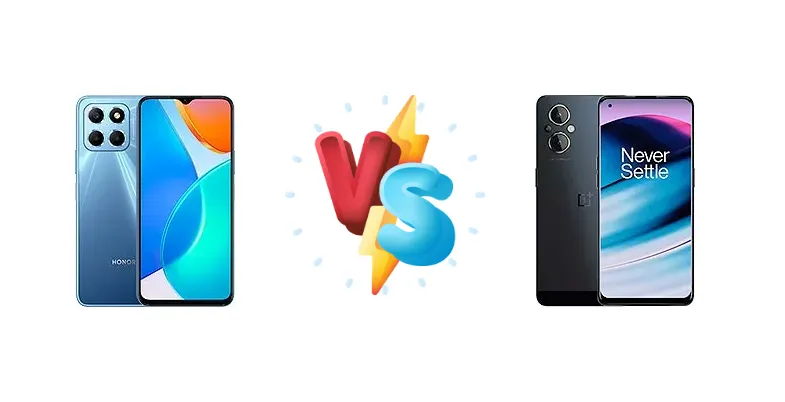
The Honor X6 and OnePlus Nord N20 5G represent compelling options in the increasingly competitive sub-$300 smartphone market. While both offer 5G connectivity, they diverge significantly in their internal hardware, leading to distinct performance and user experience profiles. This comparison dissects these differences to determine which device delivers the best value.
🏆 Quick Verdict
For the average user prioritizing responsiveness and future-proofing, the OnePlus Nord N20 5G is the better choice. Its Snapdragon 695 chipset, built on a more efficient 6nm process, provides a noticeable performance advantage over the Honor X6’s Helio G25, coupled with significantly faster 33W charging.
| Network |
|---|
| 2G bands | GSM 850 / 900 / 1800 / 1900 | GSM 850 / 900 / 1800 / 1900 |
| 3G bands | HSDPA 850 / 900 / 1900 / 2100 | HSDPA 850 / 900 / 1700(AWS) / 1900 / 2100 |
| 4G bands | LTE | 1, 2, 3, 4, 5, 7, 8, 12, 13, 17, 20, 25, 26, 28, 38, 39, 40, 41, 66, 71 |
| 5G bands | - | 2, 25, 41, 66, 71 SA/NSA |
| Speed | HSPA, LTE | HSPA 42.2/5.76 Mbps, LTE Cat15 800/200 Mbps, 5G |
| Technology | GSM / HSPA / LTE | GSM / HSPA / LTE / 5G |
| Launch |
|---|
| Announced | 2022, September 21 | 2022, April 28 |
| Status | Available. Released 2022, September 21 | Available. Released 2022, April 28 |
| Body |
|---|
| Build | - | Glass front (Schott Xensation Up), plastic frame, plastic back |
| Dimensions | 163.7 x 75.1 x 8.7 mm (6.44 x 2.96 x 0.34 in) | 159.9 x 73.2 x 7.5 mm (6.30 x 2.88 x 0.30 in) |
| SIM | Nano-SIM + Nano-SIM | Nano-SIM |
| Weight | 194 g (6.84 oz) | 173 g (6.10 oz) |
| Display |
|---|
| Protection | - | Schott Xensation Up |
| Resolution | 720 x 1600 pixels, 20:9 ratio (~270 ppi density) | 1080 x 2400 pixels, 20:9 ratio (~409 ppi density) |
| Size | 6.5 inches, 102.0 cm2 (~83.0% screen-to-body ratio) | 6.43 inches, 99.8 cm2 (~85.3% screen-to-body ratio) |
| Type | TFT LCD | AMOLED |
| | - | Always-on display |
| Platform |
|---|
| CPU | Octa-core (4x2.0 GHz Cortex-A53 & 4x1.5 GHz Cortex-A53) | Octa-core (2x2.2 GHz Kryo 660 Gold & 6x1.7 GHz Kryo 660 Silver) |
| Chipset | Mediatek MT6762G Helio G25 (12 nm) | Qualcomm SM6375 Snapdragon 695 5G (6 nm) |
| GPU | PowerVR GE8320 | Adreno 619 |
| OS | Android 12, Magic UI 6.1 | Android 11, OxygenOS 11 |
| Memory |
|---|
| Card slot | microSDXC | microSDXC (dedicated slot) |
| Internal | 64GB 4GB RAM, 128GB 4GB RAM | 128GB 6GB RAM |
| | - | UFS 2.2 |
| Main Camera |
|---|
| Features | LED flash, HDR, panorama | LED flash, HDR, panorama |
| Single | - | 16 MP, f/2.4, (wide) |
| Triple | 50 MP, f/1.8, (wide), PDAF
2 MP (macro)
Auxiliary lens | 64 MP, f/1.8, (wide), PDAF
2 MP (macro)
Auxiliary lens |
| Video | 1080p@30fps | 1080p@30fps |
| Selfie camera |
|---|
| Features | - | HDR |
| Single | 5 MP, f/2.2, (wide) | 16 MP, f/2.4, (wide) |
| Video | 1080p@30fps | 1080p@30fps |
| Sound |
|---|
| 3.5mm jack | Yes | Yes |
| 35mm jack | Yes | Yes |
| Loudspeaker | Yes | Yes |
| Comms |
|---|
| Bluetooth | 5.1, A2DP, LE | 5.1, A2DP, LE |
| NFC | Yes (VNE-LX1 only) | Yes |
| Positioning | GPS, GLONASS, GALILEO, BDS | GPS (L1+L5), GLONASS, GALILEO, BDS |
| Radio | Unspecified | No |
| USB | USB Type-C 2.0, OTG | USB Type-C 2.0, OTG |
| WLAN | Wi-Fi 802.11 a/b/g/n/ac, dual-band, Wi-Fi Direct | Wi-Fi 802.11 a/b/g/n/ac, dual-band, Wi-Fi Direct |
| Features |
|---|
| Sensors | Fingerprint (side-mounted), accelerometer, proximity | Fingerprint (under display, optical), accelerometer, gyro, proximity, compass, barometer |
| Battery |
|---|
| Charging | 10W wired | 33W wired |
| Type | Li-Po 5000 mAh | Li-Po 4500 mAh |
| Misc |
|---|
| Colors | Ocean Blue, Titanium Silver, Midnight Black | Blue |
| Models | VNE-LX1, VNE-LX2, VNE-LX3 | GN2200, CPH2459 |
| Price | About 100 EUR | About 120 EUR |
| Tests |
|---|
| Battery life | - |
Endurance rating 129h
|
| Display | - |
Contrast ratio: Infinite (nominal) |
| Performance | - |
AnTuTu: 316974 (v8), 380672 (v9)
GeekBench: 1945 (v5.1)
GFXBench: 16fps (ES 3.1 onscreen) |
Honor X6
- Potentially lower price point
- Acceptable battery endurance (129h)
- Basic functionality for essential tasks
- Outdated and less powerful Helio G25 chipset
- Slow 10W charging
- Likely inferior display quality
OnePlus Nord N20 5G
- More powerful and efficient Snapdragon 695 5G chipset
- Faster 33W wired charging
- Brighter display for better outdoor visibility
- May be slightly more expensive
- Battery endurance is similar to the Honor X6 despite faster charging
- Camera performance likely only average
Display Comparison
The OnePlus Nord N20 5G boasts a brighter display, reaching a measured 647 nits, compared to an unspecified brightness for the Honor X6. This difference translates to better visibility outdoors. While both displays are described as having an 'infinite' contrast ratio (typical for LCD/OLED panels), the Nord N20 5G’s higher peak brightness is a tangible advantage. The Honor X6’s display specifications are minimal, suggesting a more basic panel likely with lower color accuracy and viewing angles.
Camera Comparison
Without detailed camera specifications for either device, a direct comparison is difficult. However, given the market positioning, it’s reasonable to assume both phones feature modest camera systems. The absence of information regarding sensor size or optical image stabilization (OIS) suggests neither phone will excel in low-light photography. Image processing will likely be the differentiating factor, and OnePlus generally offers more refined software algorithms.
Performance
The core difference lies in the chipsets. The OnePlus Nord N20 5G’s Qualcomm Snapdragon 695 5G (6nm) is a significant upgrade over the Honor X6’s MediaTek Helio G25 (12nm). The 6nm process node of the Snapdragon 695 offers superior power efficiency and thermal performance, allowing for sustained performance under load. The Snapdragon 695’s CPU configuration – 2x2.2 GHz Kryo 660 Gold & 6x1.7 GHz Kryo 660 Silver – is also more capable than the Honor X6’s Octa-core (4x2.0 GHz Cortex-A53 & 4x1.5 GHz Cortex-A53). This translates to faster app launches, smoother multitasking, and a more responsive overall experience on the Nord N20 5G.
Battery Life
Both phones share an endurance rating of 129 hours, suggesting similar overall battery life despite the Honor X6’s unspecified battery capacity. However, the OnePlus Nord N20 5G’s 33W wired charging is a game-changer. This allows for significantly faster charging times compared to the Honor X6’s slow 10W charging. A full charge on the Nord N20 5G will take considerably less time, offering greater convenience.
Buying Guide
Buy the Honor X6 if you need a very basic smartphone for essential tasks like calls, texts, and light social media, and battery longevity is paramount. Its lower price point makes it ideal for first-time smartphone users or those on a severely restricted budget. Buy the OnePlus Nord N20 5G if you prioritize a smoother user experience, faster app loading times, and the ability to handle more demanding tasks like streaming and casual gaming, and value the convenience of rapid charging.
Frequently Asked Questions
❓ Is the Snapdragon 695 in the OnePlus Nord N20 5G capable of handling demanding games like PUBG Mobile?
The Snapdragon 695 can run PUBG Mobile, but likely at medium settings to maintain a stable frame rate. It's not a gaming powerhouse, but it offers a significantly better gaming experience than the Helio G25 in the Honor X6, which would struggle with consistent performance even at lower settings.
❓ How long does it realistically take to fully charge the OnePlus Nord N20 5G with the 33W charger?
With the included 33W charger, the OnePlus Nord N20 5G can typically charge from 0% to 100% in approximately 60-75 minutes. This is a substantial improvement over the Honor X6, which would take several hours with its 10W charger.
❓ Does the Honor X6 support VoLTE and 5G on all carriers?
While the Honor X6 supports 5G, carrier compatibility can vary. It's crucial to check with your specific carrier to ensure the device is fully compatible with their network bands and VoLTE implementation before purchasing.
❓ What type of storage does the OnePlus Nord N20 5G use, and is it expandable?
The OnePlus Nord N20 5G utilizes UFS 2.2 storage, which is faster than the eMMC storage commonly found in devices at this price point. Unfortunately, it does *not* offer microSD card expansion, so you're limited to the internal storage option you choose at purchase.