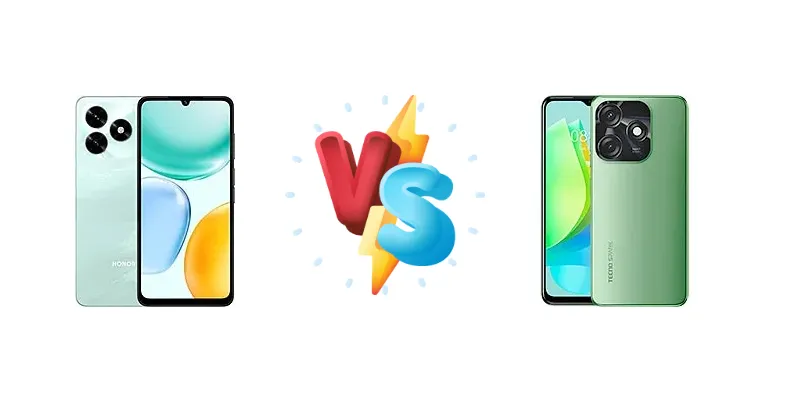
The Honor X5c and Tecno Spark 10C represent the fiercely competitive sub-$150 smartphone market. Both aim to deliver essential features at an accessible price, but they take different approaches to achieving this. The Honor X5c leverages MediaTek’s Helio G81, a chip known for its gaming capabilities, while the Tecno Spark 10C opts for the Unisoc T606, prioritizing efficiency. This comparison will dissect their key differences to determine which device offers the best value.
🏆 Quick Verdict
For the average user prioritizing consistent performance and slightly better gaming potential, the Honor X5c emerges as the winner. Its Helio G81 chipset, despite being older, offers a noticeable edge in CPU-intensive tasks. However, the Tecno Spark 10C’s 18W charging provides a faster top-up, making it a viable alternative for those who value convenience over raw power.
| Network |
|---|
| 2G bands | GSM 850 / 900 / 1800 / 1900 | GSM 850 / 900 / 1800 / 1900 |
| 3G bands | HSDPA 850 / 900 / 1900 / 2100 | HSDPA 850 / 900 / 2100 |
| 4G bands | LTE | LTE |
| Speed | HSPA, LTE | HSPA, LTE |
| Technology | GSM / HSPA / LTE | GSM / HSPA / LTE |
| Launch |
|---|
| Announced | 2025, October 05 | 2023, March 23 |
| Status | Available. Released 2025, October 05 | Available. Released 2023, March 29 |
| Body |
|---|
| Build | - | Glass front, plastic frame, plastic back |
| Dimensions | 167 x 77 x 7.9 mm (6.57 x 3.03 x 0.31 in) | 163.9 x 75.5 x 8.5 mm (6.45 x 2.97 x 0.33 in) |
| SIM | Nano-SIM + Nano-SIM | Nano-SIM + Nano-SIM |
| Weight | 186 g (6.56 oz) | - |
| Display |
|---|
| Resolution | 720 x 1600 pixels, 20:9 ratio (~260 ppi density) | 720 x 1612 pixels, 20:9 ratio (~267 ppi density) |
| Size | 6.74 inches, 109.7 cm2 (~85.3% screen-to-body ratio) | 6.6 inches, 104.6 cm2 (~84.6% screen-to-body ratio) |
| Type | TFT LCD, 90Hz | IPS LCD, 90Hz |
| Platform |
|---|
| CPU | Octa-core (2x2.0 GHz Cortex-A75 & 6x1.7 GHz Cortex-A55) | Octa-core (2x1.6 GHz Cortex-A75 & 6x1.6 GHz Cortex-A55) |
| Chipset | Mediatek Helio G81 (12 nm) | Unisoc T606 (12 nm) |
| GPU | Mali-G52 MC2 | Mali-G57 MP1 |
| OS | Android 15, MagicOS 9 | Android 12, HIOS 8.6 |
| Memory |
|---|
| Card slot | microSDXC (uses shared SIM slot) | microSDXC (dedicated slot) |
| Internal | 64GB 4GB RAM, 128GB 4GB RAM | 64GB 4GB RAM, 128GB 4GB RAM, 128GB 8GB RAM |
| Main Camera |
|---|
| Dual | - | 16 MP, (wide), PDAF
0.08 MP, (depth) |
| Features | LED flash, HDR, panorama | Dual-LED flash, HDR, panorama |
| Single | · 50 MP, f/1.8, (wide), PDAF - LATAM only
· 13 MP, f/2.2, (wide) - MEA, SEA, AF, Eurasia
Auxiliary lens | 16 MP, (wide), PDAF
Auxiliary lens |
| Video | 1080p@30fps | 1080p@30fps |
| Selfie camera |
|---|
| Features | - | Dual-LED flash |
| Single | 5 MP, f/2.2, (wide) | 8 MP, (wide) |
| Video | 1080p@30fps | 1080p@30fps |
| Sound |
|---|
| 3.5mm jack | - | Yes |
| 35mm jack | Yes | Yes |
| Loudspeaker | Yes | Yes |
| Comms |
|---|
| Bluetooth | 5.1, A2DP, LE, aptX HD | Yes |
| NFC | No | No |
| Positioning | GPS, GLONASS, GALILEO, BDS | GPS |
| Radio | FM radio | FM radio |
| USB | USB Type-C 2.0, OTG | USB Type-C 2.0 |
| WLAN | Wi-Fi 802.11 a/b/g/n/ac, dual-band, Wi-Fi Direct | Wi-Fi 802.11 a/b/g/n/ac, dual-band |
| Features |
|---|
| Sensors | Fingerprint (side-mounted), accelerometer, proximity | Fingerprint (side-mounted), accelerometer, proximity, compass |
| Battery |
|---|
| Charging | 15W wired | 18W wired |
| Type | Li-Po 5260 mAh | 5000 mAh |
| Misc |
|---|
| Colors | Ocean Cyan, Midnight Black, Tidal Blue, Meteor Silver | Black, Blue, Green |
| Models | - | KI5k, KI5m |
| Price | - | ₹ 9,990 |
Honor X5c
- More powerful Helio G81 chipset for better performance.
- Slightly better gaming capabilities.
- Potentially smoother multitasking experience.
- Slower 15W charging.
- Potentially lower battery life under heavy load.
Tecno Spark 10C
- Faster 18W wired charging.
- More efficient Unisoc T606 chipset.
- Potentially longer battery life with light usage.
- Less powerful chipset for demanding tasks.
- Lower gaming performance.
Display Comparison
Neither device boasts a standout display. Both utilize 12nm chipsets, suggesting similar power constraints impacting display capabilities. While specific display specs (resolution, panel type) are missing, the focus here is on performance. The absence of high refresh rates or advanced features like LTPO on either device indicates a cost-saving approach, prioritizing affordability over visual fidelity. Bezels are likely to be substantial on both, typical for this price bracket.
Camera Comparison
Without detailed camera specifications, a direct comparison is difficult. However, it’s safe to assume both phones feature basic camera setups geared towards social media sharing. The presence of a 2MP macro lens on either device is likely more for marketing than practical use. Image processing will likely be heavily reliant on software algorithms to enhance image quality, and differences in sensor size and lens apertures (if any) will be the key determinants of image quality. Expect similar performance in good lighting conditions, with both struggling in low-light scenarios.
Performance
The core difference lies in the chipsets. The Honor X5c’s MediaTek Helio G81 features a dual-core Cortex-A75 setup clocked at 2.0 GHz, paired with six Cortex-A55 cores at 1.7 GHz. This configuration provides a performance boost in single-core tasks and gaming compared to the Tecno Spark 10C’s Unisoc T606. The T606, with its 1.6 GHz Cortex-A75 cores and 1.6 GHz Cortex-A55 cores, emphasizes efficiency. While both are 12nm chips, the G81’s higher clock speeds translate to quicker app launches and smoother multitasking. The G81’s GPU is also more capable, offering a better gaming experience, though neither phone is a gaming powerhouse. RAM configurations are likely similar, further emphasizing the chipset as the primary differentiator.
Battery Life
The Tecno Spark 10C’s 18W wired charging is a clear advantage over the Honor X5c’s 15W charging. While battery capacity isn’t specified, the faster charging speed means less time tethered to a wall outlet. The Unisoc T606’s efficiency may contribute to slightly better battery life under light usage, but the Helio G81’s performance demands could offset this advantage during intensive tasks. The 3W difference in charging wattage translates to a noticeable reduction in 0-100% charging time for the Tecno Spark 10C.
Buying Guide
Buy the Honor X5c if you need a phone capable of handling moderate gaming and multitasking without significant slowdowns. It’s ideal for users who frequently switch between apps or enjoy casual mobile games. Buy the Tecno Spark 10C if you prioritize faster charging and a slightly more modern chipset architecture, even if it means sacrificing some peak performance. This phone suits users who primarily use their phone for calls, messaging, and light social media browsing.
Frequently Asked Questions
❓ Will the Honor X5c struggle with popular apps like Facebook and WhatsApp?
No, the Helio G81 chipset is more than capable of handling everyday apps like Facebook, WhatsApp, and web browsing. While it won't offer a flagship-level experience, it will provide a smooth and responsive user experience for these common tasks.
❓ How long will it take to fully charge the Tecno Spark 10C with the 18W charger?
While a precise charging time requires testing, the 18W charger should fully charge the Tecno Spark 10C in approximately 2-2.5 hours, depending on battery capacity. This is noticeably faster than the Honor X5c’s 15W charging, which could take closer to 3 hours.
❓ Can the Honor X5c run PUBG Mobile, and if so, at what settings?
The Honor X5c can run PUBG Mobile, but you'll likely need to play at low to medium settings to maintain a playable frame rate. The Helio G81's GPU is sufficient for casual gaming, but don't expect a consistently smooth experience at higher settings.
❓ Is the Unisoc T606 chipset known for overheating?
The Unisoc T606 is generally known for its efficiency and relatively cool operation. It's less prone to overheating compared to more powerful chipsets, making it a good choice for users who prioritize thermal management.