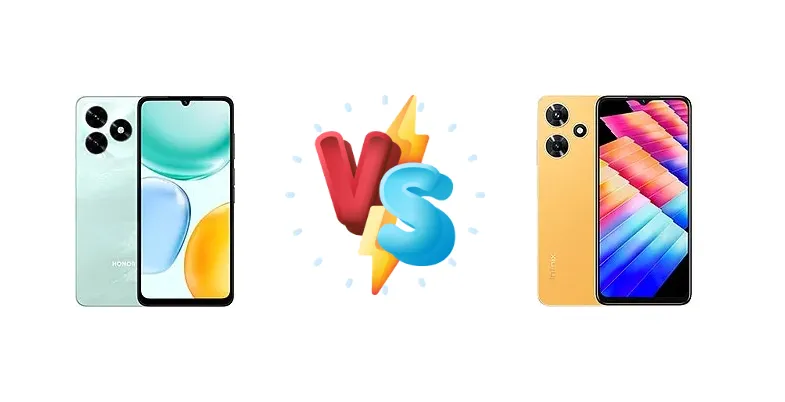
The Honor X5c and Infinix Hot 30i represent two compelling options in the increasingly competitive sub-$150 smartphone market. Both aim to deliver essential features without breaking the bank, but they take different approaches to achieving this. This comparison dives deep into their core specifications, focusing on performance, charging, and overall value to help you determine which device best suits your needs.
🏆 Quick Verdict
For the average user prioritizing consistent performance in everyday tasks, the Honor X5c emerges as the slightly better choice. Its Mediatek Helio G81 chipset, while not a powerhouse, offers a more mature architecture and generally smoother experience compared to the Unisoc T606 in the Infinix Hot 30i. However, the Hot 30i's 18W charging provides a tangible benefit for those frequently on the go.
| Network |
|---|
| 2G bands | GSM 850 / 900 / 1800 / 1900 | GSM 850 / 900 / 1800 / 1900 |
| 3G bands | HSDPA 850 / 900 / 1900 / 2100 | HSDPA 850 / 900 / 1700(AWS) / 1900 / 2100 |
| 4G bands | LTE | 1, 2, 3, 4, 5, 7, 8, 20, 28, 38, 40, 41 |
| Speed | HSPA, LTE | HSPA, LTE |
| Technology | GSM / HSPA / LTE | GSM / HSPA / LTE |
| Launch |
|---|
| Announced | 2025, October 05 | 2023, March 31 |
| Status | Available. Released 2025, October 05 | Available. Released 2023, March 31 |
| Body |
|---|
| Build | - | Glass front, plastic frame, plastic back |
| Dimensions | 167 x 77 x 7.9 mm (6.57 x 3.03 x 0.31 in) | 164 x 75.8 x 8.4 mm (6.46 x 2.98 x 0.33 in) |
| SIM | Nano-SIM + Nano-SIM | Nano-SIM + Nano-SIM |
| Weight | 186 g (6.56 oz) | 191 g (6.74 oz) |
| Display |
|---|
| Resolution | 720 x 1600 pixels, 20:9 ratio (~260 ppi density) | 720 x 1612 pixels, 20:9 ratio (~269 ppi density) |
| Size | 6.74 inches, 109.7 cm2 (~85.3% screen-to-body ratio) | 6.56 inches, 103.4 cm2 (~83.2% screen-to-body ratio) |
| Type | TFT LCD, 90Hz | IPS LCD, 90Hz, 500 nits (peak) |
| Platform |
|---|
| CPU | Octa-core (2x2.0 GHz Cortex-A75 & 6x1.7 GHz Cortex-A55) | Octa-core (2x1.6 GHz Cortex-A75 & 6x1.6 GHz Cortex-A55) |
| Chipset | Mediatek Helio G81 (12 nm) | Unisoc T606 (12 nm) |
| GPU | Mali-G52 MC2 | Mali-G57 MP1 |
| OS | Android 15, MagicOS 9 | Android 12, XOS 10.6 |
| Memory |
|---|
| Card slot | microSDXC (uses shared SIM slot) | microSDXC (dedicated slot) |
| Internal | 64GB 4GB RAM, 128GB 4GB RAM | 64GB 4GB RAM, 128GB 4GB RAM, 128GB 8GB RAM |
| | - | UFS 2.2 |
| Main Camera |
|---|
| Dual | - | 13 MP, f/1.9, (wide), AF
0.08 MP, (depth) |
| Features | LED flash, HDR, panorama | Dual-LED flash, HDR, panorama |
| Single | · 50 MP, f/1.8, (wide), PDAF - LATAM only
· 13 MP, f/2.2, (wide) - MEA, SEA, AF, Eurasia
Auxiliary lens | 13 MP, f/1.9, (wide), 1/3.07", AF
Auxiliary lens |
| Video | 1080p@30fps | 1080p@30fps |
| Selfie camera |
|---|
| Features | - | Dual-LED flash |
| Single | 5 MP, f/2.2, (wide) | 8 MP, f/2.0, (wide), 1/3.94" |
| Video | 1080p@30fps | 1080p@30fps |
| Sound |
|---|
| 3.5mm jack | - | Yes |
| 35mm jack | Yes | Yes |
| Loudspeaker | Yes | Yes |
| Comms |
|---|
| Bluetooth | 5.1, A2DP, LE, aptX HD | Yes |
| NFC | No | Yes (Hot 30i NFC only) |
| Positioning | GPS, GLONASS, GALILEO, BDS | GPS |
| Radio | FM radio | FM radio |
| USB | USB Type-C 2.0, OTG | USB Type-C 2.0, OTG |
| WLAN | Wi-Fi 802.11 a/b/g/n/ac, dual-band, Wi-Fi Direct | Wi-Fi 802.11 a/b/g/n/ac, dual-band |
| Features |
|---|
| Sensors | Fingerprint (side-mounted), accelerometer, proximity | Fingerprint (side-mounted), accelerometer, proximity, compass |
| Battery |
|---|
| Charging | 15W wired | 18W wired |
| Type | Li-Po 5260 mAh | 5000 mAh |
| Misc |
|---|
| Colors | Ocean Cyan, Midnight Black, Tidal Blue, Meteor Silver | Mirror Black, Glacier Blue, Diamond White, Marigold |
| Models | - | X669, X669D |
Honor X5c
- More powerful chipset (Helio G81)
- Proven chipset architecture for smoother performance
- Potentially better image processing
- Slower charging speed (15W)
- Limited information on display quality
Infinix Hot 30i
- Faster charging (18W)
- Competitive price point
- Potentially longer software support (Infinix's recent efforts)
- Less powerful chipset (Unisoc T606)
- Unisoc chipset may have less optimized software support
Display Comparison
Neither Honor nor Infinix provide display specifications beyond resolution in their marketing materials. Assuming both utilize standard IPS LCD panels common in this price bracket, color accuracy and viewing angles will likely be similar. The absence of high refresh rates is expected. The real difference will likely come down to panel calibration, which is difficult to assess without direct testing. Bezels are also likely comparable, contributing minimally to differentiating factors.
Camera Comparison
Without detailed camera specs, a direct comparison is challenging. Both phones likely feature a primary camera and depth/macro sensors. The image processing algorithms will be a key differentiator, and brand reputation suggests Honor may have a slight edge in image quality. However, the absence of Optical Image Stabilization (OIS) on either device means low-light performance will be limited. Focusing on the primary sensor resolution (if available) will be more informative than considering the typically low-resolution auxiliary lenses.
Performance
The core difference lies in the chipsets. The Honor X5c’s Mediatek Helio G81, built on a 12nm process, features a dual-core Cortex-A75 setup clocked at 2.0 GHz, paired with six Cortex-A55 cores at 1.7 GHz. This architecture is proven and generally delivers a smoother experience than the Unisoc T606. The Infinix Hot 30i’s Unisoc T606, also 12nm, uses a similar core configuration – dual Cortex-A75 at 1.6 GHz and six Cortex-A55 at 1.6 GHz. The lower clock speeds on the T606 translate to slightly reduced single-core and multi-core performance. While both are adequate for basic tasks, the G81 will handle multitasking and moderately demanding apps with more ease. The G81's GPU is also likely to provide a better gaming experience, though neither phone is designed for high-end gaming.
Battery Life
Both phones likely feature batteries in the 5000mAh range, typical for this segment. However, the Infinix Hot 30i’s 18W wired charging is a significant advantage over the Honor X5c’s 15W charging. This translates to a faster 0-100% charge time, potentially shaving off 30-60 minutes. While battery life will be similar under moderate usage, the Hot 30i offers more convenience for users who frequently need to top up their device.
Buying Guide
Buy the Honor X5c if you need a reliably performing device for daily tasks like social media, browsing, and light gaming, and value a more established chipset. Buy the Infinix Hot 30i if you prioritize faster charging speeds and are willing to accept potentially slightly lower performance in demanding applications. Both phones are excellent choices for users on a tight budget, but their strengths cater to different priorities.
Frequently Asked Questions
❓ Will the Unisoc T606 in the Infinix Hot 30i struggle with demanding games like PUBG Mobile?
The Unisoc T606 is capable of running PUBG Mobile, but you'll likely need to lower the graphics settings to medium or low to achieve a playable frame rate. The Helio G81 in the Honor X5c will offer a slightly smoother experience, but neither phone is designed for high-end gaming.
❓ How long will it take to fully charge the Honor X5c with its 15W charger?
Based on typical 15W charging speeds and a likely 5000mAh battery, expect a full charge to take approximately 2.5 to 3 hours. The Infinix Hot 30i's 18W charging will reduce this time by roughly 30-60 minutes.
❓ Does either phone support any form of fast charging protocols beyond standard USB Power Delivery?
Neither Honor nor Infinix explicitly advertise support for proprietary fast charging protocols like Quick Charge or VOOC. Both phones rely on standard USB Power Delivery (USB-PD), meaning you won't see significantly faster charging speeds with a different charger unless it also supports USB-PD.
❓ Which phone is likely to receive more software updates and security patches?
Historically, Honor has a better track record of providing software updates, but Infinix has been improving in this area recently. However, given both phones fall into the budget category, long-term software support cannot be guaranteed. Expect at least one major Android update, but security patches may be less frequent.