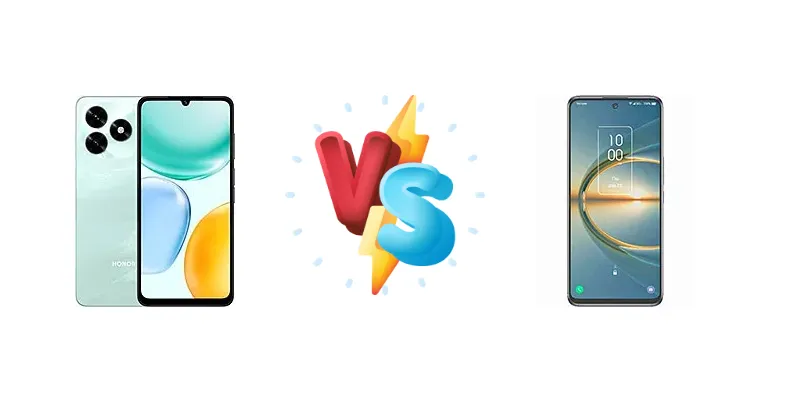
The sub-$200 5G smartphone market is heating up, and the Honor X5c Plus and TCL 30 V 5G are two contenders vying for your attention. Both aim to deliver 5G connectivity without breaking the bank, but they take different approaches to achieving this. The Honor relies on MediaTek’s Helio G81, while the TCL opts for Qualcomm’s Snapdragon 480 5G. This comparison will dissect the key differences to determine which phone offers the best value.
🏆 Quick Verdict
For the average user prioritizing 5G connectivity and slightly better efficiency, the TCL 30 V 5G is the stronger choice. Its Snapdragon 480, built on an 8nm process, offers a more modern architecture and potentially better long-term performance than the Honor X5c Plus’s 12nm Helio G81, despite similar CPU clock speeds.
| Network |
|---|
| 2G bands | GSM 850 / 900 / 1800 / 1900 | GSM 850 / 900 / 1800 / 1900 |
| 3G bands | HSDPA 850 / 900 / 1900 / 2100 | HSDPA 850 / 900 / 1700(AWS) / 1900 / 2100 |
| 4G bands | LTE | 2, 4, 5, 12, 13, 46, 48, 66 |
| 5G bands | - | 2, 5, 48, 66, 77, 260, 261 SA/NSA/Sub6/mmWave |
| Speed | HSPA, LTE | HSPA, LTE, 5G |
| Technology | GSM / HSPA / LTE | GSM / HSPA / LTE / 5G |
| Launch |
|---|
| Announced | 2025, September 24 | 2022, January 04 |
| Status | Available. Released 2025, September 24 | Available. Released 2022, January 28 |
| Body |
|---|
| Build | - | Glass front, plastic frame, plastic back |
| Dimensions | 167 x 77 x 7.9 mm (6.57 x 3.03 x 0.31 in) | 165.9 x 76 x 9.1 mm (6.53 x 2.99 x 0.36 in) |
| SIM | Nano-SIM + Nano-SIM | Nano-SIM |
| Weight | 186 g (6.56 oz) | 200.4 g (7.09 oz) |
| Display |
|---|
| Protection | - | Corning Gorilla Glass 3 |
| Resolution | 720 x 1600 pixels, 20:9 ratio (~260 ppi density) | 1080 x 2400 pixels, 20:9 ratio (~395 ppi density) |
| Size | 6.74 inches, 109.7 cm2 (~85.3% screen-to-body ratio) | 6.67 inches, 107.4 cm2 (~85.2% screen-to-body ratio) |
| Type | TFT LCD, 90Hz | IPS LCD |
| Platform |
|---|
| CPU | Octa-core (2x2.0 GHz Cortex-A75 & 6x1.7 GHz Cortex-A55) | Octa-core (2x2.0 GHz Kryo 460 & 6x1.8 GHz Kryo 460) |
| Chipset | Mediatek Helio G81 (12 nm) | Qualcomm SM4350 Snapdragon 480 5G (8 nm) |
| GPU | Mali-G52 MC2 | Adreno 619 |
| OS | Android 15, MagicOS 9 | Android 11, TCL UI |
| Memory |
|---|
| Card slot | microSDXC (uses shared SIM slot) | microSDXC (dedicated slot) |
| Internal | 64GB 4GB RAM, 128GB 4GB RAM, 256GB 4GB RAM, 256GB 6GB RAM | 128GB 4GB RAM |
| Main Camera |
|---|
| Features | LED flash, HDR, panorama | LED flash, HDR, panorama |
| Single | 50 MP, f/1.8, (wide), PDAF
Auxiliary lens | - |
| Triple | - | 50 MP, (wide), PDAF
5 MP, (ultrawide)
2 MP (macro) |
| Video | 1080p@30fps | 1080p@30fps |
| Selfie camera |
|---|
| Single | 5 MP, f/2.2, (wide) | 16 MP, (wide) |
| Video | 1080p@30fps | 1080p@30fps |
| Sound |
|---|
| 35mm jack | Yes | Yes |
| Loudspeaker | Yes | Yes, with dual speakers |
| Comms |
|---|
| Bluetooth | 5.1, A2DP, LE, aptX HD | 5.1, A2DP, LE |
| NFC | No | No |
| Positioning | GPS, GLONASS, GALILEO, BDS | GPS |
| Radio | FM radio | No |
| USB | USB Type-C 2.0, OTG | USB Type-C 3.0, OTG |
| WLAN | Wi-Fi 802.11 a/b/g/n/ac, dual-band, Wi-Fi Direct | Wi-Fi 802.11 a/b/g/n/ac, dual-band, Wi-Fi Direct |
| Features |
|---|
| Sensors | Fingerprint (side-mounted), accelerometer, proximity | Fingerprint (rear-mounted), accelerometer, proximity, compass, gyro, barometer |
| Battery |
|---|
| Charging | 15W wired | 18W wired |
| Type | Li-Po 5260 mAh | Li-Po 4500 mAh |
| Misc |
|---|
| Colors | Ocean Cyan, Meteor Silver, and Midnight Black | Midnight Gray |
| Price | About 80 EUR | About 270 EUR |
Honor X5c Plus
- Potentially lower price point
- Functional for basic tasks
- MediaTek Helio G81 is a known quantity
- Older 12nm chipset
- Slower 15W charging
- Less efficient processor
TCL 30 V 5G
- More efficient 8nm Snapdragon 480 5G
- Faster 18W charging
- Potentially better camera ISP
- May be slightly more expensive
- Qualcomm’s update support can be inconsistent
- Performance gains may not be dramatic in all scenarios
Display Comparison
Neither device boasts a standout display. Both likely utilize LCD panels, common in this price bracket. The key difference lies under the hood: the TCL 30 V 5G’s Snapdragon 480’s ISP may offer slightly better image processing for display output. However, without specific brightness or color gamut data, it’s difficult to declare a clear winner. Expect typical budget LCD characteristics – adequate viewing angles but limited peak brightness for outdoor visibility.
Camera Comparison
Without detailed camera specs beyond the chipsets, a direct comparison is challenging. However, the Snapdragon 480’s ISP (Image Signal Processor) is generally more capable than the Helio G81’s. This means the TCL 30 V 5G is likely to produce better image quality, particularly in low-light conditions, and offer faster image processing. Expect both phones to feature a primary camera and potentially depth/macro sensors, but the TCL’s ISP will likely extract more detail and dynamic range from the main sensor. The 2MP macro sensors found on many phones in this segment are unlikely to provide significant value on either device.
Performance
The core of the difference lies in the chipsets. The TCL 30 V 5G’s Qualcomm Snapdragon 480 5G (8nm) benefits from a more modern fabrication process compared to the Honor X5c Plus’s MediaTek Helio G81 (12nm). While both CPUs feature a 2x2.0 GHz core configuration alongside six efficiency cores, the Snapdragon’s Kryo 460 cores are architecturally more advanced. This translates to better power efficiency and potentially sustained performance under load. The 8nm process allows for higher transistor density and lower heat generation, reducing the likelihood of thermal throttling during extended gaming sessions. While both will handle everyday tasks adequately, the TCL has an edge in demanding applications.
Battery Life
The TCL 30 V 5G’s 18W charging is a clear advantage over the Honor X5c Plus’s 15W charging. While neither is exceptionally fast, the 3W difference will result in noticeably quicker top-ups. The Snapdragon 480’s 8nm process also contributes to better power efficiency, potentially offsetting any capacity differences (which are not specified in the provided data). Expect both phones to last a full day with moderate use, but the TCL may have a slight edge in longevity and faster charging times.
Buying Guide
Buy the Honor X5c Plus if you prioritize a potentially smoother experience in less demanding tasks and are comfortable with a slightly older chipset. Its focus is on providing a functional experience at the lowest possible price. Buy the TCL 30 V 5G if you want a more future-proof 5G experience, better power efficiency, and a chipset that’s more likely to receive software updates, even if the day-to-day difference isn’t massive.
Frequently Asked Questions
❓ Will the Snapdragon 480 in the TCL 30 V 5G handle graphically intensive games like PUBG Mobile?
The Snapdragon 480 is capable of running PUBG Mobile, but you’ll likely need to stick to medium settings for a smooth experience. While it’s not a gaming powerhouse, the 8nm process and improved GPU architecture compared to the Helio G81 will provide more stable frame rates and less thermal throttling during extended gaming sessions.
❓ How significant is the difference in charging speed between 15W and 18W?
While 3W may not sound like much, it translates to a noticeable difference in charging time. The TCL 30 V 5G’s 18W charging will likely shave off around 15-20 minutes from a full 0-100% charge compared to the Honor X5c Plus’s 15W charging. This is particularly beneficial for users who frequently need to top up their phone quickly.
❓ Does the TCL 30 V 5G support all 5G bands available in the US?
The TCL 30 V 5G supports a range of 5G bands, but compatibility varies by carrier. It’s crucial to check with your specific carrier to ensure the phone is fully compatible with their 5G network before purchasing. The Snapdragon 480 supports Sub-6GHz 5G, which is the most common type of 5G deployed in the US.