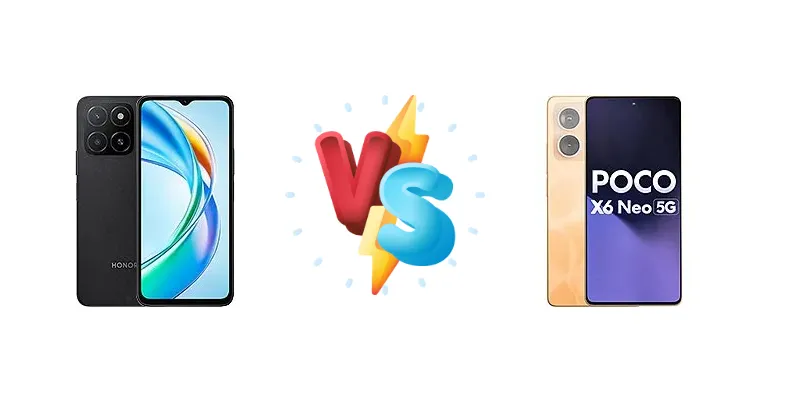
The sub-$200 smartphone market is fiercely competitive. The Honor X5b prioritizes extreme affordability, while the Xiaomi Poco X6 Neo attempts to deliver a more compelling experience with a newer chipset and faster charging. This comparison dissects the key differences to help you choose the right device for your needs.
🏆 Quick Verdict
For most users, the Xiaomi Poco X6 Neo is the better buy. Its Mediatek Dimensity 6080 chipset provides a substantial performance uplift over the Honor X5b’s Helio G36, and the 33W charging significantly reduces downtime. While the X5b is cheaper, the X6 Neo offers a more future-proof and enjoyable user experience.
| Network |
|---|
| 2G bands | GSM 850 / 900 / 1800 / 1900 | GSM 850 / 900 / 1800 / 1900 |
| 3G bands | HSDPA 850 / 900 / 1900 / 2100 | HSDPA 850 / 900 / 2100 |
| 4G bands | LTE | 1, 3, 5, 8, 28, 40, 41 |
| 5G bands | - | 1, 3, 5, 8, 28, 40, 78 SA/NSA |
| Speed | HSPA, LTE | HSPA, LTE, 5G |
| Technology | GSM / HSPA / LTE | GSM / HSPA / LTE / 5G |
| Launch |
|---|
| Announced | 2024, October 22 | 2024, March 13 |
| Status | Available. Released 2024, October | Available. Released 2024, March 13 |
| Body |
|---|
| Build | - | Glass front (Gorilla Glass 5), plastic frame, plastic back |
| Dimensions | 163.9 x 75.8 x 8.7 mm (6.45 x 2.98 x 0.34 in) | 161.1 x 75 x 7.7 mm (6.34 x 2.95 x 0.30 in) |
| SIM | Nano-SIM + Nano-SIM | Nano-SIM + Nano-SIM |
| Weight | 194 g (6.84 oz) | 175 g (6.17 oz) |
| Display |
|---|
| Protection | - | Corning Gorilla Glass 5 |
| Resolution | 720 x 1612 pixels, 20:9 ratio (~269 ppi density) | 1080 x 2400 pixels, 20:9 ratio (~395 ppi density) |
| Size | 6.56 inches, 103.4 cm2 (~83.2% screen-to-body ratio) | 6.67 inches, 107.4 cm2 (~88.9% screen-to-body ratio) |
| Type | TFT LCD, 90Hz, 530 nits (HBM) | AMOLED, 1B colors, 120Hz, 1000 nits (peak) |
| Platform |
|---|
| CPU | Octa-core (4x2.2 GHz Cortex-A53 & 4x1.6 GHz Cortex-A53) | Octa-core (2x2.4 GHz Cortex-A76 & 6x2.0 GHz Cortex-A55) |
| Chipset | Mediatek Helio G36 (12 nm) | Mediatek Dimensity 6080 (6 nm) |
| GPU | PowerVR GE8320 | Mali-G57 MC2 |
| OS | Android 14, Magic OS 8 | Android 13 |
| Memory |
|---|
| Card slot | microSDXC | microSDXC (uses shared SIM slot) |
| Internal | 64GB 4GB RAM, 128GB 4GB RAM | 128GB 8GB RAM, 256GB 12GB RAM |
| Main Camera |
|---|
| Dual | - | 108 MP, f/1.8, (wide), 0.64µm, PDAF
Auxiliary lens |
| Features | LED flash | LED flash, HDR, panorama |
| Single | 13 MP, f/1.8, (wide)
Auxiliary lens | - |
| Video | 1080p@30fps | 1080p@30fps |
| Selfie camera |
|---|
| Features | - | HDR |
| Single | 5 MP, f/2.2, (wide) | 16 MP, (wide) |
| Video | 1080p@30fps | 1080p@30fps |
| Sound |
|---|
| 35mm jack | Yes | Yes |
| Loudspeaker | Yes | Yes |
| Comms |
|---|
| Bluetooth | 5.1, A2DP, LE, aptX HD | 5.3, A2DP, LE |
| Infrared port | - | Yes |
| NFC | No | No |
| Positioning | GPS, GLONASS, GALILEO, BDS | GPS, GLONASS, GALILEO, BDS |
| Radio | Unspecified | FM radio |
| USB | USB Type-C 2.0, OTG | USB Type-C 2.0, OTG |
| WLAN | Wi-Fi 802.11 a/b/g/n/ac, dual-band, Wi-Fi Direct | Wi-Fi 802.11 a/b/g/n/ac, dual-band |
| Features |
|---|
| Sensors | Fingerprint (side-mounted), accelerometer, proximity | Fingerprint (side-mounted), accelerometer, gyro, proximity, compass |
| Battery |
|---|
| Charging | 10W wired | 33W wired |
| Type | Li-Po 5200 mAh | Li-Po 5000 mAh |
| Misc |
|---|
| Colors | Ocean Blue, Starry Purple, Midnight Black | Astral Black, Horizon Blue, Martian Orange |
| Models | - | MZB0GGWIN, 2312FRAFDI |
| Price | About 80 EUR | ₹ 18,990 |
| SAR | - | 0.85 W/kg (head) 0.71 W/kg (body) |
Honor X5b
- Lowest possible price point
- Potentially longer battery life due to less powerful chipset
- Simple and straightforward user experience
- Outdated Helio G36 chipset
- Extremely slow 10W charging
- Limited performance for gaming and demanding apps
Xiaomi Poco X6 Neo
- Significantly faster Dimensity 6080 chipset
- 33W fast charging for quick top-ups
- More responsive user experience
- Slightly higher price than the Honor X5b
- Battery life may be slightly shorter due to more powerful processor
- May still lack features found in higher-end phones
Display Comparison
Neither device boasts a standout display. Both likely utilize LCD panels, a common cost-saving measure in this segment. However, details like peak brightness and color gamut are missing. The X6 Neo’s advantage lies in its potential for a higher refresh rate (often 90Hz in this class), which would provide smoother scrolling and animations, a feature absent in the X5b’s specifications. Bezels are likely comparable, reflecting the budget nature of both devices.
Camera Comparison
Camera performance is likely to be similar in real-world usage, given the focus on affordability. Both phones likely feature a primary camera paired with depth or macro sensors of limited utility. Without sensor size or aperture information, it’s difficult to make a definitive judgment. However, the Dimensity 6080’s image signal processor (ISP) in the X6 Neo is more advanced, potentially leading to better image processing and low-light performance. The X5b’s ISP will be more limited in its capabilities.
Performance
The performance gap is the most significant differentiator. The Poco X6 Neo’s Mediatek Dimensity 6080, built on a 6nm process, is a clear upgrade over the Honor X5b’s 12nm Helio G36. The Dimensity 6080 features more powerful Cortex-A76 cores (2x2.4 GHz) compared to the X5b’s Cortex-A53 cores (4x2.2 GHz), resulting in noticeably faster app loading times and smoother multitasking. The 6nm process also contributes to better thermal efficiency, reducing the likelihood of performance throttling during sustained use. The X5b’s older architecture will struggle with demanding games and applications.
Battery Life
While battery capacity isn’t specified, both phones likely house around a 5000mAh battery, standard for this price range. The critical difference is charging speed. The Poco X6 Neo’s 33W wired charging is a game-changer, allowing for a full charge in approximately 60-75 minutes. The Honor X5b’s 10W charging is significantly slower, requiring several hours to reach 100%. This difference impacts daily usability, as the X6 Neo allows for quick top-ups when needed, while the X5b demands overnight charging.
Buying Guide
Buy the Honor X5b if your absolute priority is the lowest possible price and you primarily use your phone for basic tasks like calls, texts, and light social media. Buy the Xiaomi Poco X6 Neo if you want a phone that can handle more demanding apps, occasional gaming, and benefits from significantly faster charging, even if it means spending a little more.
Frequently Asked Questions
❓ Will the Poco X6 Neo’s Dimensity 6080 handle popular games like PUBG Mobile and Call of Duty?
Yes, the Dimensity 6080 is capable of running PUBG Mobile and Call of Duty at medium settings with playable frame rates. While it won’t deliver a flagship gaming experience, it’s a significant improvement over the Helio G36 in the Honor X5b, which would struggle with these titles.
❓ How much faster is the 33W charging on the Poco X6 Neo compared to the 10W charging on the Honor X5b?
The 33W charging on the Poco X6 Neo can charge the phone from 0% to 100% in approximately 60-75 minutes, while the Honor X5b’s 10W charging will take over 3-4 hours for a full charge. This means you can quickly top up the X6 Neo during short breaks, whereas the X5b requires overnight charging.
❓ Is the difference in chipset performance between the Helio G36 and Dimensity 6080 noticeable in everyday tasks?
Absolutely. The Dimensity 6080 offers a much smoother and more responsive experience when opening apps, browsing the web, and multitasking. The Helio G36 will exhibit noticeable lag and slowdowns, especially with multiple apps open.