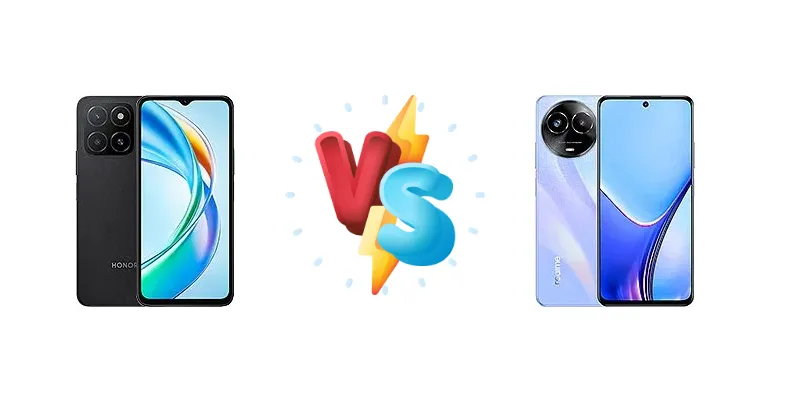
The sub-$200 smartphone market is fiercely competitive. The Honor X5b represents a commitment to extreme affordability, while the Realme 11x attempts to bridge the gap between price and performance with a more modern chipset and faster charging. This comparison dissects the key differences to help you determine which device best suits your needs.
🏆 Quick Verdict
For most users, the Realme 11x is the superior choice. Its Mediatek Dimensity 6100+ chipset delivers a noticeably smoother experience for everyday tasks and gaming, and the 33W charging significantly reduces downtime. The Honor X5b remains a viable option for those prioritizing absolute lowest cost.
| Network |
|---|
| 2G bands | GSM 850 / 900 / 1800 / 1900 | GSM 850 / 900 / 1800 / 1900 |
| 3G bands | HSDPA 850 / 900 / 1900 / 2100 | HSDPA 850 / 900 / 2100 |
| 4G bands | LTE | 1, 3, 5, 8, 28, 40, 41 |
| 5G bands | - | 1, 3, 5, 8, 28, 40, 41, 77, 78 SA/NSA |
| Speed | HSPA, LTE | HSPA, LTE, 5G |
| Technology | GSM / HSPA / LTE | GSM / HSPA / LTE / 5G |
| Launch |
|---|
| Announced | 2024, October 22 | 2023, August 23 |
| Status | Available. Released 2024, October | Available. Released 2023, August 30 |
| Body |
|---|
| Build | - | Glass front, aluminum frame, plastic back |
| Dimensions | 163.9 x 75.8 x 8.7 mm (6.45 x 2.98 x 0.34 in) | 165.7 x 76 x 7.9 mm (6.52 x 2.99 x 0.31 in) |
| SIM | Nano-SIM + Nano-SIM | Nano-SIM + Nano-SIM |
| Weight | 194 g (6.84 oz) | 190 g (6.70 oz) |
| Display |
|---|
| Resolution | 720 x 1612 pixels, 20:9 ratio (~269 ppi density) | 1080 x 2400 pixels, 20:9 ratio (~392 ppi density) |
| Size | 6.56 inches, 103.4 cm2 (~83.2% screen-to-body ratio) | 6.72 inches, 109.0 cm2 (~86.6% screen-to-body ratio) |
| Type | TFT LCD, 90Hz, 530 nits (HBM) | IPS LCD, 120Hz, 550 nits (typ), 680 nits (HBM) |
| Platform |
|---|
| CPU | Octa-core (4x2.2 GHz Cortex-A53 & 4x1.6 GHz Cortex-A53) | Octa-core (2x2.2 GHz Cortex-A76 & 6x2.0 GHz Cortex-A55) |
| Chipset | Mediatek Helio G36 (12 nm) | Mediatek Dimensity 6100+ (6 nm) |
| GPU | PowerVR GE8320 | Mali-G57 MC2 |
| OS | Android 14, Magic OS 8 | Android 13, Realme UI 4.0 |
| Memory |
|---|
| Card slot | microSDXC | microSDXC (dedicated slot) |
| Internal | 64GB 4GB RAM, 128GB 4GB RAM | 128GB 6GB RAM, 128GB 8GB RAM |
| Main Camera |
|---|
| Dual | - | 64 MP, f/1.8, 25mm (wide), 1/2.0", 0.7µm, PDAF
Auxiliary lens |
| Features | LED flash | LED flash, HDR, panorama |
| Single | 13 MP, f/1.8, (wide)
Auxiliary lens | - |
| Video | 1080p@30fps | 1080p@30fps |
| Selfie camera |
|---|
| Features | - | Panorama |
| Single | 5 MP, f/2.2, (wide) | 8 MP, f/2.1, 26mm (wide) |
| Video | 1080p@30fps | 1080p@30fps |
| Sound |
|---|
| 35mm jack | Yes | Yes |
| Loudspeaker | Yes | Yes |
| Comms |
|---|
| Bluetooth | 5.1, A2DP, LE, aptX HD | 5.2, A2DP, LE |
| NFC | No | No |
| Positioning | GPS, GLONASS, GALILEO, BDS | GPS, GALILEO, GLONASS, BDS |
| Radio | Unspecified | Unspecified |
| USB | USB Type-C 2.0, OTG | USB Type-C 2.0 |
| WLAN | Wi-Fi 802.11 a/b/g/n/ac, dual-band, Wi-Fi Direct | Wi-Fi 802.11 a/b/g/n/ac, dual-band, Wi-Fi Direct |
| Features |
|---|
| Sensors | Fingerprint (side-mounted), accelerometer, proximity | Fingerprint (side-mounted), accelerometer, proximity, compass |
| Battery |
|---|
| Charging | 10W wired | 33W wired, 50% in 29 min |
| Type | Li-Po 5200 mAh | 5000 mAh |
| Misc |
|---|
| Colors | Ocean Blue, Starry Purple, Midnight Black | Midnight Black, Purple Dawn |
| Models | - | RMX3785 |
| Price | About 80 EUR | About 170 EUR |
Honor X5b
- Lowest possible price point
- Functional for basic smartphone tasks
- Potentially longer battery life due to less powerful chipset
- Slow performance with demanding apps
- Extremely slow 10W charging
- Likely lower quality camera
Realme 11x
- Significantly faster performance with Dimensity 6100+
- 33W fast charging (50% in 29 minutes)
- Likely better camera quality
- Higher price than the Honor X5b
- Potentially slightly shorter battery life due to more powerful chipset
- May still lack features found in higher-end phones
Display Comparison
Neither device boasts a standout display. Both likely utilize LCD panels, a common cost-saving measure in this segment. However, details like peak brightness and color gamut are missing. The Realme 11x’s potential for a higher refresh rate (based on Realme’s typical offerings) would be a significant advantage, though unconfirmed. Bezels are likely comparable, focusing on minimizing cost rather than achieving an immersive experience.
Camera Comparison
Without detailed camera specifications, a direct comparison is difficult. However, it’s safe to assume both phones feature a primary camera and potentially depth/macro sensors. The Realme 11x, given its positioning, is more likely to have a larger sensor and potentially better image processing algorithms. The Honor X5b will likely prioritize cost savings, resulting in lower-resolution sensors and less sophisticated image processing. The presence of Optical Image Stabilization (OIS) is unlikely on either device, but the 11x has a higher probability. The 2MP macro cameras often found on these devices are generally of limited practical use.
Performance
The performance disparity is the most significant difference. The Realme 11x’s Mediatek Dimensity 6100+ (6nm) is a substantial upgrade over the Honor X5b’s Helio G36 (12nm). The Dimensity 6100+ features more powerful Cortex-A76 cores (2x2.2 GHz) compared to the X5b’s Cortex-A53 cores (4x2.2 GHz), resulting in faster application loading and smoother multitasking. The 6nm process also translates to better power efficiency. While both are octa-core CPUs, the architectural differences mean the 11x will handle demanding apps and games with far greater ease. The X5b’s Helio G36 is adequate for basic tasks, but will struggle with resource-intensive applications.
Battery Life
Battery capacity is not specified for either device, but both likely fall in the 5000mAh range, typical for this price point. The Realme 11x’s 33W wired charging is a game-changer, allowing for a 50% charge in just 29 minutes. The Honor X5b’s 10W charging is significantly slower, requiring considerably more time to reach a full charge. This difference in charging speed directly impacts usability, making the 11x more convenient for users who need to quickly top up their battery.
Buying Guide
Buy the Honor X5b if you need a functional smartphone for basic communication – calls, texts, and light social media – and are operating on a very strict budget. It's a good choice for first-time smartphone users or as a reliable backup device. Buy the Realme 11x if you prioritize a responsive user experience, enjoy mobile gaming, or value faster charging speeds. It's ideal for users who want a phone that can handle more demanding tasks without breaking the bank.
Frequently Asked Questions
❓ Is the Mediatek Dimensity 6100+ in the Realme 11x capable of handling popular games like PUBG Mobile or Call of Duty Mobile?
Yes, the Dimensity 6100+ is a capable chipset for mobile gaming. It should be able to run PUBG Mobile and Call of Duty Mobile at medium to high settings with stable frame rates. While it won't deliver flagship-level performance, it provides a significantly better gaming experience than the Helio G36 in the Honor X5b.
❓ How much faster is the 33W charging on the Realme 11x compared to the 10W charging on the Honor X5b in real-world usage?
The difference is substantial. The Realme 11x can reach 50% charge in approximately 29 minutes, while the Honor X5b will take well over two hours to achieve the same level. This means you can quickly top up the 11x during a short break, whereas the X5b requires overnight charging for a full battery.
❓ Will the Honor X5b struggle with multitasking or running multiple apps simultaneously?
Yes, the Helio G36 chipset and limited RAM (likely 3-4GB) in the Honor X5b will result in noticeable slowdowns when multitasking. Switching between apps will be slower, and running demanding apps in the background may cause performance issues.
❓ Are there any significant differences in software experience between Realme UI and Honor's Magic UI?
Realme UI is generally considered more feature-rich and customizable, while Honor's Magic UI aims for a cleaner, more minimalist approach. Both are based on Android, but Realme UI often receives updates more quickly. User preference plays a large role here, but Realme UI offers more options for personalization.