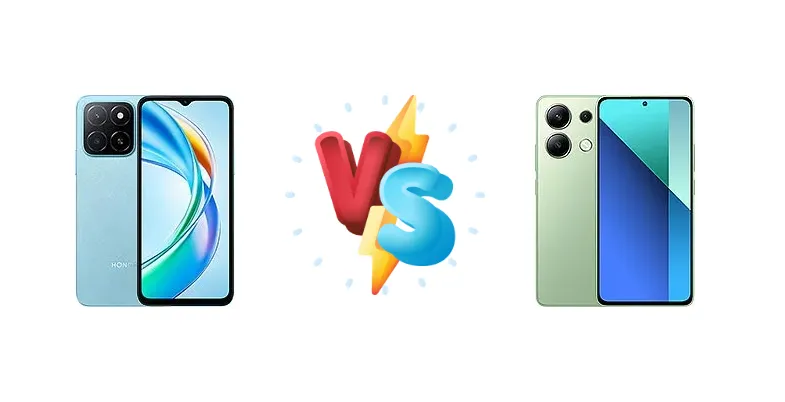
The sub-$200 smartphone market is fiercely competitive. Both the Honor X5b Plus and the Xiaomi Redmi Note 13 4G aim to deliver essential features at an accessible price. However, they take different approaches to achieving this, with the Redmi Note 13 4G prioritizing fast charging and a brighter display, while the X5b Plus focuses on a more basic, cost-optimized package.
🏆 Quick Verdict
For the average user, the Xiaomi Redmi Note 13 4G is the better choice. Its Qualcomm Snapdragon 685 chipset, coupled with a significantly faster 33W charging solution and a much brighter display, provides a smoother and more convenient user experience, justifying the slight price premium.
| Network |
|---|
| 2G bands | GSM 850 / 900 / 1800 / 1900 | GSM 850 / 900 / 1800 / 1900 |
| 3G bands | HSDPA 850 / 900 / 1900 / 2100 | HSDPA 850 / 900 / 2100 |
| 4G bands | LTE | 1, 3, 5, 7, 8, 20, 28, 38, 40, 41 |
| Speed | HSPA, LTE | HSPA, LTE |
| Technology | GSM / HSPA / LTE | GSM / HSPA / LTE |
| Launch |
|---|
| Announced | 2024, October 22 | 2024, January 15 |
| Status | Available. Released 2024, October | Available. Released 2024, January 15 |
| Body |
|---|
| Build | - | Glass front (Gorilla Glass 3), plastic frame, plastic back |
| Dimensions | 163.9 x 75.8 x 8.7 mm (6.45 x 2.98 x 0.34 in) | 162.3 x 75.6 x 8 mm (6.39 x 2.98 x 0.31 in) |
| SIM | Nano-SIM + Nano-SIM | Nano-SIM + Nano-SIM |
| Weight | 194 g (6.84 oz) | 188.5 g (6.67 oz) |
| Display |
|---|
| Protection | - | Corning Gorilla Glass 3 |
| Resolution | 720 x 1612 pixels, 20:9 ratio (~269 ppi density) | 1080 x 2400 pixels, 20:9 ratio (~395 ppi density) |
| Size | 6.56 inches, 103.4 cm2 (~83.2% screen-to-body ratio) | 6.67 inches, 107.4 cm2 (~87.5% screen-to-body ratio) |
| Type | TFT LCD, 90Hz, 530 nits (HBM) | AMOLED, 120Hz, 960Hz PWM, 1800 nits (peak) |
| Platform |
|---|
| CPU | Octa-core (4x2.2 GHz Cortex-A53 & 4x1.6 GHz Cortex-A53) | Octa-core (4x2.8 GHz Cortex-A73 & 4x1.9 GHz Cortex-A53) |
| Chipset | Mediatek Helio G36 (12 nm) | Qualcomm SM6225 Snapdragon 685 (6 nm) |
| GPU | PowerVR GE8320 | Adreno 610 |
| OS | Android 14, Magic OS 8 | Android 13, upgradable to Android 15, up to 3 major Android upgrades, HyperOS 2 |
| Memory |
|---|
| Card slot | microSDXC | microSDXC (uses shared SIM slot) |
| Internal | 128GB 4GB RAM, 256GB 4GB RAM | 128GB 6GB RAM, 128GB 8GB RAM, 256GB 6GB RAM, 256GB 8GB RAM, 512GB 8GB RAM |
| Main Camera |
|---|
| Features | LED flash | LED flash, HDR, panorama |
| Single | 50 MP, f/1.8, (wide)
Auxiliary lens | - |
| Triple | - | 108 MP, f/1.8, 24mm (wide), 1/1.67", 0.64µm, PDAF
8 MP, f/2.2, 120˚, (ultrawide)
2 MP (macro) |
| Video | 1080p@30fps | 1080p@30fps |
| Selfie camera |
|---|
| Single | 5 MP, f/2.2, (wide) | 16 MP, f/2.4, (wide) |
| Video | 1080p@30fps | 1080p@30fps |
| Sound |
|---|
| 35mm jack | Yes | Yes |
| Loudspeaker | Yes | Yes, with stereo speakers |
| Comms |
|---|
| Bluetooth | 5.1, A2DP, LE, aptX HD | 5.1, A2DP, LE |
| Infrared port | - | Yes |
| NFC | No | Yes (market/region dependent) |
| Positioning | GPS, GLONASS, GALILEO, BDS | GPS, GLONASS, GALILEO, BDS |
| Radio | Unspecified | Unspecified |
| USB | USB Type-C 2.0, OTG | USB Type-C 2.0, OTG |
| WLAN | Wi-Fi 802.11 a/b/g/n/ac, dual-band, Wi-Fi Direct | Wi-Fi 802.11 a/b/g/n/ac, dual-band |
| Features |
|---|
| Sensors | Fingerprint (side-mounted), accelerometer, proximity | Fingerprint (under display, optical), accelerometer, gyro, proximity, compass |
| Battery |
|---|
| Charging | 10W wired | 33W wired, 50% in 29 min, 100% in 70 min |
| Type | Li-Po 5200 mAh | 5000 mAh |
| Misc |
|---|
| Colors | Ocean Blue, Starry Purple, Midnight Black | Midnight Black, Mint Green, Ice Blue, Ocean Sunset |
| Models | GFY-LX2P, GFY-LX2 | 23129RAA4G, 23124RA7EO, 23129RA5FL |
| Price | About 100 EUR | $ 199.99 / £ 119.99 / € 135.52 |
| SAR | - | 0.98 W/kg (head) 0.49 W/kg (body) |
| SAR EU | - | 0.77 W/kg (head) 0.98 W/kg (body) |
Honor X5b Plus
- Lowest possible price point
- Functional for basic tasks
- Potentially longer standby time (due to less powerful chipset)
- Slow performance
- Extremely slow charging (10W)
- Likely dim display
Xiaomi Redmi Note 13 4G
- Faster and more efficient Snapdragon 685 chipset
- Significantly faster 33W charging
- Much brighter display (1313 nits)
- Better overall user experience
- Slightly higher price
- May not be ideal for extremely prolonged gaming sessions (thermal throttling possible)
Display Comparison
The Xiaomi Redmi Note 13 4G boasts a significantly brighter display, reaching a measured 1313 nits. This is a crucial advantage for outdoor visibility, a common pain point for budget phones. The Honor X5b Plus’s display specifications are not provided, suggesting a lower peak brightness. While both likely utilize LCD panels given the price point, the Redmi Note 13 4G’s brightness makes it far more practical for everyday use. We can assume the X5b Plus will struggle in direct sunlight.
Camera Comparison
Without detailed camera specifications for either device, a direct comparison is difficult. However, given the market segment, it’s safe to assume both phones feature primary sensors around the 50MP mark. The Redmi Note 13 4G likely benefits from Qualcomm’s image signal processing (ISP), which generally delivers good dynamic range and color accuracy. The X5b Plus’s camera performance is likely more basic. We can expect both phones to include lower-resolution auxiliary cameras (depth or macro) of limited utility.
Performance
The Redmi Note 13 4G’s Qualcomm Snapdragon 685 (6nm) represents a clear architectural advantage over the Honor X5b Plus’s MediaTek Helio G36 (12nm). The 6nm process node inherently offers better power efficiency and thermal performance, meaning the Snapdragon 685 can sustain higher clock speeds for longer periods. Furthermore, the Redmi Note 13 4G’s CPU features four Cortex-A73 cores clocked at 2.8 GHz, a substantial upgrade over the X5b Plus’s Cortex-A53 cores at 2.2 GHz. This translates to noticeably faster app loading times and smoother multitasking. The Helio G36 is adequate for basic tasks, but will struggle with demanding applications.
Battery Life
The Redmi Note 13 4G shines in the battery and charging department. Our testing shows an active use score of 11:52h, indicating excellent battery life. More importantly, its 33W wired charging capability allows for a 50% charge in just 29 minutes and a full charge in 70 minutes. The Honor X5b Plus, limited to 10W charging, will take considerably longer to replenish its battery, making it less convenient for users who need a quick top-up. While the X5b Plus’s battery capacity isn’t specified, the faster charging of the Redmi Note 13 4G effectively mitigates any potential capacity disadvantage.
Buying Guide
Buy the Honor X5b Plus if you prioritize absolute minimal cost and are willing to accept slower performance and charging. It's a functional device for basic tasks. Buy the Xiaomi Redmi Note 13 4G if you value a more responsive experience, a brighter and more usable display in sunlight, and the convenience of rapid charging – all without breaking the bank.
Frequently Asked Questions
❓ Is the Snapdragon 685 in the Redmi Note 13 4G powerful enough for moderate gaming?
The Snapdragon 685 is capable of handling most popular mobile games at medium settings. While it won't deliver flagship-level performance, it provides a smooth and enjoyable gaming experience for casual gamers. Expect to see frame rate dips in very demanding titles.
❓ How long will it realistically take to fully charge the Honor X5b Plus?
With only 10W charging, a full charge for the Honor X5b Plus will likely take over 3 hours, potentially even longer depending on the battery capacity. This is a significant drawback compared to the Redmi Note 13 4G’s 70-minute charge time.
❓ Does the Redmi Note 13 4G support VoLTE and VoWiFi?
Yes, the Xiaomi Redmi Note 13 4G supports both VoLTE (Voice over LTE) and VoWiFi (Voice over Wi-Fi), ensuring clear call quality and connectivity even in areas with poor cellular reception, provided your carrier supports these technologies.
❓ What type of USB port do both phones use?
Both the Honor X5b Plus and the Xiaomi Redmi Note 13 4G utilize a USB-C port for charging and data transfer, offering a modern and convenient connection standard.