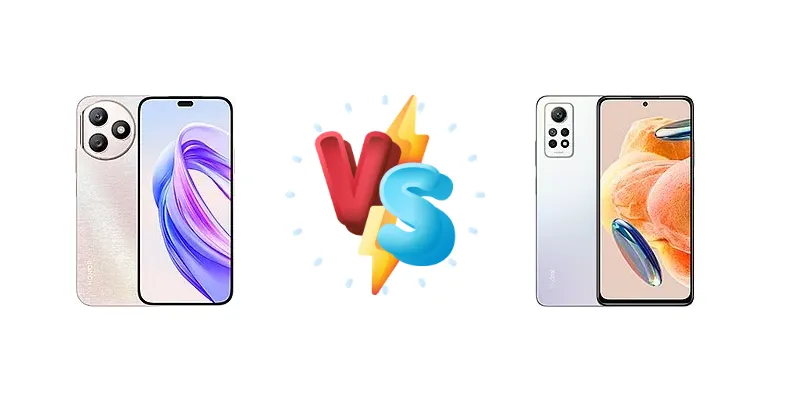
The Honor X50i+ and Xiaomi Redmi Note 12 Pro 4G represent compelling options in the competitive mid-range smartphone market. While both aim to deliver a balanced experience, they take different approaches to chipset choice and charging technology, creating a clear distinction for potential buyers. This comparison dives deep into the specifics to reveal which device offers the best value.
🏆 Quick Verdict
For the average user prioritizing fast charging and a slightly more mature software experience, the Xiaomi Redmi Note 12 Pro 4G is the better choice. Its 67W charging significantly outperforms the Honor X50i+'s 35W, offsetting the Dimensity 6080's slight CPU advantage. However, the X50i+ offers a competitive package for those seeking a newer chipset.
| Network |
|---|
| 2G bands | GSM 850 / 900 / 1800 / 1900 | GSM 850 / 900 / 1800 / 1900 |
| 3G bands | HSDPA 850 / 900 / 1900 / 2100 | HSDPA 850 / 900 / 1700(AWS) / 1900 / 2100 |
| 4G bands | LTE | 1, 2, 3, 4, 5, 7, 8, 20, 28, 38, 40, 41, 66 |
| 5G bands | SA/NSA | - |
| Speed | HSPA, LTE, 5G | HSPA, LTE |
| Technology | GSM / CDMA / HSPA / EVDO / LTE / 5G | GSM / HSPA / LTE |
| Launch |
|---|
| Announced | 2023, November 10 | 2023, March 03 |
| Status | Available. Released 2023, November 10 | Available. Released 2023, April 11 |
| Body |
|---|
| Dimensions | 161.1 x 74.6 x 6.8 mm (6.34 x 2.94 x 0.27 in) | 164.2 x 76.1 x 8.1 mm (6.46 x 3.00 x 0.32 in) |
| SIM | Nano-SIM + Nano-SIM | Nano-SIM + Nano-SIM |
| Weight | 166 g (5.86 oz) | 201.8 g (7.13 oz) |
| Display |
|---|
| Resolution | 1080 x 2412 pixels, 20:9 ratio (~394 ppi density) | 1080 x 2400 pixels, 20:9 ratio (~395 ppi density) |
| Size | 6.7 inches, 108.0 cm2 (~89.9% screen-to-body ratio) | 6.67 inches, 107.4 cm2 (~86.0% screen-to-body ratio) |
| Type | AMOLED, 90Hz, 1200 nits (HBM), 2000 nits (peak) | AMOLED, 120Hz, Dolby Vision, 700 nits (HBM), 1100 nits (peak) |
| Platform |
|---|
| CPU | Octa-core (2x2.4 GHz Cortex-A76 & 6x2.0 GHz Cortex-A55) | Octa-core (2x2.2 GHz Kryo 470 Gold & 6x1.8 GHz Kryo 470 Silver) |
| Chipset | Mediatek Dimensity 6080 (6 nm) | Qualcomm SM7150 Snapdragon 732G (8 nm) |
| GPU | Mali-G57 MC2 | Adreno 618 |
| OS | Android 13, MagicOS 7.2 | Android 11, MIUI 13 |
| Memory |
|---|
| Card slot | No | microSDXC (uses shared SIM slot) |
| Internal | 256GB 12GB RAM, 512GB 12GB RAM | 128GB 6GB RAM, 128GB 8GB RAM, 256GB 8GB RAM |
| | - | UFS 2.2 |
| Main Camera |
|---|
| Dual | 108 MP, f/1.8, 24mm (wide), PDAF
Auxiliary lens | - |
| Features | LED flash, HDR, panorama | LED flash, HDR, panorama |
| Quad | - | 108 MP, f/1.9, (wide), 1/1.52", 0.7µm, PDAF
8 MP, 120˚, (ultrawide)
2 MP (macro)
Auxiliary lens |
| Video | 1080p@30fps | 4K@30fps, 1080p@30/60fps |
| Selfie camera |
|---|
| Single | 8 MP, f/2.0, (wide) | 16 MP, f/2.4, (wide) |
| Video | 1080p@30fps | 1080p@30fps |
| Sound |
|---|
| 3.5mm jack | - | Yes |
| 35mm jack | No | Yes |
| Loudspeaker | Yes | Yes, with stereo speakers |
| Comms |
|---|
| Bluetooth | 5.1, A2DP, LE, aptX HD | 5.0, A2DP, LE |
| Infrared port | - | Yes |
| NFC | No | Yes (market/region dependent) |
| Positioning | GPS, GLONASS, GALILEO, BDS | GPS, GLONASS, GALILEO, BDS |
| Radio | No | Unspecified |
| USB | USB Type-C 2.0, OTG | USB Type-C 2.0, OTG |
| WLAN | Wi-Fi 802.11 a/b/g/n/ac, dual-band, Wi-Fi Direct | Wi-Fi 802.11 a/b/g/n/ac, dual-band |
| Features |
|---|
| Sensors | Fingerprint (side-mounted), accelerometer, proximity, compass | Fingerprint (side-mounted), accelerometer, gyro, compass |
| Battery |
|---|
| Charging | 35W wired
Reverse wired | 67W wired |
| Type | Li-Po 4500 mAh | Li-Po 5000 mAh |
| Misc |
|---|
| Colors | Black, Green, Blue, Pink | Star Blue, Graphite Gray, Polar White, Ice blue |
| Models | LLY-AN00 | 2209116AG, 2209116AG |
| Price | About 210 EUR | About 150 EUR |
Honor X50i+
- Newer chipset architecture (Dimensity 6080)
- Potentially better thermal efficiency due to 6nm process
- Reverse wired charging capability
- Slower 35W charging
- Software optimization may be less mature
Xiaomi Redmi Note 12 Pro 4G
- Faster 67W wired charging
- Proven Snapdragon 732G chipset
- More established software ecosystem
- Older chipset architecture
- 8nm process may be less efficient than 6nm
Display Comparison
Neither device boasts a standout display. Both likely feature LCD panels, common in this price bracket. The key difference lies in the processing power needed to drive them. The Snapdragon 732G's 8nm process may offer slightly better efficiency in display rendering, but without specific display specs (resolution, brightness, color gamut) it's difficult to definitively declare a winner. Bezels are likely comparable, and color accuracy will depend heavily on software calibration.
Camera Comparison
Without detailed camera specs, a direct comparison is challenging. Both phones likely feature a multi-camera setup, but the quality will hinge on sensor size and image processing. We can assume the Redmi Note 12 Pro 4G, given Xiaomi's camera focus, may have a slightly more refined image processing pipeline. The presence of Optical Image Stabilization (OIS) on either device would be a significant advantage, but this information is unavailable. Ignoring the likely inclusion of low-resolution macro/depth sensors on both, the primary sensor's size and aperture will be the deciding factors.
Performance
The core battleground is the chipset. The Honor X50i+'s Mediatek Dimensity 6080 (6nm) features two Cortex-A76 cores clocked at 2.4 GHz, offering a performance edge in single-core tasks compared to the Xiaomi Redmi Note 12 Pro 4G's Snapdragon 732G (8nm) with its 2.2 GHz Kryo 470 Gold cores. However, the Snapdragon 732G benefits from a more mature software optimization and a potentially more efficient 8nm manufacturing process. While the Dimensity 6080 is newer, the Snapdragon 732G's established track record suggests consistent performance. The 6nm node of the Dimensity 6080 *should* translate to better thermal efficiency under sustained load, but real-world testing is needed to confirm.
Battery Life
The Xiaomi Redmi Note 12 Pro 4G’s 67W wired charging is a clear advantage. This will significantly reduce charging times compared to the Honor X50i+'s 35W charging. While battery capacity isn't specified, the faster charging speed allows the Redmi Note 12 Pro 4G to effectively mitigate any potential capacity disadvantage. The 67W charging means a full charge in under an hour is highly probable, while the X50i+ will likely take considerably longer.
Buying Guide
Buy the Honor X50i+ if you prioritize a newer chipset architecture and are comfortable with potentially less refined software. This phone suits users who frequently multitask and appreciate the benefits of the Dimensity 6080's Cortex-A76 cores. Buy the Xiaomi Redmi Note 12 Pro 4G if you value rapid charging, a proven chipset, and a more established software ecosystem. This is ideal for users who need to quickly top up their battery and prefer a reliable, well-tested experience.
Frequently Asked Questions
❓ Will the Dimensity 6080 in the Honor X50i+ struggle with demanding games like Genshin Impact?
While the Dimensity 6080 is a capable chipset, Genshin Impact is a particularly demanding title. Expect to play at medium settings with moderate frame rates. The Snapdragon 732G in the Redmi Note 12 Pro 4G will offer a similar gaming experience, potentially with slightly more consistent frame rates due to better optimization.
❓ How much faster is the 67W charging on the Redmi Note 12 Pro 4G compared to the 35W charging on the Honor X50i+?
The 67W charging on the Redmi Note 12 Pro 4G can realistically charge the phone from 0-100% in around 45-60 minutes, depending on usage. The 35W charging on the Honor X50i+ will likely take over 90 minutes, potentially exceeding two hours for a full charge. This difference is substantial for users who frequently need to quickly top up their battery.
❓ Does the Snapdragon 732G in the Redmi Note 12 Pro 4G get hot during prolonged gaming sessions?
The Snapdragon 732G is known for its relatively good thermal management. While it will get warm during extended gaming, it's unlikely to experience significant throttling. The 8nm process contributes to its efficiency, preventing excessive heat buildup. However, sustained performance will still be impacted over very long sessions.