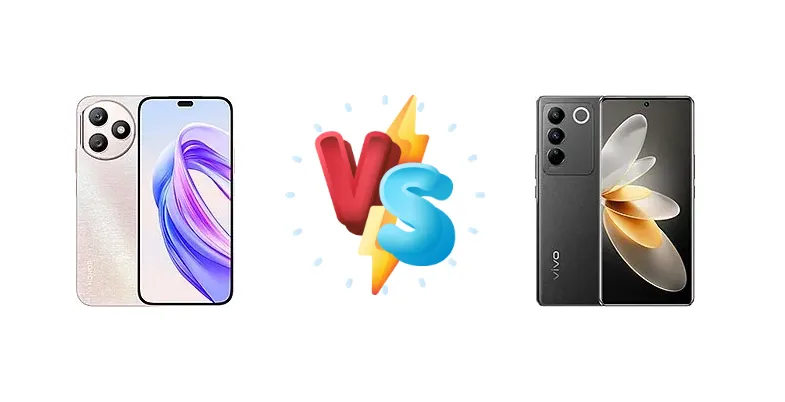
The Honor X50i+ and vivo V27 Pro both target the competitive mid-range smartphone market, but cater to slightly different priorities. The X50i+ focuses on providing a solid all-around experience at a potentially lower price point, while the V27 Pro aims for a more premium feel with a stronger emphasis on performance and charging speed. This comparison will dissect their key differences to help you determine which device best suits your needs.
🏆 Quick Verdict
For the average user prioritizing performance and faster charging, the vivo V27 Pro is the clear winner. Its Dimensity 8200 chipset delivers a substantial performance uplift over the X50i+'s Dimensity 6080, and the 66W charging significantly reduces downtime. However, the X50i+ remains a viable option for budget-conscious buyers.
| Network |
|---|
| 2G bands | GSM 850 / 900 / 1800 / 1900 | GSM 850 / 900 / 1800 / 1900 |
| 3G bands | HSDPA 850 / 900 / 1900 / 2100 | HSDPA 850 / 900 / 1700(AWS) / 2100 |
| 4G bands | LTE | 1, 3, 4, 5, 8, 28, 38, 40, 41 |
| 5G bands | SA/NSA | 1, 3, 5, 8, 28, 77, 78 SA/NSA |
| Speed | HSPA, LTE, 5G | HSPA, LTE, 5G |
| Technology | GSM / CDMA / HSPA / EVDO / LTE / 5G | GSM / HSPA / LTE / 5G |
| Launch |
|---|
| Announced | 2023, November 10 | 2023, March 01 |
| Status | Available. Released 2023, November 10 | Available. Released 2023, March 01 |
| Body |
|---|
| Build | - | Glass front, plastic frame, glass back |
| Dimensions | 161.1 x 74.6 x 6.8 mm (6.34 x 2.94 x 0.27 in) | 164.1 x 74.8 x 7.4 mm (6.46 x 2.94 x 0.29 in) |
| SIM | Nano-SIM + Nano-SIM | Nano-SIM + Nano-SIM |
| Weight | 166 g (5.86 oz) | 182 g (6.42 oz) |
| | - | Color changing back panel color |
| Display |
|---|
| Resolution | 1080 x 2412 pixels, 20:9 ratio (~394 ppi density) | 1080 x 2400 pixels, 20:9 ratio (~388 ppi density) |
| Size | 6.7 inches, 108.0 cm2 (~89.9% screen-to-body ratio) | 6.78 inches, 111.0 cm2 (~90.4% screen-to-body ratio) |
| Type | AMOLED, 90Hz, 1200 nits (HBM), 2000 nits (peak) | AMOLED, 1B colors, 120Hz, HDR10+ |
| Platform |
|---|
| CPU | Octa-core (2x2.4 GHz Cortex-A76 & 6x2.0 GHz Cortex-A55) | Octa-core (1x3.1 GHz Cortex-A78 & 3x3.0 GHz Cortex-A78 & 4x2.0 GHz Cortex-A55) |
| Chipset | Mediatek Dimensity 6080 (6 nm) | Mediatek Dimensity 8200 (4 nm) |
| GPU | Mali-G57 MC2 | Mali-G610 MC6 |
| OS | Android 13, MagicOS 7.2 | Android 13, Funtouch 13 |
| Memory |
|---|
| Card slot | No | No |
| Internal | 256GB 12GB RAM, 512GB 12GB RAM | 128GB 8GB RAM, 256GB 8GB RAM, 256GB 12GB RAM |
| | - | UFS 3.1 |
| Main Camera |
|---|
| Dual | 108 MP, f/1.8, 24mm (wide), PDAF
Auxiliary lens | - |
| Features | LED flash, HDR, panorama | Ring-LED flash, panorama, HDR |
| Single | - | 50 MP, f/2.5, (wide), AF |
| Triple | - | 50 MP, f/1.9, (wide), 1/1.56", 1.0µm, PDAF, OIS
8 MP, f/2.2, 16mm, 120˚ (ultrawide), 1/4.0", 1.12µm
2 MP (macro) |
| Video | 1080p@30fps | 4K@30/60fps, 1080p@30fps, gyro-EIS |
| Selfie camera |
|---|
| Features | - | Dual-LED flash, HDR |
| Single | 8 MP, f/2.0, (wide) | 50 MP, f/2.5, (wide), AF |
| Video | 1080p@30fps | 4K@30/60fps, 1080p@30fps, gyro-EIS |
| Sound |
|---|
| 3.5mm jack | - | No |
| 35mm jack | No | No |
| Loudspeaker | Yes | Yes |
| | - | 24-bit/192kHz audio |
| Comms |
|---|
| Bluetooth | 5.1, A2DP, LE, aptX HD | 5.3, A2DP, LE |
| NFC | No | Yes |
| Positioning | GPS, GLONASS, GALILEO, BDS | GPS, GLONASS, GALILEO, BDS, NavIC |
| Radio | No | No |
| USB | USB Type-C 2.0, OTG | USB Type-C 2.0, OTG |
| WLAN | Wi-Fi 802.11 a/b/g/n/ac, dual-band, Wi-Fi Direct | Wi-Fi 802.11 a/b/g/n/ac/6, dual-band, Wi-Fi Direct |
| Features |
|---|
| Sensors | Fingerprint (side-mounted), accelerometer, proximity, compass | Fingerprint (under display, optical), accelerometer, gyro, proximity, compass |
| Battery |
|---|
| Charging | 35W wired
Reverse wired | 66W wired, 50% in 19 min, 72% in 30 min |
| Type | Li-Po 4500 mAh | 4600 mAh |
| Misc |
|---|
| Colors | Black, Green, Blue, Pink | Magic Blue, Noble Black |
| Models | LLY-AN00 | V2230 |
| Price | About 210 EUR | About 440 EUR |
| SAR | - | 1.22 W/kg (head) 0.89 W/kg (body) |
| Tests |
|---|
| Battery life | - |
Endurance rating 121h
|
| Camera | - |
Photo / Video |
| Display | - |
Contrast ratio: Infinite (nominal) |
| Loudspeaker | - |
-29.1 LUFS (Average)
|
| Performance | - |
AnTuTu: 846767 (v9)
GeekBench: 3933 (v5.1), 3421 (v6)
GFXBench: 57fps (ES 3.1 onscreen) |
Honor X50i+
- Potentially lower price point
- Decent battery endurance (121h)
- Reverse wired charging capability
- Less powerful Dimensity 6080 chipset
- Slower 35W charging
- Display brightness likely lower than V27 Pro
vivo V27 Pro
- Significantly faster Dimensity 8200 chipset
- Much faster 66W charging (50% in 19 min)
- Brighter display (978 nits)
- Likely higher price tag
- Battery endurance similar to X50i+
- No reverse wired charging
Display Comparison
The vivo V27 Pro boasts a significantly brighter display, reaching a measured 978 nits, compared to an unspecified peak brightness for the Honor X50i+. This higher brightness translates to better visibility outdoors under direct sunlight. While both displays are described as having an 'infinite' contrast ratio (a marketing term), the V27 Pro’s superior brightness is a tangible advantage. Details regarding panel technology (AMOLED vs. LCD) and refresh rates are missing for the X50i+, but the V27 Pro’s brightness suggests a higher-quality panel overall.
Camera Comparison
Both phones are listed as having 'Photo / Video' capabilities, but specific details are lacking. Without sensor size, aperture, or OIS information, a direct comparison is difficult. However, the V27 Pro’s higher processing power from the Dimensity 8200 will likely contribute to better image processing, particularly in low-light conditions. The presence of a dedicated image signal processor (ISP) within the 8200 will also enhance image quality. We can assume the V27 Pro will offer a more versatile and capable camera system.
Performance
The core difference lies in the chipsets. The vivo V27 Pro’s Mediatek Dimensity 8200 (4nm) is a substantial upgrade over the Honor X50i+'s Dimensity 6080 (6nm). The 8200 features a more powerful Cortex-A78 prime core clocked at 3.1 GHz, alongside three additional Cortex-A78 cores at 3.0 GHz, versus the X50i+'s dual 2.4 GHz Cortex-A76 cores. This architectural advantage, coupled with the more efficient 4nm process, results in significantly faster CPU and GPU performance on the V27 Pro, benefiting demanding tasks like gaming and video editing. The V27 Pro will exhibit less throttling under sustained load.
Battery Life
Both devices share an endurance rating of 121 hours, suggesting similar real-world battery life despite the difference in chip efficiency. However, the vivo V27 Pro’s 66W wired charging is a game-changer. It can achieve 50% charge in just 19 minutes and 72% in 30 minutes, significantly reducing downtime. The Honor X50i+’s 35W charging is considerably slower, requiring more time to fully replenish the battery. This charging speed difference is a major convenience factor for the V27 Pro.
Buying Guide
Buy the Honor X50i+ if you need a dependable daily driver with a focus on value and aren't heavily reliant on demanding applications or gaming. Buy the vivo V27 Pro if you prioritize smoother multitasking, faster app loading times, and quicker charging, and are willing to spend a bit more for a more refined experience.
Frequently Asked Questions
❓ Does the Dimensity 8200 in the vivo V27 Pro get hot during extended gaming sessions?
While the Dimensity 8200 is a powerful chip, its 4nm process and the V27 Pro’s thermal management system are designed to mitigate overheating. It will get warm, but should not throttle significantly during typical gaming sessions. The 6nm Dimensity 6080 in the X50i+ will likely throttle sooner under the same load.
❓ Is the 35W charging on the Honor X50i+ slow enough to be a major inconvenience?
Compared to the V27 Pro’s 66W charging, 35W is noticeably slower. A full charge will take considerably longer, potentially requiring overnight charging. This is a trade-off for the lower price point, but users accustomed to fast charging may find it frustrating.
❓ How much of a performance difference will I realistically see between the Dimensity 6080 and 8200 in everyday tasks?
For basic tasks like browsing, social media, and messaging, the difference will be minimal. However, when launching demanding apps, multitasking, or playing graphically intensive games, the Dimensity 8200 in the V27 Pro will provide a much smoother and more responsive experience.