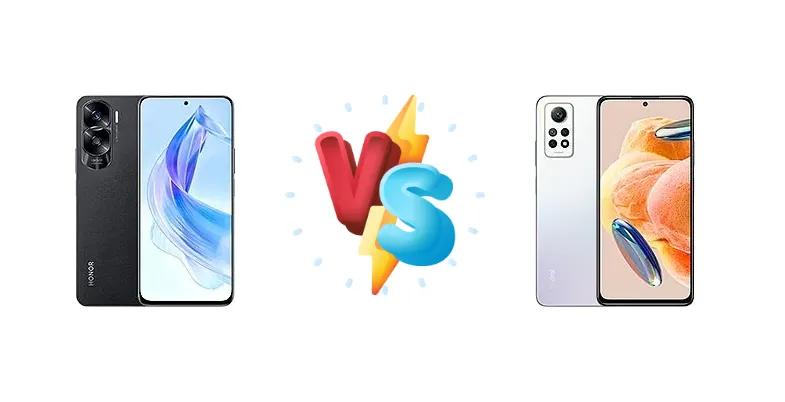
The Honor X50i and Xiaomi Redmi Note 12 Pro 4G represent compelling options in the competitive mid-range 4G smartphone market. While both aim to deliver a balanced experience, they diverge in their core components – specifically, their chipsets and charging capabilities – creating a clear distinction for potential buyers. This comparison dives deep into these differences to determine which device offers the best value.
🏆 Quick Verdict
For the average user prioritizing rapid replenishment, the Xiaomi Redmi Note 12 Pro 4G takes the lead with its significantly faster 67W charging. However, the Honor X50i’s Dimensity 6020 offers a potentially more efficient architecture, making it a strong contender for those valuing sustained performance and battery life.
| Network |
|---|
| 2G bands | GSM 850 / 900 / 1800 / 1900 | GSM 850 / 900 / 1800 / 1900 |
| 3G bands | HSDPA 850 / 900 / 1900 / 2100 | HSDPA 850 / 900 / 1700(AWS) / 1900 / 2100 |
| 4G bands | 1, 3, 5, 7, 8, 34, 38, 39, 40, 41 | 1, 2, 3, 4, 5, 7, 8, 20, 28, 38, 40, 41, 66 |
| 5G bands | 1, 5, 8, 28, 41, 78 SA/NSA | - |
| Speed | HSPA, LTE, 5G | HSPA, LTE |
| Technology | GSM / HSPA / LTE / 5G | GSM / HSPA / LTE |
| Launch |
|---|
| Announced | 2023, July 05 | 2023, March 03 |
| Status | Available. Released 2023, July 05 | Available. Released 2023, April 11 |
| Body |
|---|
| Dimensions | 162.9 x 74.5 x 7.5 mm (6.41 x 2.93 x 0.30 in) | 164.2 x 76.1 x 8.1 mm (6.46 x 3.00 x 0.32 in) |
| SIM | Nano-SIM + Nano-SIM | Nano-SIM + Nano-SIM |
| Weight | 179 g (6.31 oz) | 201.8 g (7.13 oz) |
| Display |
|---|
| Resolution | 1080 x 2388 pixels (~391 ppi density) | 1080 x 2400 pixels, 20:9 ratio (~395 ppi density) |
| Size | 6.7 inches, 108.7 cm2 (~89.6% screen-to-body ratio) | 6.67 inches, 107.4 cm2 (~86.0% screen-to-body ratio) |
| Type | IPS LCD, 90Hz | AMOLED, 120Hz, Dolby Vision, 700 nits (HBM), 1100 nits (peak) |
| Platform |
|---|
| CPU | Octa-core (2x2.2 GHz Cortex-A76 & 6x2.0 GHz Cortex-A55) | Octa-core (2x2.2 GHz Kryo 470 Gold & 6x1.8 GHz Kryo 470 Silver) |
| Chipset | Mediatek Dimensity 6020 (7 nm) | Qualcomm SM7150 Snapdragon 732G (8 nm) |
| GPU | Mali-G57 MC2 | Adreno 618 |
| OS | Android 13, Magic OS 7.1 | Android 11, MIUI 13 |
| Memory |
|---|
| Card slot | No | microSDXC (uses shared SIM slot) |
| Internal | 256GB 8GB RAM, 256GB 12GB RAM | 128GB 6GB RAM, 128GB 8GB RAM, 256GB 8GB RAM |
| | - | UFS 2.2 |
| Main Camera |
|---|
| Dual | 100 MP, f/1.9, 27mm (wide), PDAF
Auxiliary lens | - |
| Features | LED flash, HDR, panorama | LED flash, HDR, panorama |
| Quad | - | 108 MP, f/1.9, (wide), 1/1.52", 0.7µm, PDAF
8 MP, 120˚, (ultrawide)
2 MP (macro)
Auxiliary lens |
| Video | 1080p@30fps | 4K@30fps, 1080p@30/60fps |
| Selfie camera |
|---|
| Single | 8 MP, f/2.0, (wide) | 16 MP, f/2.4, (wide) |
| Video | 1080p@30fps | 1080p@30fps |
| Sound |
|---|
| 3.5mm jack | - | Yes |
| 35mm jack | No | Yes |
| Loudspeaker | Yes | Yes, with stereo speakers |
| Comms |
|---|
| Bluetooth | 5.1, A2DP, LE, aptX HD | 5.0, A2DP, LE |
| Infrared port | - | Yes |
| NFC | No | Yes (market/region dependent) |
| Positioning | GPS, GLONASS, GALILEO, BDS | GPS, GLONASS, GALILEO, BDS |
| Radio | No | Unspecified |
| USB | USB Type-C 2.0, OTG | USB Type-C 2.0, OTG |
| WLAN | Wi-Fi 802.11 a/b/g/n/ac, dual-band, Wi-Fi Direct | Wi-Fi 802.11 a/b/g/n/ac, dual-band |
| Features |
|---|
| Sensors | Fingerprint (side-mounted), accelerometer, compass | Fingerprint (side-mounted), accelerometer, gyro, compass |
| Battery |
|---|
| Charging | 35W wired, 55% in 30 min | 67W wired |
| Type | Li-Po 4500 mAh | Li-Po 5000 mAh |
| Misc |
|---|
| Colors | Black, Blue, Pink, Light Blue | Star Blue, Graphite Gray, Polar White, Ice blue |
| Models | CRT-AN00 | 2209116AG, 2209116AG |
| Price | About 180 EUR | About 150 EUR |
Honor X50i
- Potentially more efficient chipset (Dimensity 6020)
- Stronger multi-core CPU performance
- Likely competitive pricing
- Slower charging speed (35W)
- Camera performance is unknown
- Display specs are unconfirmed
Xiaomi Redmi Note 12 Pro 4G
- Significantly faster charging (67W)
- Historically strong camera performance in Redmi Note series
- Potentially better sustained performance
- Less efficient chipset (Snapdragon 732G)
- CPU performance may lag behind Dimensity 6020 in multi-core tasks
- Display specs are unconfirmed
Display Comparison
Neither device's display specifications are provided, so a direct comparison is limited. However, given the price bracket, both likely feature LCD panels. The Redmi Note 12 Pro 4G, historically, has offered vibrant displays in this segment. The Honor X50i, being a newer release, *may* incorporate improvements in color accuracy or brightness, but this remains speculative without further data. Bezels are likely comparable, and both will likely target FHD+ resolution.
Camera Comparison
Camera specifications are absent, so analysis relies on brand tendencies. Xiaomi’s Redmi Note series often emphasizes camera capabilities, potentially giving the Redmi Note 12 Pro 4G an advantage in image processing and sensor quality. Honor has been improving its camera systems, but typically focuses on a balanced approach. Without knowing sensor sizes or aperture values, it’s difficult to definitively state which phone will capture better photos. The presence or absence of Optical Image Stabilization (OIS) on either device would be a significant differentiator, but this information is unavailable.
Performance
The core difference lies in the chipsets: the Honor X50i utilizes the Mediatek Dimensity 6020 (7nm) while the Redmi Note 12 Pro 4G features the Qualcomm Snapdragon 732G (8nm). The 8nm process of the Snapdragon 732G generally translates to better power efficiency compared to the 7nm Dimensity 6020, *however*, the Dimensity 6020’s Cortex-A76 cores offer a performance advantage over the Kryo 470 Gold cores in the Snapdragon 732G. The Dimensity 6020’s CPU configuration (2x2.2 GHz Cortex-A76 & 6x2.0 GHz Cortex-A55) suggests stronger multi-core performance, beneficial for demanding applications. The Snapdragon 732G (2x2.2 GHz Kryo 470 Gold & 6x1.8 GHz Kryo 470 Silver) prioritizes sustained performance. Without GPU details, gaming performance is difficult to assess, but the Dimensity 6020 likely holds an edge in graphics-intensive tasks.
Battery Life
The Redmi Note 12 Pro 4G’s 67W charging is a clear win, promising significantly faster recharge times compared to the Honor X50i’s 35W charging. Honor claims 55% charge in 30 minutes, while the Redmi Note 12 Pro 4G should achieve a much higher percentage in the same timeframe. While battery capacity isn’t specified, the faster charging of the Redmi Note 12 Pro 4G mitigates the impact of a potentially smaller battery, offering more convenient top-ups throughout the day.
Buying Guide
Buy the Honor X50i if you prioritize a potentially more power-efficient chipset for extended usage and are comfortable with slower charging speeds. This phone suits users who stream videos, browse the web, and engage in moderate multitasking. Buy the Xiaomi Redmi Note 12 Pro 4G if you absolutely need the fastest possible charging and value quick top-ups throughout the day. This is ideal for users who are constantly on the go and can’t afford downtime waiting for their phone to charge.
Frequently Asked Questions
❓ Will the Dimensity 6020 in the Honor X50i struggle with graphically demanding games like Genshin Impact?
While the Dimensity 6020 is a capable chipset, Genshin Impact is notoriously demanding. Expect to play at medium settings with moderate frame rates. The Snapdragon 732G in the Redmi Note 12 Pro 4G may offer slightly more stable performance in prolonged gaming sessions due to its more efficient thermal characteristics, but neither phone is a dedicated gaming device.
❓ How much faster is the 67W charging on the Redmi Note 12 Pro 4G compared to the 35W charging on the Honor X50i in real-world use?
The 67W charging on the Redmi Note 12 Pro 4G will likely take the phone from 0% to 50% in around 20-25 minutes, while the Honor X50i’s 35W charging will take closer to 45-60 minutes to reach the same level. This difference is substantial for users who frequently need to quickly top up their battery.
❓ Does the Snapdragon 732G in the Redmi Note 12 Pro 4G have any known throttling issues under sustained load?
The Snapdragon 732G is generally known for its good thermal management and doesn't typically exhibit significant throttling issues under sustained load. However, prolonged gaming or intensive tasks can still lead to some performance reduction, but it's less pronounced than with some other chipsets in this price range.