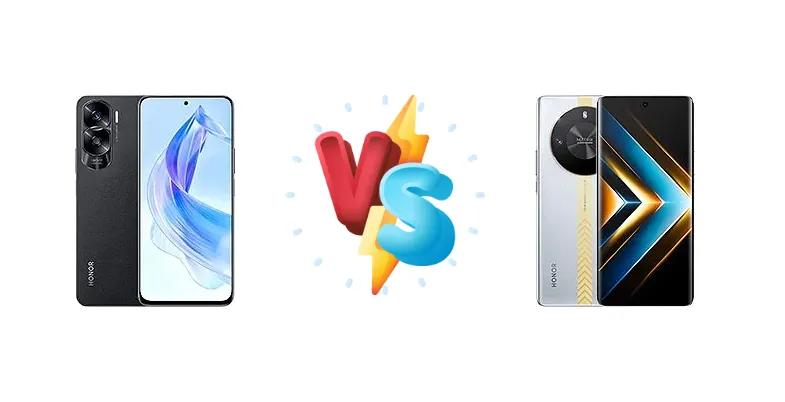
Honor has positioned the X50i and X50 GT as compelling options within the competitive mid-range smartphone market. While both share the 'X50' branding, they diverge significantly in their core components, particularly the chipset. This comparison dissects these differences, focusing on how they impact real-world performance and user experience, helping you determine which device best suits your needs.
🏆 Quick Verdict
For the average user prioritizing smooth daily tasks and efficient battery life, the Honor X50i offers excellent value. However, the Honor X50 GT emerges as the clear winner for gamers and power users, thanks to the significantly more powerful Snapdragon 8+ Gen 1 chipset, despite sharing the same 35W charging.
| Network |
|---|
| 2G bands | GSM 850 / 900 / 1800 / 1900 | GSM 850 / 900 / 1800 / 1900 |
| 3G bands | HSDPA 850 / 900 / 1900 / 2100 | HSDPA 850 / 900 / 1700(AWS) / 1900 / 2100 |
| 4G bands | 1, 3, 5, 7, 8, 34, 38, 39, 40, 41 | LTE |
| 5G bands | 1, 5, 8, 28, 41, 78 SA/NSA | SA/NSA |
| Speed | HSPA, LTE, 5G | HSPA, LTE, 5G |
| Technology | GSM / HSPA / LTE / 5G | GSM / CDMA / HSPA / CDMA2000 / LTE / 5G |
| Launch |
|---|
| Announced | 2023, July 05 | 2024, January 04 |
| Status | Available. Released 2023, July 05 | Available. Released 2024, January 09 |
| Body |
|---|
| Dimensions | 162.9 x 74.5 x 7.5 mm (6.41 x 2.93 x 0.30 in) | 163.6 x 75.5 x 8 mm (6.44 x 2.97 x 0.31 in) |
| SIM | Nano-SIM + Nano-SIM | Nano-SIM + Nano-SIM |
| Weight | 179 g (6.31 oz) | 192 g (6.77 oz) |
| Display |
|---|
| Resolution | 1080 x 2388 pixels (~391 ppi density) | 1220 x 2652 pixels, 19.5:9 ratio (~431 ppi density) |
| Size | 6.7 inches, 108.7 cm2 (~89.6% screen-to-body ratio) | 6.78 inches, 112.6 cm2 (~91.2% screen-to-body ratio) |
| Type | IPS LCD, 90Hz | AMOLED, 1B colors, 120Hz |
| Platform |
|---|
| CPU | Octa-core (2x2.2 GHz Cortex-A76 & 6x2.0 GHz Cortex-A55) | Octa-core (1x3.0 GHz Cortex-X2 & 3x2.5 GHz Cortex-A710 & 4x1.80 GHz Cortex-A510) |
| Chipset | Mediatek Dimensity 6020 (7 nm) | Qualcomm SM8475 Snapdragon 8+ Gen 1 (4 nm) |
| GPU | Mali-G57 MC2 | Adreno 730 |
| OS | Android 13, Magic OS 7.1 | Android 13, MagicOS 7.2 |
| Memory |
|---|
| Card slot | No | No |
| Internal | 256GB 8GB RAM, 256GB 12GB RAM | 256GB 12GB RAM, 256GB 16GB RAM, 512GB 16GB RAM, 1TB 16GB RAM |
| Main Camera |
|---|
| Dual | 100 MP, f/1.9, 27mm (wide), PDAF
Auxiliary lens | 108 MP, f/1.8, (wide), 1/1.67", PDAF
Auxiliary lens |
| Features | LED flash, HDR, panorama | LED flash, panorama, HDR |
| Video | 1080p@30fps | 4K@30fps, 1080p@30fps |
| Selfie camera |
|---|
| Single | 8 MP, f/2.0, (wide) | 8 MP, f/2.0, (wide) |
| Video | 1080p@30fps | 1080p@30fps |
| Sound |
|---|
| 35mm jack | No | No |
| Loudspeaker | Yes | Yes |
| Comms |
|---|
| Bluetooth | 5.1, A2DP, LE, aptX HD | 5.2, A2DP, LE, aptX HD |
| NFC | No | Yes |
| Positioning | GPS, GLONASS, GALILEO, BDS | GPS, GLONASS, GALILEO, BDS |
| Radio | No | No |
| USB | USB Type-C 2.0, OTG | USB Type-C 2.0, OTG |
| WLAN | Wi-Fi 802.11 a/b/g/n/ac, dual-band, Wi-Fi Direct | Wi-Fi 802.11 a/b/g/n/ac/6, dual-band, Wi-Fi Direct |
| Features |
|---|
| Sensors | Fingerprint (side-mounted), accelerometer, compass | Fingerprint (under display, optical), accelerometer, gyro, ultrasound proximity, compass |
| Battery |
|---|
| Charging | 35W wired, 55% in 30 min | 35W wired
7.5W reverse wired |
| Type | Li-Po 4500 mAh | Li-Po 5800 mAh |
| Misc |
|---|
| Colors | Black, Blue, Pink, Light Blue | Black, Silver |
| Models | CRT-AN00 | ALP-AN00 |
| Price | About 180 EUR | About 260 EUR |
Honor X50i
- Excellent value for money
- Efficient Dimensity 6020 chipset for daily tasks
- Potentially longer battery life due to lower power consumption
- Limited gaming performance
- Likely lacks advanced display features like AMOLED or high refresh rate
Honor X50 GT
- Flagship-level Snapdragon 8+ Gen 1 performance
- Superior gaming capabilities
- Potential for a higher-quality display (AMOLED, 120Hz)
- Higher price point
- Potentially shorter battery life under heavy load
Display Comparison
Both phones lack detailed display specifications in the provided data. However, given the X50i's positioning, it likely features an LCD panel, while the X50 GT may incorporate an AMOLED display to complement its higher performance tier. The absence of refresh rate data is notable; the X50 GT, being the more premium model, is more likely to feature a 120Hz panel for smoother scrolling and animations. Bezels are expected to be similar, focusing on maximizing screen real estate within their respective price brackets.
Camera Comparison
Without specific camera sensor details, a direct comparison is limited. However, the X50 GT, as the higher-end model, is expected to feature a more capable primary sensor with a larger aperture for better low-light performance. The inclusion of Optical Image Stabilization (OIS) is also more probable on the X50 GT, further enhancing image quality and video stabilization. The X50i likely relies on software processing to compensate for a potentially less advanced camera system. Any 2MP macro or depth sensors on either device should be considered supplementary features with limited practical benefit.
Performance
The core difference lies in the chipsets. The Honor X50 GT’s Qualcomm Snapdragon 8+ Gen 1 (4nm) is a flagship-level processor, featuring a Cortex-X2 prime core clocked at 3.0 GHz, supported by Cortex-A710 and A510 cores. This architecture delivers significantly higher CPU and GPU performance compared to the Honor X50i’s MediaTek Dimensity 6020 (7nm). The 4nm fabrication process of the Snapdragon 8+ Gen 1 also translates to improved thermal efficiency, reducing throttling during sustained workloads. The Dimensity 6020, while capable for everyday tasks, will struggle with graphically intensive games at higher settings. The Snapdragon 8+ Gen 1’s Adreno GPU provides a substantial advantage in gaming performance.
Battery Life
Both devices share the same 35W wired charging capability, with the X50i claiming a 55% charge in 30 minutes. While the battery capacity isn't specified, the Snapdragon 8+ Gen 1 in the X50 GT is more power-hungry than the Dimensity 6020. Therefore, despite the same charging speed, the X50i will likely achieve a full charge faster and offer longer battery life during typical usage. The X50 GT’s 7.5W reverse wired charging is a useful addition for topping up accessories, a feature absent on the X50i.
Buying Guide
Buy the Honor X50i if you need a reliable daily driver for social media, browsing, and light tasks, prioritizing battery efficiency and a lower price point. Buy the Honor X50 GT if you prefer a phone capable of handling demanding games, intensive multitasking, and benefit from a substantial performance uplift, even if it means slightly reduced battery life under heavy load.
Frequently Asked Questions
❓ Will the Snapdragon 8+ Gen 1 in the X50 GT get noticeably hot during extended gaming sessions?
While the Snapdragon 8+ Gen 1 is efficient for a flagship chip, it can generate heat under sustained load. Honor likely employs thermal management solutions, but some throttling is possible during prolonged, graphically demanding games. However, the X50 GT's cooling system will be significantly more effective than what's found in the X50i.
❓ Is the Dimensity 6020 in the X50i sufficient for playing popular games like PUBG Mobile or Call of Duty Mobile?
The Dimensity 6020 can run PUBG Mobile and Call of Duty Mobile, but you'll likely need to lower the graphics settings to medium or low to maintain a stable frame rate. Expect a less fluid experience compared to the X50 GT, especially in intense firefights.
❓ Does the Honor X50 GT support any advanced gaming features like game mode or trigger buttons?
While not explicitly stated in the provided data, Honor often includes gaming-centric features in their GT series. It's highly probable the X50 GT includes a dedicated game mode to optimize performance and minimize distractions, and potentially software-based trigger mapping for enhanced control.
❓ How does the 35W charging compare to other phones with higher wattage charging?
35W charging is respectable, but slower than the 65W or 120W charging found on some competing devices. However, the X50i's more efficient chipset means it may reach a usable charge level relatively quickly, while the X50 GT's larger power draw will take longer to fully replenish its battery.