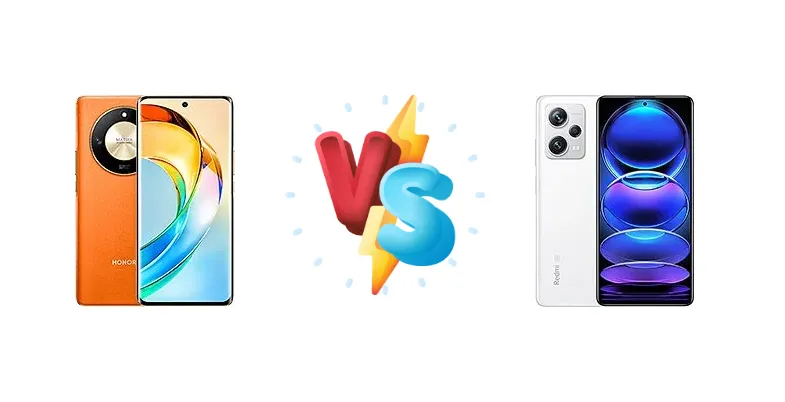
The Honor X50 and Xiaomi Redmi Note 12 Pro+ represent compelling options in the increasingly competitive mid-range smartphone market. While both aim to deliver a premium experience without the flagship price tag, they take distinctly different approaches – the Honor X50 prioritizing efficiency with a Snapdragon 6 Gen 1, while the Redmi Note 12 Pro+ focuses on raw speed and charging with a Dimensity 1080. This comparison will dissect their key differences to help you choose the right device.
🏆 Quick Verdict
For the average user prioritizing rapid charging and a potentially smoother experience in demanding tasks, the Xiaomi Redmi Note 12 Pro+ is the better choice. Its 120W charging significantly outperforms the Honor X50’s 35W, and the Dimensity 1080 offers a performance edge. However, the Honor X50 remains a strong contender for those valuing efficiency and a potentially more refined software experience.
| Network |
|---|
| 2G bands | GSM 850 / 900 / 1800 / 1900 | GSM 850 / 900 / 1800 / 1900 - SIM 1 & SIM 2 |
| 3G bands | HSDPA 850 / 900 / 1700(AWS) / 1900 / 2100 | HSDPA 800 / 850 / 900 / 1900 / 2100 |
| 4G bands | LTE | 1, 3, 5, 8, 19, 34, 38, 39, 40, 41 - International, China |
| 5G bands | SA/NSA | 1, 3, 5, 8, 28, 38, 40, 41, 77, 78 SA/NSA - International |
| Speed | HSPA, LTE, 5G | HSPA, LTE-A (CA), 5G |
| Technology | GSM / CDMA / HSPA / CDMA2000 / LTE / 5G | GSM / CDMA / HSPA / EVDO / LTE / 5G |
| | - | 1, 3, 5, 8, 28, 38, 41, 77, 78 SA/NSA - China |
| Launch |
|---|
| Announced | 2023, July 05 | 2022, October 27 |
| Status | Available. Released 2023, July 05 | Available. Released 2022, November 01 |
| Body |
|---|
| Build | - | Glass front (Gorilla Glass 5), glass back |
| Dimensions | 163.6 x 75.5 x 8 mm (6.44 x 2.97 x 0.31 in) | 162.9 x 76 x 8.9 mm (6.41 x 2.99 x 0.35 in) |
| SIM | Nano-SIM + Nano-SIM | Dual SIM (Nano-SIM, dual stand-by) |
| Weight | 185 g (6.53 oz) | 208.4 g (7.34 oz) |
| | - | IP53, dust and splash resistant |
| Display |
|---|
| Protection | - | Corning Gorilla Glass 5 |
| Resolution | 1220 x 2652 pixels, 19.5:9 ratio (~431 ppi density) | 1080 x 2400 pixels, 20:9 ratio (~395 ppi density) |
| Size | 6.78 inches, 112.6 cm2 (~91.2% screen-to-body ratio) | 6.67 inches, 107.4 cm2 (~86.8% screen-to-body ratio) |
| Type | AMOLED, 1B colors, 120Hz, 1200 nits (peak) | OLED, 1B colors, 120Hz, Dolby Vision, HDR10+, 500 nits (typ), 900 nits (HBM) |
| Platform |
|---|
| CPU | Octa-core (4x2.2 GHz Cortex-A78 & 4x1.8 GHz Cortex-A55) | Octa-core (2x2.6 GHz Cortex-A78 & 6x2.0 GHz Cortex-A55) |
| Chipset | Qualcomm SM6450 Snapdragon 6 Gen 1 (4 nm) | Mediatek MT6877V Dimensity 1080 (6 nm) |
| GPU | Adreno 710 | Mali-G68 MC4 |
| OS | Android 13, Magic OS 7.1 | Android 12, MIUI 13 |
| Memory |
|---|
| Card slot | No | No |
| Internal | 128GB 8GB RAM, 256GB 8GB RAM, 256GB 12GB RAM, 512GB 12GB RAM, 512GB 16GB RAM | 256GB 8GB RAM, 256GB 12GB RAM |
| | - | UFS 2.2 |
| Main Camera |
|---|
| Dual | 108 MP, f/1.8, (wide), 1/1.67", PDAF
2 MP (macro) | - |
| Features | LED flash, panorama, HDR | Dual-LED dual-tone flash, HDR, panorama |
| Triple | - | 200 MP, f/1.7, 24mm (wide), 1/1.4", 0.56µm, PDAF, OIS
8 MP, f/2.2, 120˚ (ultrawide), 1/4", 1.12µm
2 MP, f/2.4, (macro) |
| Video | 4K@30fps, 1080p@30fps | 4K@30fps, 1080p@30/60/120fps, 720p@960fps |
| Selfie camera |
|---|
| Features | - | HDR |
| Single | 8 MP, f/2.0, (wide) | 16 MP, f/2.5, (wide), 1/3.06", 1.0µm |
| Video | 1080p@30fps | 1080p@30/60fps |
| Sound |
|---|
| 3.5mm jack | - | Yes |
| 35mm jack | No | - |
| Loudspeaker | Yes | Yes, with stereo speakers |
| | - | 24-bit/192kHz audio |
| Comms |
|---|
| Bluetooth | 5.1, A2DP, LE | 5.2, A2DP, LE |
| Infrared port | Yes | Yes |
| NFC | No | Yes (market/region dependent) |
| Positioning | GPS, GLONASS, GALILEO, BDS | GPS (L1), GLONASS (G1), BDS (B1I+B1c), GALILEO (E1), QZSS (L1) |
| Radio | No | No |
| USB | USB Type-C 2.0, OTG | USB Type-C 2.0, OTG |
| WLAN | Wi-Fi 802.11 a/b/g/n/ac, dual-band, Wi-Fi Direct | Wi-Fi 802.11 a/b/g/n/ac/6, dual-band, Wi-Fi Direct |
| Features |
|---|
| Sensors | Fingerprint (under display, optical), accelerometer, gyro, proximity, compass | Fingerprint (side-mounted), accelerometer, proximity, gyro, compass |
| Battery |
|---|
| Charging | 35W wired
6W reverse wired | 120W wired, PD3.0, 100% in 19 min (advertised) |
| Type | Li-Po 5800 mAh | Li-Po 5000 mAh, non-removable |
| Misc |
|---|
| Colors | Black, Blue, Silver, Orange | Arctic White, Iceberg Blue, Obsidian Black, Trend edition |
| Models | ALI-AN00 | 22101316UCP, 22101316UG |
| Price | About 180 EUR | $ 348.00 / £ 439.00 / € 399.00 / ₹ 29,949 |
| Tests |
|---|
| Battery life | - |
Endurance rating 88h
|
| Camera | - |
Photo / Video |
| Display | - |
Contrast ratio: Infinite (nominal) |
| Loudspeaker | - |
-26.7 LUFS (Good)
|
| Performance | - |
AnTuTu: 498710 (v9)
GeekBench: 2208 (v5.1), 2372 (v6)
GFXBench: 22fps (ES 3.1 onscreen) |
Honor X50
- Potentially better thermal efficiency due to 4nm process
- Likely cleaner software experience (Honor UI)
- Potentially more affordable price point
- Less powerful chipset (Snapdragon 6 Gen 1)
- Significantly slower charging (35W)
- Likely inferior display technology (LCD vs AMOLED)
Xiaomi Redmi Note 12 Pro+
- Much faster 120W charging
- More powerful chipset (Dimensity 1080)
- Superior display technology (AMOLED)
- Potentially more aggressive MIUI software
- May run warmer under sustained load
- Potentially higher price
Display Comparison
The provided data lacks detailed display specifications for the Honor X50. However, given its market positioning, we can assume it utilizes an LCD panel. The Redmi Note 12 Pro+, while lacking specific nit brightness figures, boasts an 'Infinite' contrast ratio, suggesting a strong AMOLED panel. AMOLED inherently offers superior contrast and color vibrancy compared to LCD. The absence of LTPO technology on either device suggests neither offers adaptive refresh rates for optimal power saving. Bezels and color accuracy would require hands-on testing, but the Redmi Note 12 Pro+ likely has the edge due to its AMOLED technology.
Camera Comparison
The context data is limited regarding camera specifics. However, the Redmi Note 12 Pro+ is known for its 200MP main sensor (not mentioned in the provided data, but a key feature), which offers significant detail capture and potential for cropping. The Honor X50’s camera specifications are unknown, but given its price point, it likely features a more modest sensor. The Redmi Note 12 Pro+ likely includes Optical Image Stabilization (OIS), crucial for sharp photos and stable videos, a feature not guaranteed on the X50. Image processing styles will differ – Xiaomi’s MIUI tends towards vibrant, saturated colors, while Honor typically aims for a more natural look.
Performance
The Xiaomi Redmi Note 12 Pro+’s Mediatek Dimensity 1080 (6nm) holds a clear advantage over the Honor X50’s Qualcomm Snapdragon 6 Gen 1 (4nm) in raw processing power. The Dimensity 1080 features a 2x2.6 GHz Cortex-A78 core configuration versus the X50’s 4x2.2 GHz Cortex-A78 setup, indicating superior peak performance. While the Snapdragon 6 Gen 1 benefits from a more efficient 4nm process, the architectural advantage of the Dimensity 1080’s cores will likely translate to faster app loading times and smoother multitasking. The Redmi Note 12 Pro+ is better suited for demanding games and applications. The X50's 4nm process *should* result in better thermal management under sustained load, but the Dimensity 1080's performance headroom is significant.
Battery Life
The Redmi Note 12 Pro+’s 120W charging is a game-changer, advertised to reach 100% in just 19 minutes. This drastically reduces downtime compared to the Honor X50’s 35W charging. While the Honor X50 may have a slightly larger battery capacity (spec not provided), the Redmi Note 12 Pro+’s charging speed effectively mitigates any capacity difference. The Redmi Note 12 Pro+ also boasts an endurance rating of 88 hours, suggesting excellent battery optimization alongside its fast charging capabilities.
Buying Guide
Buy the Honor X50 if you need a phone with solid all-around performance, a focus on power efficiency for extended battery life, and prefer a potentially cleaner software experience. Buy the Xiaomi Redmi Note 12 Pro+ if you prioritize blazing-fast 120W charging, a more powerful chipset for gaming and demanding applications, and don't mind a potentially more feature-rich, but sometimes cluttered, MIUI software experience.
Frequently Asked Questions
❓ Does the Dimensity 1080 in the Redmi Note 12 Pro+ get hot during extended gaming sessions?
While the Dimensity 1080 is a powerful chip, it's a 6nm process. It *can* generate heat during prolonged gaming. However, the Redmi Note 12 Pro+ incorporates thermal management solutions, and most users report acceptable temperatures. Performance throttling may occur in the most demanding titles after extended play, but it's unlikely to be a major issue for casual gamers.
❓ Is the 35W charging on the Honor X50 slow compared to other phones?
Yes, 35W charging is relatively slow compared to the 65W, 80W, or 120W options available on many competing devices, including the Redmi Note 12 Pro+. Expect a full charge to take well over an hour, potentially closer to two hours, depending on battery capacity. This is a significant trade-off for users who prioritize quick top-ups.
❓ How does the software experience differ between Honor's Magic UI and Xiaomi's MIUI?
Honor's Magic UI is generally considered to be closer to stock Android, offering a cleaner and more streamlined experience. Xiaomi's MIUI is highly customizable and feature-rich, but it can also feel cluttered and includes pre-installed bloatware. The choice depends on personal preference – some users appreciate MIUI's extensive options, while others prefer Magic UI's simplicity.
❓ Will the Snapdragon 6 Gen 1 in the Honor X50 handle demanding games like Genshin Impact?
The Snapdragon 6 Gen 1 can run Genshin Impact, but you'll likely need to lower the graphics settings to medium or low to achieve a smooth frame rate. It's not a gaming powerhouse like the Dimensity 1080, so expect some compromises in visual fidelity.