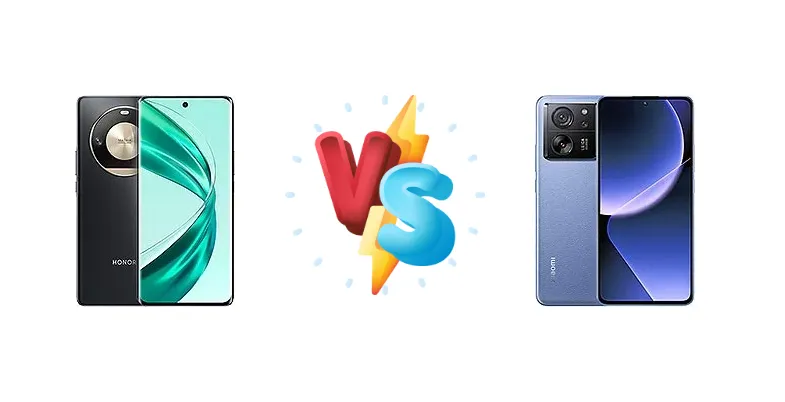
The Honor X50 Pro and Xiaomi 13T Pro represent compelling options in a crowded flagship market, both aiming to deliver premium experiences without the ultra-premium price tag. The X50 Pro leverages the proven Snapdragon 8+ Gen 1, while the 13T Pro debuts with the newer MediaTek Dimensity 9200+. This comparison dissects the key differences to determine which device best suits your needs.
🏆 Quick Verdict
For most users, the Xiaomi 13T Pro emerges as the stronger contender. Its significantly faster 120W charging, coupled with a measured peak brightness of 1094 nits, provides a more convenient and visually vibrant experience. While the X50 Pro offers a solid chipset, the 13T Pro’s overall package is more compelling.
| Network |
|---|
| 2G bands | GSM 850 / 900 / 1800 / 1900 | GSM 850 / 900 / 1800 / 1900 |
| 3G bands | HSDPA 850 / 900 / 1700(AWS) / 1900 / 2100 | HSDPA 800 / 850 / 900 / 1700(AWS) / 1900 / 2100 |
| 4G bands | LTE | 1, 2, 3, 4, 5, 7, 8, 12, 13, 17, 18, 19, 20, 25, 26, 28, 32, 38, 39, 40, 41, 42, 48, 66 |
| 5G bands | SA/NSA | 1, 3, 5, 7, 8, 20, 28, 38, 40, 41, 66, 75, 77, 78 SA/NSA |
| Speed | HSPA, LTE, 5G | HSPA, LTE, 5G |
| Technology | GSM / CDMA / HSPA / CDMA2000 / LTE / 5G | GSM / HSPA / LTE / 5G |
| Launch |
|---|
| Announced | 2023, December 29 | 2023, September 26 |
| Status | Cancelled | Available. Released 2023, September 26 |
| Body |
|---|
| Build | - | Glass front (Gorilla Glass 5), glass back or silicone polymer back, plastic frame |
| Dimensions | 163.6 x 75.5 x 8 mm (6.44 x 2.97 x 0.31 in) | 162.2 x 75.7 x 8.5 mm (6.39 x 2.98 x 0.33 in) |
| SIM | Nano-SIM + Nano-SIM | · Nano-SIM + eSIM· Nano-SIM + Nano-SIM |
| Weight | 192 g (6.77 oz) | 200 g or 206 g (7.05 oz) |
| Display |
|---|
| Protection | - | Corning Gorilla Glass 5 |
| Resolution | 1220 x 2652 pixels, 19.5:9 ratio (~431 ppi density) | 1220 x 2712 pixels, 20:9 ratio (~446 ppi density) |
| Size | 6.78 inches, 112.6 cm2 (~91.2% screen-to-body ratio) | 6.67 inches, 107.4 cm2 (~87.5% screen-to-body ratio) |
| Type | AMOLED, 1B colors, 120Hz | AMOLED, 68B colors, 144Hz, Dolby Vision, HDR10+, 1200 nits (HBM), 2600 nits (peak) |
| Platform |
|---|
| CPU | Octa-core (1x3.0 GHz Cortex-X2 & 3x2.5 GHz Cortex-A710 & 4x1.80 GHz Cortex-A510) | Octa-core (1x3.35 GHz Cortex-X3 & 3x3.0 GHz Cortex-A715 & 4x2.0 GHz Cortex-A510) |
| Chipset | Qualcomm SM8475 Snapdragon 8+ Gen 1 (4 nm) | Mediatek Dimensity 9200+ (4 nm) |
| GPU | Adreno 730 | Immortalis-G715 MC11 |
| OS | Android 14 | Android 13, up to 4 major Android upgrades, HyperOS |
| Memory |
|---|
| Card slot | No | No |
| Internal | 256GB 12GB RAM | 256GB 12GB RAM, 512GB 12GB RAM, 1TB 16GB RAM |
| Main Camera |
|---|
| Dual | 108 MP, f/1.8, (wide), 1/1.67", PDAF
Auxiliary lens | - |
| Features | LED flash, panorama, HDR | Leica lens, color spectrum sensor, LED flash, HDR, panorama |
| Triple | - | 50 MP, f/1.9, 24mm (wide), 1/1.28", 1.22µm, PDAF, OIS
50 MP, f/1.9, 50mm (telephoto), 1/2.88", 0.61µm, PDAF, 2x optical zoom
12 MP, f/2.2, 15mm (ultrawide), 1/3.06", 1.12µm |
| Video | 4K@30fps, 1080p@30fps | 8K@24fps, 4K@24/30/60fps, 4K/1080p@30fps HDR10+, 1080p@30/60/120/240fps; 10-bit LOG, gyro-EIS |
| Selfie camera |
|---|
| Features | - | HDR |
| Single | 8 MP, f/2.0, (wide) | 20 MP, f/2.2, (wide), 0.8µm |
| Video | 1080p@30fps | 1080p@30fps, HDR10+ |
| Sound |
|---|
| 35mm jack | No | No |
| Loudspeaker | Yes | Yes, with stereo speakers |
| Comms |
|---|
| Bluetooth | 5.2, A2DP, LE | 5.4, A2DP, LE |
| Infrared port | - | Yes |
| NFC | Yes | Yes |
| Positioning | GPS, GLONASS, GALILEO, BDS | GPS (L1+L5), GLONASS (G1), GALILEO (E1+E5a), NavIC (L5), BDS |
| Radio | No | No |
| USB | USB Type-C 2.0, OTG | USB Type-C 2.0, OTG |
| WLAN | Wi-Fi 802.11 a/b/g/n/ac/6, dual-band, Wi-Fi Direct | Wi-Fi 802.11 a/b/g/n/ac/6e/7, dual/tri-band (market/region dependent), Wi-Fi Direct |
| Features |
|---|
| Sensors | Fingerprint (under display, optical), accelerometer, gyro, ultrasound proximity, compass | Fingerprint (under display, optical), accelerometer, gyro, proximity, compass |
| Battery |
|---|
| Charging | 35W wired
7.5W reverse wired | 120W wired, PD3.0, QC4, 100% in 19 min |
| Type | Li-Po 5800 mAh | Li-Po 5000 mAh |
| Misc |
|---|
| Colors | Black, Green | Alpine Blue, Meadow Green, Black |
| Models | ALP-AN00 | 23078PND5G |
| Price | About 360 EUR | $ 370.00 / £ 482.55 / € 301.99 |
| SAR EU | - | 1.00 W/kg (head) 0.99 W/kg (body) |
Honor X50 Pro
- Proven Snapdragon 8+ Gen 1 chipset
- Potentially more affordable price point
- 7.5W reverse wired charging
- Significantly slower 35W charging
- Display brightness likely lower than the 13T Pro
- Limited camera information available
Xiaomi 13T Pro
- Ultra-fast 120W wired charging
- Brighter display (1094 nits)
- More powerful Dimensity 9200+ chipset
- May be slightly more expensive
- MediaTek chipset may have less software optimization
- Limited information on camera sensor details
Display Comparison
The Xiaomi 13T Pro boasts a notably brighter display, reaching a measured peak of 1094 nits, compared to an unspecified peak brightness for the Honor X50 Pro. This translates to superior visibility in direct sunlight. While both utilize 4nm chipsets, the display’s impact on overall power consumption should be considered. Details regarding panel technology (LTPO vs standard OLED) and color accuracy are missing for the X50 Pro, but the 13T Pro’s brightness advantage is a clear win for outdoor usability.
Camera Comparison
Detailed camera specifications beyond 'Photo / Video' are absent for both devices, making a direct comparison challenging. However, the market positioning suggests the Xiaomi 13T Pro may prioritize camera capabilities more heavily. The absence of information regarding sensor size, OIS, and lens apertures for the X50 Pro hinders a thorough assessment. We can assume both phones will feature multi-camera setups, but the 13T Pro’s brand reputation leans towards more advanced imaging features.
Performance
The Xiaomi 13T Pro’s MediaTek Dimensity 9200+ features a Cortex-X3 prime core clocked at 3.35 GHz, exceeding the 3.0 GHz Cortex-X2 in the Honor X50 Pro’s Snapdragon 8+ Gen 1. This architectural upgrade, combined with faster Cortex-A715 performance cores (3.0 GHz vs 2.5 GHz), suggests a performance edge for the 13T Pro in demanding tasks. Both chips are built on a 4nm process, offering good efficiency, but the Dimensity 9200+’s newer architecture likely translates to better sustained performance under load. The X50 Pro’s LPDDR5X RAM is comparable to the 13T Pro’s, minimizing memory-related bottlenecks.
Battery Life
The Xiaomi 13T Pro’s 120W wired charging is a game-changer, achieving a full charge in just 19 minutes. This is a significant advantage over the Honor X50 Pro’s 35W charging. While the 13T Pro’s battery capacity isn’t explicitly stated, its endurance rating of 102 hours and active use score of 11:50h indicates excellent battery life. The X50 Pro’s 7.5W reverse wired charging is a niche feature, useful for topping up accessories but unlikely to be a primary selling point.
Buying Guide
Buy the Honor X50 Pro if you prioritize a slightly more established chipset with a proven track record and are comfortable with slower 35W charging. It’s a good choice for users who value stability over bleeding-edge features. Buy the Xiaomi 13T Pro if you demand rapid charging – a full charge in under 20 minutes – and a brighter, more modern display. This phone is ideal for power users and those who frequently find themselves needing to top up their battery quickly.
Frequently Asked Questions
❓ Is the Dimensity 9200+ in the Xiaomi 13T Pro prone to overheating during extended gaming sessions?
While the Dimensity 9200+ is a powerful chip, thermal management is crucial. The 13T Pro’s cooling system, which isn’t detailed in the provided specs, will be key. However, the 4nm process and architectural improvements suggest it should handle sustained loads better than older generation chips, though real-world testing is needed to confirm.
❓ How does the 35W charging on the Honor X50 Pro compare to typical charging speeds for other phones in its price range?
35W charging is relatively slow compared to many modern smartphones, even within the same price bracket. Many competitors now offer 65W or even 80W charging, meaning the X50 Pro will take considerably longer to fully recharge. This is a significant trade-off for users who prioritize convenience.
❓ Does the Xiaomi 13T Pro support features like HDR10+ for enhanced video playback?
While not explicitly stated in the provided specs, Xiaomi typically includes HDR10+ support in its flagship and upper-midrange devices. This would provide a more dynamic and visually appealing viewing experience when streaming HDR content from services like Netflix and YouTube.