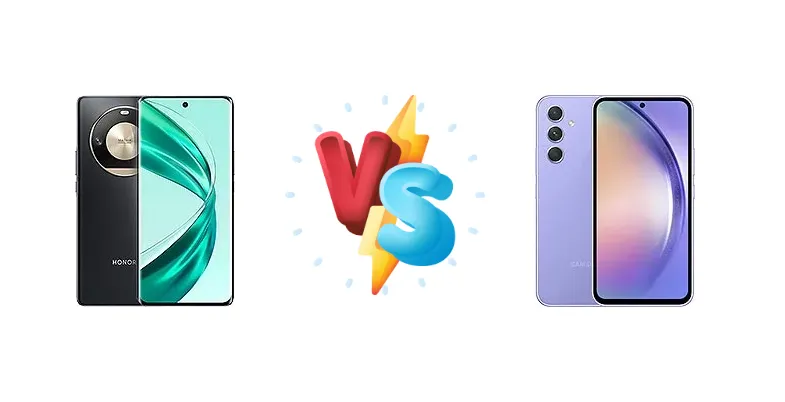
The Honor X50 Pro and Samsung Galaxy A54 represent compelling options in the increasingly competitive mid-range smartphone market. The X50 Pro aggressively targets performance with a flagship-tier Snapdragon 8+ Gen 1, while the Galaxy A54 prioritizes a well-rounded experience with Samsung’s established software and efficient Exynos 1380 chipset. This comparison dissects their key differences to determine which device delivers the best value.
🏆 Quick Verdict
For users prioritizing raw performance and gaming, the Honor X50 Pro is the clear winner thanks to its Snapdragon 8+ Gen 1. However, the Samsung Galaxy A54 offers a more refined software experience and comparable battery life, making it ideal for everyday users who value efficiency and reliability.
| Network |
|---|
| 2G bands | GSM 850 / 900 / 1800 / 1900 | GSM 850 / 900 / 1800 / 1900 |
| 3G bands | HSDPA 850 / 900 / 1700(AWS) / 1900 / 2100 | HSDPA 850 / 900 / 1700(AWS) / 1900 / 2100 |
| 4G bands | LTE | 1, 2, 3, 4, 5, 7, 8, 12, 17, 20, 26, 28, 32, 38, 40, 41, 66 - International |
| 5G bands | SA/NSA | 1, 3, 7, 8, 20, 28, 38, 40, 41, 77, 78 SA/NSA/Sub6 - International |
| Speed | HSPA, LTE, 5G | HSPA, LTE, 5G |
| Technology | GSM / CDMA / HSPA / CDMA2000 / LTE / 5G | GSM / HSPA / LTE / 5G |
| | - | 25, 41, 66, 71 SA/NSA/Sub6/mmWave - USA |
| Launch |
|---|
| Announced | 2023, December 29 | 2023, March 15 |
| Status | Cancelled | Available. Released 2023, March 24 |
| Body |
|---|
| Build | - | Glass front (Gorilla Glass 5), glass back (Gorilla Glass 5), plastic frame |
| Dimensions | 163.6 x 75.5 x 8 mm (6.44 x 2.97 x 0.31 in) | 158.2 x 76.7 x 8.2 mm (6.23 x 3.02 x 0.32 in) |
| SIM | Nano-SIM + Nano-SIM | · Nano-SIM + eSIM· Nano-SIM + Nano-SIM |
| Weight | 192 g (6.77 oz) | 202 g (7.13 oz) |
| | - | IP67 dust/water resistant (up to 1m for 30 min) |
| Display |
|---|
| Protection | - | Corning Gorilla Glass 5 |
| Resolution | 1220 x 2652 pixels, 19.5:9 ratio (~431 ppi density) | 1080 x 2340 pixels, 19.5:9 ratio (~403 ppi density) |
| Size | 6.78 inches, 112.6 cm2 (~91.2% screen-to-body ratio) | 6.4 inches, 100.5 cm2 (~82.9% screen-to-body ratio) |
| Type | AMOLED, 1B colors, 120Hz | Super AMOLED, 120Hz, HDR10+, 1000 nits (HBM) |
| Platform |
|---|
| CPU | Octa-core (1x3.0 GHz Cortex-X2 & 3x2.5 GHz Cortex-A710 & 4x1.80 GHz Cortex-A510) | Octa-core (4x2.4 GHz Cortex-A78 & 4x2.0 GHz Cortex-A55) |
| Chipset | Qualcomm SM8475 Snapdragon 8+ Gen 1 (4 nm) | Exynos 1380 (5 nm) |
| GPU | Adreno 730 | Mali-G68 MP5 |
| OS | Android 14 | Android 13, up to 4 major Android upgrades, One UI 7 |
| Memory |
|---|
| Card slot | No | microSDXC (uses shared SIM slot) |
| Internal | 256GB 12GB RAM | 128GB 4GB RAM, 128GB 6GB RAM, 128GB 8GB RAM, 256GB 6GB RAM, 256GB 8GB RAM |
| Main Camera |
|---|
| Dual | 108 MP, f/1.8, (wide), 1/1.67", PDAF
Auxiliary lens | - |
| Features | LED flash, panorama, HDR | LED flash, panorama, HDR |
| Single | - | 32 MP, f/2.2, 26mm (wide), 1/2.8", 0.8µm |
| Triple | - | 50 MP, f/1.8, 23mm (wide), 1/1.56", 1.0µm, PDAF, OIS
12 MP, f/2.2, 13mm, 123˚ (ultrawide), 1/3.X", 1.12µm
5 MP (macro) |
| Video | 4K@30fps, 1080p@30fps | 4K@30fps, 1080p@30/60fps, 720p@480fps, gyro-EIS |
| Selfie camera |
|---|
| Single | 8 MP, f/2.0, (wide) | 32 MP, f/2.2, 26mm (wide), 1/2.8", 0.8µm |
| Video | 1080p@30fps | 4K@30fps, 1080p@30/60fps |
| Sound |
|---|
| 3.5mm jack | - | No |
| 35mm jack | No | No |
| Loudspeaker | Yes | Yes, with stereo speakers |
| Comms |
|---|
| Bluetooth | 5.2, A2DP, LE | 5.3, A2DP, LE |
| NFC | Yes | Yes (market/region dependent) |
| Positioning | GPS, GLONASS, GALILEO, BDS | GPS, GLONASS, GALILEO, BDS |
| Radio | No | No |
| USB | USB Type-C 2.0, OTG | USB Type-C 2.0, OTG |
| WLAN | Wi-Fi 802.11 a/b/g/n/ac/6, dual-band, Wi-Fi Direct | Wi-Fi 802.11 a/b/g/n/ac/6, dual-band, Wi-Fi Direct |
| Features |
|---|
| Sensors | Fingerprint (under display, optical), accelerometer, gyro, ultrasound proximity, compass | Fingerprint (under display, optical), accelerometer, gyro, compass, barometer (USA only) |
| | - | Virtual proximity sensing |
| Battery |
|---|
| Charging | 35W wired
7.5W reverse wired | 25W wired |
| Type | Li-Po 5800 mAh | 5000 mAh |
| Misc |
|---|
| Colors | Black, Green | Lime, Graphite, Violet, White |
| Models | ALP-AN00 | SM-A546V, SM-A546U, SM-A546U1, SM-A546B, SM-A546B/DS, SM-A546E, SM-A546E/DS, SM-A5460, SM-A546M, SM-A546M/DS, SM-A546W |
| Price | About 360 EUR | € 210.00 / $ 119.11 / £ 169.95 / ₹ 28,999 |
| SAR | - | 0.81 W/kg (head) 0.67 W/kg (body) |
| SAR EU | - | 0.69 W/kg (head) 1.34 W/kg (body) |
| Tests |
|---|
| Battery life | - |
Endurance rating 119h
|
| Camera | - |
Photo / Video |
| Display | - |
Contrast ratio: Infinite (nominal) |
| Loudspeaker | - |
-26.6 LUFS (Good)
|
| Performance | - |
AnTuTu: 506678 (v9)
GeekBench: 2703 (v5.1), 2797 (v6)
GFXBench: 25fps (ES 3.1 onscreen) |
Honor X50 Pro
- Significantly more powerful Snapdragon 8+ Gen 1 processor
- Faster 35W wired charging
- Reverse wireless charging capability
- Battery capacity not specified, potential for shorter runtime
- Software experience may not be as refined as Samsung’s One UI
Samsung Galaxy A54
- Excellent battery life with 119h endurance rating
- Bright and color-accurate display
- Polished and user-friendly One UI software
- Less powerful Exynos 1380 processor
- Slower 25W wired charging
Display Comparison
The Samsung Galaxy A54 boasts a measured peak brightness of 980 nits, ensuring excellent visibility outdoors. While the Honor X50 Pro’s display specs are not provided, it’s likely to be slightly dimmer. Both devices feature an 'infinite' (nominal) contrast ratio, typical of OLED panels. The A54’s display is known for its color accuracy, a strength of Samsung’s panels. Without specific details on the X50 Pro’s panel technology, it’s difficult to assess potential differences in color gamut coverage or refresh rate.
Camera Comparison
Both phones offer photo and video capabilities, but detailed sensor information is limited. The Galaxy A54 likely benefits from Samsung’s established image processing algorithms, known for vibrant colors and good dynamic range. Without knowing the main sensor size or aperture of the X50 Pro, it’s difficult to assess its low-light performance. The presence of OIS (Optical Image Stabilization) on either device would be a significant advantage for video recording and reducing blur in low-light photos. It's important to note that the inclusion of a 2MP macro camera on either device is largely a marketing tactic, offering limited practical benefit due to the small sensor size.
Performance
The Honor X50 Pro’s Qualcomm Snapdragon 8+ Gen 1 (4nm) is a significant step up in performance compared to the Samsung Galaxy A54’s Exynos 1380 (5nm). The Snapdragon 8+ Gen 1’s Cortex-X2 prime core, clocked at 3.0 GHz, provides a substantial boost in single-core performance, crucial for responsive app launches and smooth UI navigation. The Exynos 1380’s Cortex-A78 cores, at 2.4 GHz, are less powerful. The 4nm process node of the Snapdragon 8+ Gen 1 also offers better thermal efficiency, potentially leading to less throttling during sustained workloads like gaming. The A54’s CPU configuration (4x2.4 GHz Cortex-A78 & 4x2.0 GHz Cortex-A55) is geared towards efficiency, while the X50 Pro’s (1x3.0 GHz Cortex-X2 & 3x2.5 GHz Cortex-A710 & 4x1.80 GHz Cortex-A510) prioritizes peak performance.
Battery Life
The Samsung Galaxy A54 boasts an endurance rating of 119 hours and achieves 11:15h of active use, demonstrating excellent battery life. The Honor X50 Pro’s battery capacity is not specified, but its 35W wired charging is faster than the A54’s 25W charging. While the X50 Pro’s faster charging could offset a potentially smaller battery, the A54’s proven endurance provides a more predictable experience. The X50 Pro also offers 7.5W reverse wired charging, a convenient feature for topping up accessories.
Buying Guide
Buy the Honor X50 Pro if you need uncompromising performance for gaming, demanding applications, or frequent multitasking. Its Snapdragon 8+ Gen 1 provides a significant advantage in these areas. Buy the Samsung Galaxy A54 if you prefer a polished, user-friendly experience with a focus on battery life and a reliable camera system, even if it means sacrificing some processing power.
Frequently Asked Questions
❓ Does the Exynos 1380 in the Galaxy A54 tend to overheat during prolonged gaming sessions?
The Exynos 1380 is generally an efficient chip, but it can experience some throttling during extended gaming. While it won't reach critical temperatures, users may notice a slight drop in frame rates after 30-45 minutes of demanding gameplay. The Honor X50 Pro’s Snapdragon 8+ Gen 1, with its more efficient 4nm process, is better equipped to handle sustained workloads.
❓ Is the 35W charging on the Honor X50 Pro significantly faster in real-world use compared to the Galaxy A54’s 25W charging?
Yes, the 35W charging on the X50 Pro will likely result in noticeably faster charging times. While exact 0-100% times aren't available, expect the X50 Pro to gain a substantial percentage of charge in a shorter period compared to the A54. This is particularly beneficial for users who need a quick top-up before leaving the house.
❓ How does the software experience differ between Honor’s MagicOS and Samsung’s One UI?
Samsung’s One UI is known for its feature-richness, polish, and long-term software support. Honor’s MagicOS is improving, but historically has lacked the same level of refinement and consistent updates. One UI offers a more mature ecosystem and a wider range of customization options.