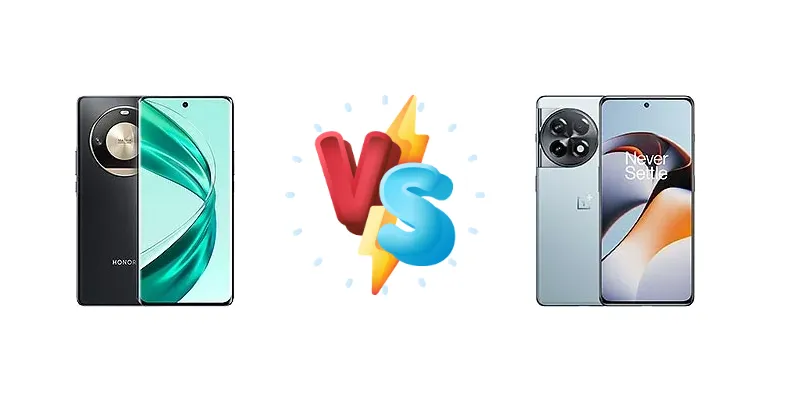
The Honor X50 Pro and OnePlus 11R represent a fascinating intersection in the smartphone market. Both devices leverage the proven Qualcomm Snapdragon 8+ Gen 1 chipset, offering flagship-level performance at increasingly competitive price points. However, the key differentiator isn't raw power, but how each manufacturer chooses to package and optimize that power, particularly in the areas of charging speed and overall user experience.
🏆 Quick Verdict
For the average user prioritizing convenience and minimizing downtime, the OnePlus 11R is the clear winner. Its 100W SuperVOOC charging drastically reduces charging times, offsetting the Honor X50 Pro’s slightly more conservative approach. While both phones deliver similar performance, the OnePlus 11R’s charging speed is a game-changer.
| Network |
|---|
| 2G bands | GSM 850 / 900 / 1800 / 1900 | GSM 850 / 900 / 1800 / 1900 |
| 3G bands | HSDPA 850 / 900 / 1700(AWS) / 1900 / 2100 | HSDPA 850 / 900 / 1700(AWS) / 2100 |
| 4G bands | LTE | 1, 3, 4, 5, 8, 28, 34, 38, 39, 40, 41 |
| 5G bands | SA/NSA | 1, 3, 5, 8, 28, 40, 41, 77, 78 SA/NSA |
| Speed | HSPA, LTE, 5G | HSPA, LTE (3CA), 5G |
| Technology | GSM / CDMA / HSPA / CDMA2000 / LTE / 5G | GSM / CDMA / HSPA / LTE / 5G |
| | - | CDMA 800 |
| Launch |
|---|
| Announced | 2023, December 29 | 2023, February 07 |
| Status | Cancelled | Available. Released 2023, February 21 |
| Body |
|---|
| Build | - | Glass front, glass back (Gorilla Glass 5), plastic frame |
| Dimensions | 163.6 x 75.5 x 8 mm (6.44 x 2.97 x 0.31 in) | 163.4 x 74.3 x 8.7 mm (6.43 x 2.93 x 0.34 in) |
| SIM | Nano-SIM + Nano-SIM | Nano-SIM + Nano-SIM |
| Weight | 192 g (6.77 oz) | 204 g (7.20 oz) |
| Display |
|---|
| Resolution | 1220 x 2652 pixels, 19.5:9 ratio (~431 ppi density) | 1240 x 2772 pixels, 20:9 ratio (~451 ppi density) |
| Size | 6.78 inches, 112.6 cm2 (~91.2% screen-to-body ratio) | 6.74 inches, 109.2 cm2 (~90.0% screen-to-body ratio) |
| Type | AMOLED, 1B colors, 120Hz | Fluid AMOLED, 1B colors, 120Hz, HDR10+, 1450 nits (peak) |
| Platform |
|---|
| CPU | Octa-core (1x3.0 GHz Cortex-X2 & 3x2.5 GHz Cortex-A710 & 4x1.80 GHz Cortex-A510) | Octa-core (1x3.0 GHz Cortex-X2 & 3x2.5 GHz Cortex-A710 & 4x1.80 GHz Cortex-A510) |
| Chipset | Qualcomm SM8475 Snapdragon 8+ Gen 1 (4 nm) | Qualcomm SM8475 Snapdragon 8+ Gen 1 (4 nm) |
| GPU | Adreno 730 | Adreno 730 |
| OS | Android 14 | Android 13, upgradable to Android 15, OxygenOS 15 |
| Memory |
|---|
| Card slot | No | No |
| Internal | 256GB 12GB RAM | 128GB 8GB RAM, 256GB 16GB RAM, 512GB 18GB RAM |
| | - | UFS 3.1 |
| Main Camera |
|---|
| Dual | 108 MP, f/1.8, (wide), 1/1.67", PDAF
Auxiliary lens | - |
| Features | LED flash, panorama, HDR | Color spectrum sensor, LED flash, HDR, panorama |
| Single | - | 16 MP, f/2.4, 24mm (wide), 1/3.09", 1.0µm |
| Triple | - | 50 MP, f/1.8, 24mm (wide), 1/1.56", 1.0µm, multi-directional PDAF, OIS
8 MP, f/2.2, 120˚ (ultrawide), 1/4.0", 1.12µm
2 MP (macro) |
| Video | 4K@30fps, 1080p@30fps | 4K@30/60fps, 1080p@30/60/240fps, gyro-EIS |
| Selfie camera |
|---|
| Features | - | HDR |
| Single | 8 MP, f/2.0, (wide) | 16 MP, f/2.4, 24mm (wide), 1/3.09", 1.0µm |
| Video | 1080p@30fps | 1080p@30fps |
| Sound |
|---|
| 3.5mm jack | - | No |
| 35mm jack | No | No |
| Loudspeaker | Yes | Yes, with stereo speakers |
| | - | 24-bit/192kHz audio |
| Comms |
|---|
| Bluetooth | 5.2, A2DP, LE | 5.3, A2DP, LE, aptX HD |
| Infrared port | - | Yes |
| NFC | Yes | Yes |
| Positioning | GPS, GLONASS, GALILEO, BDS | GPS (L1+L5), GLONASS (G1), BDS (B1I+B1c+B2a), GALILEO (E1+E5a), QZSS (L1+L5) |
| Radio | No | No |
| USB | USB Type-C 2.0, OTG | USB Type-C 2.0 |
| WLAN | Wi-Fi 802.11 a/b/g/n/ac/6, dual-band, Wi-Fi Direct | Wi-Fi 802.11 a/b/g/n/ac/6, dual-band |
| Features |
|---|
| Sensors | Fingerprint (under display, optical), accelerometer, gyro, ultrasound proximity, compass | Fingerprint (under display, optical), accelerometer, gyro, proximity, compass |
| Battery |
|---|
| Charging | 35W wired
7.5W reverse wired | 100W wired |
| Type | Li-Po 5800 mAh | Li-Po 5000 mAh |
| Misc |
|---|
| Colors | Black, Green | Galactic Silver, Sonic Black, Solar Red |
| Models | ALP-AN00 | CPH2487 |
| Price | About 360 EUR | About 600 EUR |
| SAR | - | 1.16 W/kg (head) 0.61 W/kg (body) |
Honor X50 Pro
- Potentially refined MagicOS software experience
- 7.5W reverse wired charging for accessories
- Snapdragon 8+ Gen 1 offers flagship-level performance
- Significantly slower 35W charging
- Limited information on camera sensor details
OnePlus 11R
- Blazing-fast 100W SuperVOOC charging
- Streamlined OxygenOS interface
- Snapdragon 8+ Gen 1 delivers excellent performance
- Lacks reverse wireless charging
- OxygenOS can be prone to occasional bugs
Display Comparison
Both the Honor X50 Pro and OnePlus 11R are expected to feature AMOLED displays, though specific details like peak brightness and refresh rate are not provided. However, given the market segment, we can anticipate both offering at least 120Hz refresh rates for smooth scrolling and gaming. The absence of LTPO technology in either device suggests a trade-off in power efficiency compared to higher-end flagships. Bezels are likely to be minimal on both, reflecting current design trends. Color accuracy will be a key differentiator, with OnePlus typically calibrating for more natural tones, while Honor often leans towards more vibrant, saturated colors.
Camera Comparison
Without specific camera sensor details, a direct comparison is difficult. However, given the price points, we can expect both phones to feature a multi-camera system headlined by a primary sensor. The OnePlus 11R is likely to benefit from OnePlus’ established image processing algorithms, known for producing pleasing, shareable images. Honor’s MagicOS typically emphasizes AI scene detection and enhancement. The absence of information regarding Optical Image Stabilization (OIS) is a concern; its presence would significantly improve low-light performance and video stabilization on either device. We can safely assume both will include ultrawide and potentially macro lenses, though the utility of a 2MP macro lens is often limited.
Performance
The core of both devices is the Qualcomm SM8475 Snapdragon 8+ Gen 1 (4nm). This means identical CPU configurations: an octa-core setup with 1x3.0 GHz Cortex-X2, 3x2.5 GHz Cortex-A710, and 4x1.80 GHz Cortex-A510 cores. Performance will be virtually indistinguishable in CPU-bound tasks. The 4nm process node ensures relatively efficient power consumption, but thermal management will be crucial during sustained loads. While RAM configurations aren't specified, both are likely to offer LPDDR5X RAM for fast data access. The key difference will be how each manufacturer implements cooling solutions and manages thermal throttling under heavy gaming or video recording.
Battery Life
This is where the OnePlus 11R pulls decisively ahead. While battery capacity isn’t specified, the 100W wired charging support is a massive advantage. This allows for a full charge in under 30 minutes, a significant time saver compared to the Honor X50 Pro’s 35W charging. The Honor X50 Pro also offers 7.5W reverse wired charging, a niche feature for topping up accessories, but the OnePlus 11R lacks this capability. The faster charging of the OnePlus 11R effectively mitigates any potential disadvantage from a slightly smaller battery capacity, as users can quickly replenish power throughout the day.
Buying Guide
Buy the Honor X50 Pro if you prioritize a potentially more refined software experience (depending on your preference for MagicOS) and are comfortable with a slower charging speed. Buy the OnePlus 11R if you absolutely need the fastest possible charging and value a streamlined OxygenOS interface. Gamers and power users will particularly appreciate the OnePlus 11R’s ability to quickly top up between sessions.
Frequently Asked Questions
❓ Will the Snapdragon 8+ Gen 1 in either phone overheat during prolonged gaming sessions?
The Snapdragon 8+ Gen 1 is a capable chip, but it can generate heat under sustained load. Both Honor and OnePlus will employ thermal management solutions, but the effectiveness will vary. Expect some throttling during extended gaming, but neither phone should become unbearably hot. The OnePlus 11R's faster charging allows for quicker top-ups between gaming sessions, mitigating the impact of potential throttling.
❓ Is the 35W charging on the Honor X50 Pro slow compared to other phones?
Yes, 35W charging is relatively slow compared to the 100W charging on the OnePlus 11R and other modern smartphones. A full charge will take significantly longer, potentially over an hour. This is a major drawback for users who prioritize convenience and quick power replenishment.
❓ Does the OnePlus 11R support wireless charging?
No, the OnePlus 11R does not support wireless charging. This is a feature reserved for higher-end OnePlus models. The focus is clearly on the incredibly fast 100W wired charging.
❓ How does MagicOS on the Honor X50 Pro compare to OxygenOS on the OnePlus 11R?
MagicOS and OxygenOS represent different philosophies. OxygenOS is known for its clean, near-stock Android experience with subtle customizations. MagicOS is more heavily customized, with a focus on AI-powered features and a distinct visual style. Preference is subjective; some users prefer the simplicity of OxygenOS, while others appreciate the added features of MagicOS.